Overview
The Qatar Digital Library contains a rich array of Arabic manuscripts on astronomy and its allied subjects. Ranging from practical handbooks for timekeepers in mosques to lavishly illustrated guides, to constellations and detailed astronomical tables, these works reveal the intellectual, social, and spiritual worlds of their authors and users. Astronomy was not pursued in isolation: it was entangled with mathematics, navigation, statecraft, and astrology. This article introduces four major themes visible in the manuscripts: observation and instruments, teaching and learning, zījes (astronomical tables), and astrology.
Observation and Instruments
From the early centuries of Islam, astronomers devised and refined instruments to observe the heavens. These included astrolabes, quadrants, sundials, and a host of specialized devices for measuring time, direction, and celestial positions. Instruments were essential not only for learned study but for everyday religious practices such as determining the qibla (direction of prayer), calculating prayer times, and establishing the start of lunar months. Many astronomers worked directly for mosques, where accurate timekeeping was vital.

Some instruments were made by professional craftsmen, others by astronomers themselves. The manuscripts available on the Qatar Digital Library often describe how to construct and use them:
- Or 2411 contains a treatise on the use of the astrolabe Ancient instrument for astronomical observations. quadrant, preserved alongside an actual quadrant.
- Or 5593 explains the astrolabe’s functions in detail, demonstrating the blending of theoretical and practical knowledge.
- IO Islamic 4419 presents treatises by al-Birjandī and another anonymous author on instrument construction.
- Or 9587 includes works on gnomonics (the science of sundials) by Ibn al-Raqqām.
- Add MS 9598 gathers multiple treatises on instruments and their uses.
- IO Islamic 1308 features an Arabic translation of Christophorus Clavius’ Gnomonices libri octo (Kitāb al-maqāyīs) on gnomonics.
These works reflect a vibrant culture of innovation, transmission, and adaptation, as instruments circulated across linguistic, geographic, and religious boundaries.

Teaching and Learning
Astronomy was a discipline taught in madrasas, courts, and private study circles. Students learned from didactic poems, textbooks, and hand-copied manuals, sometimes receiving certificates of transmission to prove their training. Such certificates not only authenticated the text but also attested to the student’s competence, opening doors to professional employment.
- Or 8349 is a copy of al-Bīrūnī’s Kitāb al-tafhīm li-awā’īl ṣinā‘at al-tanjīm, a celebrated introduction to astronomy and astrology. Designed for students, it combines clear explanations with worked examples. The book is uniquely dedicated to a woman named Rayḥānah bint al-Ḥasan.
- Or 11864 is a copy of Kitāb al-Tashīl wa-al-taqrīb by al-Majdī. It contains a transmission certificate showing how texts moved through scholarly networks.

These manuscripts illuminate the social life of the sciences: how students encountered the cosmos through texts, how knowledge passed from master to pupil, and how expertise in astronomy and astrology could secure employment. Didactic poems and mnemonic verses reveal a pedagogical culture in which memorization, recitation, and commentary played central roles.
Inheriting the Classics
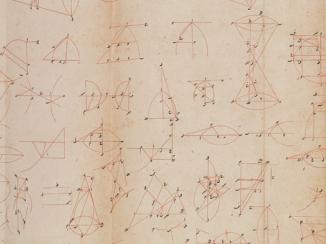
Islamic astronomy did not emerge in isolation. Arabic-speaking scholars absorbed, translated, and expanded upon earlier Greek, Indian, and Persian sources. The most influential was Claudius Ptolemy, whose Greek Almagest (Kitāb al-Majisṭī) provided a geometrical model of the heavens that remained authoritative for centuries.
- Copies of the Almagest – such as Add MS 7474, Add MS 7475 and Add MS 23392 – were studied, annotated, and revised by generations of scholars, including the great polymath Naṣīr al-Dīn al-Ṭūsī (see IO Islamic 1148).
- Or 5323 contains images of the forty-eight classical constellations and notes comparing Ptolemaic descriptions to local Arabic star-lore, written by the Persian astronomer ‘Abd al-Raḥmān al-Ṣūfī.
- Other manuscripts preserve texts by Theodosius (Add MS 23570, ff 30r-62r), Aristarchus (IO Islamic 923, ff 52v-69r), Autolycus of Pitane (IO Islamic 1249, ff 87v-110r), and Euclid (IO Islamic 1249, ff 57v-86r), showing the wide range of classical learning available in Arabic.

These translations were not passive acts of preservation. Astronomers tested, corrected, and reinterpreted the data they inherited. Their manuscripts record an active engagement with the cosmos, one that linked Baghdad and Damascus to Alexandria and Athens.
Tables, Charts, and Zījes
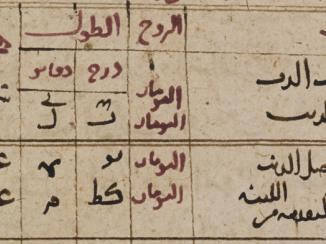
A hallmark of Islamic astronomy was the production of zījes – astronomical handbooks consisting of tables of calculated data, often accompanied by explanatory texts, including ways for comparing dates across various chronological systems. Zījes provided practical information for predicting planetary positions, lunar phases, eclipses, and calendars. They were indispensable to astronomers, astrologers, navigators, and officials charged with regulating time.

- Or 6669 is a copy of al-Khāzinī’s Zīj prepared for the Seljuq ruler Sanjar. This work shows how state patronage supported astronomical research.
- IO Islamic 1148, ff 68v-135v is a copy of Ulugh Beg’s Zīj, compiled at the Samarkand observatory in the fifteenth century. This text represents one of the most accurate pre-modern astronomical tables.
- Or 2920 is a nautical almanac designed for maritime navigation.
These works embody a culture of large-scale data collection and computation, often carried out in observatories with state support. They illustrate how astronomy was embedded in administration, navigation, and imperial displays of scientific sophistication.
Astrology and its Uses
Astrology, the interpretation of celestial phenomena as signs for mundane affairs, was pervasive in pre-modern societies as it still is in some parts of the world today. Using the same observational techniques and mathematical tools as astronomy, astrologers cast horoscopes, judged auspicious times for action, and advised rulers. The boundary between astronomy and astrology was fluid. Many leading astronomers also wrote on astrology, and vice versa.
- In Kitāb al-tafhīm, al-Bīrūnī not only introduces arithmetic, geometry, and astronomy, but also lays out astrological principles, showing how intertwined the disciplines were.
- Or 5709 contains al-Takrītī’s al-Mukhtār min kutub al-ikhtiyārāt al-falakīyah, which collects texts on astrological elections (choosing the right moment for an action).
- Delhi Arabic 1916 is a two-volume copy of al-Qaṣrānī’s Kitāb al-masā’il. This work preserves interrogational astrology, in which astrologers answered specific questions, and explains the interpretation of horoscopes using historical examples.
- Or 5591 and Or 8857 both hold collections of astrological and divinatory texts.
Related Articles








These manuscripts attest to the practical and intellectual prestige of astrology. Courts employed astrologers to advise on politics, medicine, and warfare, while private individuals consulted them for personal matters. Astrological manuscripts often circulated alongside astronomical treatises, demonstrating the shared technical foundations of both pursuits.
Brilliant and Timeless
The manuscripts available on the QDL reveal a vibrant culture of astronomical inquiry across the Islamic world, pulsing with curiosity and imagination. Astronomers charted the skies with instruments of astonishing precision; astrologers read those same skies for signs of fortune and fate. In these illuminated folios, we glimpse not only the brilliance of scholars from the Islamic world but the timeless human impulse to look upward and find our place in the cosmos.