
Overview
Archaeological Interests
Very little is known about Corbiau’s early life. The public record of her career begins in 1935 when she published a letter in the anthropological journal Man. In the letter, she contests Major Douglas Hamilton Gordon’s interpretation of finds from Dherai Sar (in modern day Pakistan) as being local and unique, arguing instead for stylistic connections with material from Mesopotamia and Ukraine. She concludes that ‘[t]he Sari Dheri site may be of special interest to the Indus civilisation, since the stratification seems to extend from protohistoric to our era’ (Corbiau, ‘Indian and Babylonian Figurines’, p. 144).
Archive items in this article


These claims led to expeditions in 1936 and 1938. The first resulted in publications consolidating her Indo-Mesopotamian connection theory. The second, however, ended in disappointment. Despite receiving letters of support from the Belgian Government and the Director General of the Archaeology Department in India, Corbiau did not succeed in carrying out the excavations. This was partially due to the extensive areas she wanted to cover, for which she lacked sufficient resources, and may have also been related to accusations of espionage. The Malakand Political Agency An office of the East India Company and, later, of the British Raj, headed by an agent. reported at the time that she had ‘a propensity for visiting Border Posts’ and relayed allegations that she was ‘receiving money for secret service work’ (Shaheen and Khan, p. 172). Although never tested in court, these accusations were taken seriously enough that officials debated whether the case should be referred to the Criminal Investigation Department of the Government of India. Corbiau’s archaeological expedition, already precarious, may have collapsed as a result of these suspicions.

Encounter in Persia
The records of the India Office The department of the British Government to which the Government of India reported between 1858 and 1947. The successor to the Court of Directors. contain traces of Corbiau’s later movements. She appears in April 1944 in the Consular Diaries for Ahwaz, described not as an archaeologist but as a ‘Belgian miniaturist’ (IOR/L/PS/12/3533, f. 185r). While travelling to Shushtar in Khuzestan Province, her party was attacked by ‘a band of armed Arabs’ and her possessions looted. She herself escaped unharmed, although others in her party were injured.

Reinvention in Bahrain
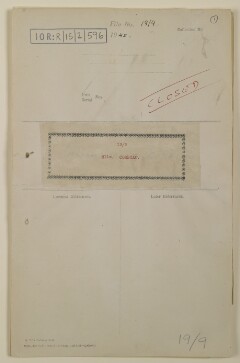
Corbiau surfaces again in 1945. In a file titled ‘19/9 Mlle. Corbiau’, Ernest Vincent Packer of the Petroleum Concessions Ltd in Bahrain writes:
Our Manager was approached by the British Consul General, Basrah, on behalf of a certain Mademoiselle Corbiau. This lady wishes to visit Bahrein to earn money by painting portraits. She has spent some years in India, has visited the Persian oil fields and Basrah and is apparently collecting funds to make her way home. She thinks Bapco [Bahrain Petroleum Company] offers scope for her talents. The Consul General, Basrah, guarantees that she is not an undesirable. Our Manager adds that she is 40ish. Apparently the Consul General’s idea is that some one [sic] in Manama or Bapco might be prepared to accommodate her (IOR/R/15/2/596, f. 2r).
Packer goes to point out that ‘it might be misunderstood if I offer to put her up myself’. The records then contain telegrams from the Political Agent A mid-ranking political representative (equivalent to a Consul) from the diplomatic corps of the Government of India or one of its subordinate provincial governments, in charge of a Political Agency. at Bahrain to the Consul-General in Basrah asking for ‘confirmation that Mademoiselle Corbiau is not undesirable and is deserving of assistance’ (IOR/R/15/2/596, f. 4r). The Consul-General’s reply is clear: ‘Lady in question is not repeat not undesirable. She is a good artist and deserving assistance’ (IOR/R/15/2/596, f. 7r).

Corbiau’s artistic talents are showcased in a portrait of the psychiatrist Dr. Isabel Emslie, Lady Hutton, painted in India in 1942 and now held at the National Galleries of Scotland. Corbiau also advertised her services as a painter of miniatures in the Civil & Military Gazette (Lahore) in 1941 and 1943, stating that she specialised in children’s portraiture. A rare extant example of such a miniature (sold by the Goxe-Belaisch Auction House) is signed by Corbiau and dated 1953.

The Question of Espionage
Although never conclusively proven, the possibility of Corbiau’s involvement in espionage cannot be dismissed. Archaeologists were valuable assets for their governments, especially during wartime. They were familiar with local customs, geography, languages, and their work often involved mapping terrain and gathering intelligence. For example, during the First World War, British archaeologists such as T. E. Lawrence, Gertrude Bell, and Leonard Woolley were recruited to work for Britain’s Office of Military Intelligence (later renamed the Arab Bureau) in Cairo.
No document definitively identifies Corbiau as an intelligence operative. Nevertheless, viewed collectively, the traces of evidence form a discernible pattern. She appeared repeatedly in areas of strategic importance, attracted allegations of secret funding, benefitted from unusual consular support, and cultivated access to expatriate and diplomatic networks. Considered in isolation, each of these factors might be viewed as coincidental. Pieced together, they make the hypothesis of espionage at least plausible.
Related Articles




Today, Simone Corbiau occupies a marginal place in both the history of archaeology and the history of the Gulf. Her story offers valuable insight into the blurred boundaries between cultural enterprise and political intrigue in the interwar Middle East. Whether she was an archaeologist undone by bad fortune, an artist in search of patrons, a covert operative, or a mixture of all three, her life exemplifies how knowledge, suspicion, and power intersected in the twilight years of the British empire.