
Overview
War and Protectorate (1914-15)
Egypt remained under Ottoman control even after Britain occupied it in 1882 to supress a rebellion. When the Ottoman Empire entered the First World War on the side of Germany, Egypt became a battleground for imperialist military control. In December 1914, Britain unilaterally declared Egypt a protectorate, formally severing its ties to the Ottoman Empire. The tensions of this period are vividly documented in a proclamation addressed to the ‘People of Egypt’, and attributed to the Senussi clan of Libya, who opposed colonial expansion. The proclamation denounced the ‘nations of Christendom’, accusing Britain of destroying local industry, introducing moral corruption, and promoting Christianity. These charges echoed broader regional resistance to European imperialist expansion.
Archive items in this article
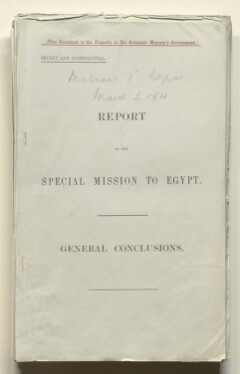
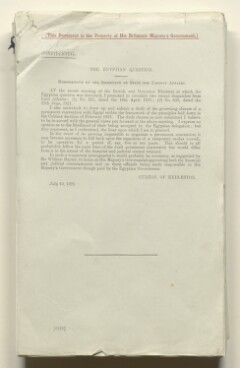


As the later ‘Report of the Special Mission to Egypt under Lord Milner’ acknowledges, nationalist sentiments within both the civil service and broader Egyptian society had begun to accelerate the country’s drive toward self-rule.

British officials attempted to navigate these growing tensions through divide-and-rule strategies. Sir Mark Sykes, writing in 1915, classifies Muslims into ‘ancient’ and ‘modern’, arguing that ‘In Class II. (ancient) lies our greatest hope’ (IOR/L/PS/10/525/2, f. 235v). He particularly focuses on the scholars of Al-Azhar University, whom he believes could ‘sway the whole tendency of ancient Islamic thought and curb the uninformed masses of peasant, urban, and nomadic population’ (IOR/L/PS/10/525/2, f. 235v). This paternalistic approach proved ineffective as Egyptian nationalism gained momentum.
The mounting frustrations of Egypt’s population culminated in the Revolution of 1919, a nationwide uprising driven by political, economic, and social grievances that fundamentally altered the trajectory of Anglo-Egyptian relations.
The Milner Mission
In the wake of the 1919 Revolution, Britain dispatched Lord Alfred Milner to lead a commission charged with investigating the causes of unrest and proposing a new political framework. Confronted by Egyptian opposition, Milner abandoned the idea of an outright protectorate or formal annexation, instead recommending a negotiated treaty. He argued that Britain should allow Egypt significant independence in internal affairs, while preserving essential British controls over foreign relations and imperialist strategy. Milner’s vision was not to incorporate Egypt into the empire like India, but rather to grant it a unique status – independent but still aligned with Britain in diplomatic and strategic matters. While acknowledging that ‘[i]t is unquestionably a bold experiment to leave them [Egyptians] to devise their own constitution’, the Mission also revealed the calculated nature of British concessions: ‘the blessed word “independence” will get us round many awkward corners’ (Mss Eur F112/260, f. 18v).

The real priority remained to ‘exclude foreign interference in the internal affairs of Egypt’, a formula designed to preserve Britain’s privileged position (Mss Eur F112/260, f. 18v). The Milner Commission’s findings laid the groundwork for new negotiations between British officials and Egyptian nationalists, seeking a settlement that acknowledged the realities of popular Egyptian demands.
Negotiating the Limits of Sovereignty (1921-23)
Negotiations between Foreign Secretary Lord Curzon and Adly Pasha An Ottoman title used after the names of certain provincial governors, high-ranking officials and military commanders. , the Prime Minster of Egypt, took place in London from July to November 1921. Adly Pasha An Ottoman title used after the names of certain provincial governors, high-ranking officials and military commanders. wanted to end Egypt’s Protectorate status which Lord Curzon resisted, insisting that the presence of British troops was necessary for safeguarding the Suez Canal. The negotiations foundered on irreconcilable differences. Adly rejected Curzon’s treaty proposals because he viewed Britain’s claimed right to station troops anywhere in Egypt as tantamount to continued occupation. He similarly objected to provisions that would have tied Egypt to Britain in the conduct of foreign affairs, seeing these as incompatible with genuine independence.
Meanwhile, Sa‘d Zaghlul, the leader of the Wafd Party who opposed Britain and rivalled Adly Pasha An Ottoman title used after the names of certain provincial governors, high-ranking officials and military commanders. , galvanised popular opposition. Arrested in 1921, Zaghlul protested, ‘This is tyrannical order, against which I protest with all my power’, declaring that he and his colleagues ‘are all prepared to meet what may befall us with a steady heart’.

Such defiance was met with escalating repression and violent confrontations, underscoring the impossibility of imposing a settlement without Egyptian consent.
The Unilateral Declaration and its Limitations (1922)
The slow progress of negotiations and persistent agitation ultimately led the British Government to issue a unilateral declaration of Egyptian independence on 28 February 1922. While Britain recognised Egypt as an independent sovereign state, it insisted on four reserved points, until an agreement between the two countries could be reached. These were the security of communications of the British Empire in Egypt, the defence of Egypt against all foreign aggression or interference (direct or indirect), the protection of both foreign interests and minorities, and the Sudan (which Egypt claimed but Britain rejected). These reservations preserved the core elements of British strategic control, ensuring that the new status fell considerably short of genuine independence.

The 1922 declaration inaugurated a period of intense diplomatic negotiation. The struggle for full independence continued for over a decade, marked by periodic crises and partial reforms.
Treaty of Alliance 1936
A significant development was the Treaty of Alliance of 1936 (also known as the Anglo-Egyptian Treaty), which came at the end of protracted negotiations by several Egyptian governments. The treaty marked the official end of over five decades of British occupation of Egypt but did not grant full Egyptian sovereignty, as it established a twenty-year military alliance allowing Britain to retain significant strategic privileges. The treaty fuelled nationalist resentment within Egypt due to the continued presence of British forces and limitations on true independence. This dissatisfaction ultimately led the ruling Wafd Government to abrogate the treaty unilaterally in 1951, setting the stage for the revolutionary upheaval that followed.
Related Articles







Conclusion
The documents available on the Qatar Digital Library chart the transformation of Egypt from a theatre of wartime propaganda to an independent state. They reveal the gradual retreat of British authority, from the unyielding protectorate of 1914 to the hesitant concessions of Milner’s Mission, the compromises of 1922, and the negotiated treaty of 1936.
Independence, as these papers make clear, was not a singular event but the product of decades of negotiation, conflict, and compromise. The making of modern Egypt was as much about the limits Britain sought to impose as it was about the determination of Egyptians to transcend them.