
Overview
Alchemy is often portrayed as an irrational pursuit, concerned with mysticism rather than experiment, and focused on converting base metals to gold or finding a universal elixir. Manuscripts preserved in the Qatar Digital Library, however, tell a different story. In the medieval Islamic world, alchemy formed part of a systematic investigation into the nature of matter. The scholars discussed in this article developed experimental techniques, classifications of substances, and laboratory practices that laid the foundations of chemistry as a modern science.
Alchemy and Scientific Practice in the Islamic World
In modern usage, alchemy and chemistry are treated as distinct disciplines, but this distinction is a relatively late development. In the medieval Islamic world, the term al-kīmiyāʼ referred broadly to the study and manipulation of materials, encompassing what would now be recognised as chemistry.
Manuscripts found on the QDL illustrate that alchemists in the Islamic world, like the Greek and Syriac alchemists before them, were deeply concerned with measurement, observation, and repeatable procedures. Their work included the preparation of medicines, pigments, salts, alloys, glass, and perfumes, as well as investigations into the properties of metals and minerals. These activities required specialised equipment, careful control of conditions, and practical expertise.
Jābir ibn Ḥayyān and the Experimental Study of Matter
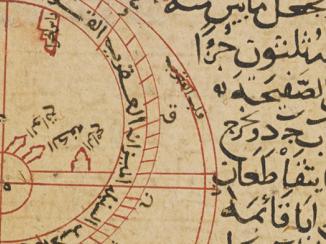
One of the most influential figures associated with alchemy during the Golden age of the Islamic civilisation is Jābir ibn Ḥayyān (fl. second/eighth century AH/CE) who lived during the reign of Hārūn al-Rashīd. A copy of work attributed to him, Kitāb al-khawāṣṣ al-kabīr (The Great Book of Properties), survives on the Qatar Digital Library.
The book comprises seventy one chapters, the majority of which are dedicated to chemical, industrial chemistry, and alchemical topics. The text is a testament to Jābir’s innovative techniques and his empirical approach to validating inherited recipes from pre-Islamic traditions. It includes detailed instructions for processes such as water desalination, annealing and hardening of steel, glass colouring, manufacturing of artificial pearl, and the preparation of cosmetics, varnishes, paints, inks, and other industrial products.
Archive items in this article


Jābir’s methods often involved testing and refining inherited recipes, demonstrating his commitment to empirical validation and scientific rigour. For instance, his desalination technique using thick membranes resembles modern reverse osmosis technology. Similarly, his recipes for steel production and hardening reveal an advanced understanding of metallurgical processes, including the use of sour milk for annealing.
Jābir’s work bridges the perceived divide between alchemy and practical chemistry, challenging the notion that his alchemical writings were merely concerned with mysticism or charlatanry. His detailed recipes and descriptions of laboratory equipment highlight his role as a pioneer in industrial chemistry and emphasise the practical applications of chemical knowledge. While some recipes reflect the mystical and symbolic aspects of alchemy, the majority focus on tangible, reproducible chemical processes, marking a significant step toward the emergence of modern chemistry.
The Jābirian Tradition and Chemical Techniques
The large body of writings attributed to Jābir, often referred to as the Jābirian Corpus, has long raised questions of authorship. Modern scholars recognise that these texts represent a tradition shaped by multiple contributors over time, rather than the work of a single author. Nevertheless, they preserve a consistent emphasis on the experimental method.
Techniques associated with this tradition include crystallisation, evaporation, calcination, and sublimation, all of which remain fundamental to chemical practice. Laboratory apparatus such as the alembic (al-anbīq) is frequently described, highlighting the importance of controlled experimentation. These techniques were later transmitted to Europe through translations of Arabic texts, shaping the development of chemistry beyond the Islamic world.

Al-Rāzī and the Classification of Substances
A clearer step toward chemistry as an experimental science can be seen in the work of Abū Bakr Muḥammad ibn Zakarīyā al-Rāzī (239-313/c. 854-c. 925), known in Latin as Rhazes. A thirteenth-century list of his writings, including his alchemical works, is found in a bibliography (fihrist), and extracts from his alchemical encyclopaedia, al-Kutub al-ithnāʻashara (The Twelve Books), appear in a manuscript compendium of alchemical texts.

Al-Rāzī was both a physician and a chemist, and his approach reflects this dual expertise. In his writings on chemistry, he classified substances into animal, vegetable, mineral, and derived categories, and further subdividing minerals according to their chemical behaviour. Substances were grouped based on properties such as solubility, combustibility, and malleability rather than appearance or symbolic associations.
This emphasis on classification through observation and experiment represents a significant conceptual advance. Al-Rāzī’s work shows chemistry becoming increasingly independent from speculative philosophy and more closely aligned with practical and medical applications.
Al-Ṭughrāʼī and the Theory of Balance
Muʼayyad al-Dīn Abū Ismāʻīl al-Ḥusayn ibn ʻAlī al-Ṭughrāʼī (d. 515/1121) was not only an alchemist but also a poet and a Seljuq government minister (wazīr). Among his notable contributions is Kitāb Tarākīb al-anwār (The Composition of Lights), which explores both the theoretical and practical aspects of alchemy. The text emphasises the concept of balance (mīzān), a principle central to the Jabirian corpus. It refers to the attempt to determine the proportions of the four elements (earth, water, air, and fire) in a given substance, by analysing the numerological values of the letters forming the name of that substance.
Related Articles




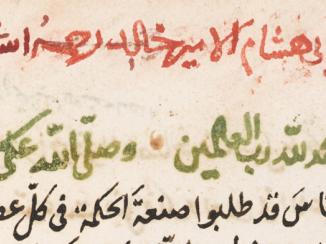


Al-Ṭughrāʼī integrates philosophical insights with alchemical practices, often referencing ancient sages like Hermes Trismegistus and Apollonius of Tyana, alongside Muslim alchemists such as Jābir ibn Ḥayyān. His work reflects a commitment to uncovering the hidden truths of alchemy through rigorous study and the deciphering of ciphers, which he considered essential for mastering the discipline. Al-Ṭughrāʼī’s contributions, including this book, showcase his efforts to bridge the gap between alchemical theories and broader philosophical frameworks, while defending alchemy against criticisms from non-alchemists like Ibn Sīnā.
The development of chemical works in Arabic is cumulative, building on earlier scholarship through commentary and comparison. This is evident in the large compendium which brings together texts by multiple authors, including al-Ṭughrāʾī, Jābir, al-Rāzī, and later writers.
Foundations for the Future
The manuscripts preserved on the Qatar Digital Library challenge the assumption that chemistry emerged only after alchemy was abandoned. In the Islamic world, what is now labelled “alchemy” included experimental practices, industrial processes, and attempts to classify matter on the basis of observation.
Figures such as Jābir ibn Ḥayyān, al-Rāzī, and al-Ṭughrāʼī played crucial roles in shaping the study of matter, laying foundations that later generations would recognise as chemistry. Alchemy, far from being a scientific dead end, was the intellectual space from which chemistry initially developed.