
Overview
The Great Famine in Iran (1870-72) was a catastrophic event that resulted in widespread suffering and significant loss of life, with death estimates reaching into the millions. The famine was primarily triggered by consecutive years of severe drought, which led to crop failures and a dramatic shortage of food. The drought can be traced back as early as 1863-64, with consistently ‘below average’ rainfall culminating in the dry winter of 1869-70 (Melville, p. 309).
This natural disaster was compounded by socio-economic factors, including hoarding and market manipulation by landlords, grain merchants, and government officials. Additionally, ‘very inefficient’ transportation and irrigation systems exacerbated the crisis, preventing the distribution of food from surplus regions to famine-stricken areas (Seyf, p. 290). The impact was devastating, with entire villages abandoned, widespread starvation, and ‘recurring reports of cannibalism’ in the worst-hit areas such as Yazd, Isfahan, and Mashhad (Amanat, p. 1017). The famine not only decimated the population but also left long-lasting scars on Iran’s economy and social structure.
British records on the QDL capture the famine as it was experienced day by day. Officials struggled to respond to crowds of starving people, rising prices, disease, and the limitations of charitable funds. Their words convey a stark immediacy that makes the famine visible as a human catastrophe rather than an abstract economic event.
Archive items in this article


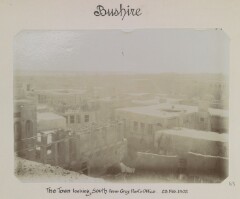

‘The helpless poor being seen in the streets’
By late 1871, distress around the port of Bushire [Bushehr] had become impossible to ignore. In a report dated 29 November 1871, the Uncovenanted Assistant Political Resident A senior ranking political representative (equivalent to a Consul General) from the diplomatic corps of the Government of India or one of its subordinate provincial governments, in charge of a Political Residency. , James Charles Edwards, describes conditions in and around the town in bleak terms: ‘a much greater number of the helpless poor being seen in the streets […] many of them are so far reduced that they die there. Want of labor [sic] is the greatest evil and has brought many workmen and their families to beggary. It is a well known fact too that many respectable families are selling off their substance to obtain the means of sustenance’ (IOR/L/PS/9/20, f. 124v). He goes on to say that Dr George Waters, the Residency An office of the East India Company and, later, of the British Raj, established in the provinces and regions considered part of, or under the influence of, British India. Surgeon, had informed him that most patients attending the dispensary were ‘afflicted with diseases caused by famine. Want of shelter clothing and proper food kill many of these unfortunate sufferers’ (IOR/L/PS/9/20, ff. 124v-125r).
Crowds, Contagion, and the Limits of Charity
The demand quickly overwhelmed conventional forms of relief. Edwards proposed establishing a large feeding station at a caravanserai A roadside inn providing accommodation for caravans (groups of travellers). outside Bushire, where bread and dates could be distributed. This plan was rejected by the Political Resident A senior ranking political representative (equivalent to a Consul General) from the diplomatic corps of the Government of India or one of its subordinate provincial governments, in charge of a Political Residency. in the Persian Gulf The historical term used to describe the body of water between the Arabian Peninsula and Iran. , Lewis Pelly, on public health and security grounds. Concentrating thousands of starving and diseased people in one place, he warned, would be dangerous:
The result of so collecting the poor would be to render the locality intolerably filthy and to breed some noxious disease […] a final result would be quarrels among the mob themselves […] and finally unpleasant discussions with the Persian authorities. We must remember we are in a Foreign Territory (IOR/L/PS/9/20, ff. 125r-125v).
Distributing bread or money in narrow streets caused instant crowding, sometimes forcing officials to withdraw for their own safety. In one instance, Dr Waters reported being confronted by crowds of six to seven thousand people while attempting to supervise relief.
Work As Relief: Roads, wages, and dignity
Faced with the dangers of mass handouts, British officials increasingly turned to employment schemes. Road-building emerged as the most sustained form of relief. By early 1872, hundreds of labourers were employed daily on roads across the Bushire peninsula and towards the interior. Pelly regarded this as the most effective form of charity: ‘This description of charity is in every way beneficial – giving full wages to the laborers [sic], and indirect relief to those dependent on them; and further generally facilitating the small traffic of the country’ (IOR/L/PS/9/20, f. 261r).
By March 1872, more than thirty-five miles of road had been completed, with between 250 and 300 labourers employed at any one time. Even so, officials noted the physical condition of the workers, some of whom were described as so emaciated ‘that some are hardly recognizable as human beings’.

Disease, Winter, and Fear of Extinction
The winter of 1871-72 was especially deadly. Cold weather compounded hunger, and disease spread rapidly among weakened populations. Writing to Major Champain, secretary of the Mansion House Relief Fund in London, Pelly reports that: ‘the number of starving people appears to me on the increase and that they appear more and more emaciated. The Winter too has set in and the poor are dying of cold especially during the nights’ (IOR/L/PS/9/20, f. 133v). Even those administering relief were not spared. By May 1872, the Native Superintendent of the Scavengers and the Matron of the Asylum had died of a ‘fever of a malignant and contagious type’, believed to have been contracted while working among the sick and dying.

Medical officers warned that the long-term effects of famine would persist even if food supplies improved. Dr Waters cautioned that the population had been reduced to such weakness that dysentery, diarrhoea, and typhoid-type fevers were almost inevitable in the coming summer and autumn.
Beyond Bushire
Although Bushire was a focal point, records on the QDL show that distress extended inland. In a letter to Pelly in June 1872, Ronald Ferguson Thomson, a diplomat based in Tehran describes conditions in the capital itself: ‘Tehran is in a deplorable state at present -though prices are falling, still numbers die daily from starvation and a sort of famine fever appears to have broken out which is carrying off about 200 daily in the city’.
Related Articles






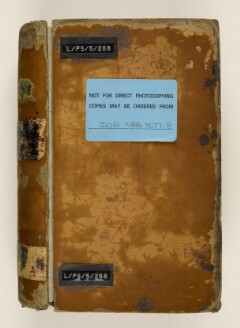
Earlier travel accounts reinforce this picture. During a journey through Persia in mid-1871, a British officer reports ‘stories of children left in sudden orphanhood, of unburied or half-devoured corpses, of human beings contending with brute beasts for offensive food’, concluding that famine had ‘left its mark in the land’ (IOR/L/PS/5/268, f. 415r).
Orphanages, Scavenging, and Public Health
As the famine deepened, relief efforts expanded beyond food and wages. Orphanages were established in Bushire, housing up to ninety children by early 1872. Separate institutions were proposed for destitute elderly men and women.
Public health measures also became central. Committees, such as the Persian Famine Relief Committee, organised scavenging teams to clean streets and worked with Persian authorities to address flooded graveyards and stagnant water believed to cause ‘malarious fever’ (IOR/L/PS/9/20, f. 446r). Dr Waters’ reports describe ‘the crowded state of the grave yards, almost adjoining the residency’ which require the ‘gravest consideration’ (IOR/L/PS/9/20, f. 451r).
The End of the Famine
The famine came to an end primarily due to improved weather conditions, including abundant rainfall and snowfall. By March 1872, officials cautiously reported improvement. Deaths from starvation around Bushire were said to have reduced or ceased, and fewer beggars were visible in the streets. However, Pelly warned that assistance would still be required ‘during the whole of the approaching hot season’ (IOR/L/PS/9/20, f. 449v).
Even as prices fell and harvest conditions improved, the longer-term effects of famine were clear. Less land was cultivated due to the loss of seed corn and the mortality of both people and cattle. Its end marked the beginning of a long recovery for Iran’s population and economy.
Conclusion
Records on the QDL capture the voices of officials, doctors, and relief organisers, the starvation in the streets, the spread of disease, and the difficult choices involved in administering aid. These papers show famine not only as a failure of harvests, but as a collapse of labour, health, and social security, one that charity could mitigate, but never fully resolve.
Acknowledgements
Thanks to Amanda Engineer (Content Specialist, Archivist - British Library) for her extensive research and support.