Overview
Arabic-Language Scholarship in al-Andalus and the Contemporary Maghrib
Numerous texts bear witness to cultural, literary, and technological achievements across genres such as religious studies, poetry, and historiography, both in al-Andalus and in neighbouring North Africa (the Maghrib). In science, Andalusī scholars excelled in the study of astronomy and astronomical instrumentation, mathematics, medicine, pharmacology, botany, and agronomy, building on knowledge acquired and developed by earlier Arabic-language scholars.
Archive items in this article



Dissemination and Transmission
Arabic-language knowledge was valued by some contemporary Christian rulers and scholars. This was exemplified by translation activities into Castilian and Latin under Alfonso X, known as el Sabio (The Wise), King of Castile, León, and Galicia (650-683/1252-84), and illustrated by the Latinised names by which many Andalusī scholars became known in Europe. For instance, the physician Abū al-Qāsim al-Zahrāwī (d. c. 403-04/1013) became Latinised as Abulcasis, and the astronomer and instrument-maker Abū Isḥāq Ibrāhīm ibn Yaḥyá al-Zarqālī (d. 493/1100) was Latinised as Azarquiel. However, the Arabic written tradition was denigrated following the final Christian conquest of al-Andalus (897/1492). As a result, very few Arabic manuscripts created in al-Andalus survive today.

Fortunately, later compositions and copies, many written in the distinctive North African calligraphic style (known as Maghribī), bear witness to the scientific legacy of al-Andalus, as well as the fluidity of physical and intellectual exchanges across the straits of Gibraltar and beyond. This interconnectedness saw North African students, such as the Moroccan mathematician Ibn al-Yāsamīn (d. 601/1204), travel to centres of learning in al-Andalus. Conversely, some Andalusī scholars sought knowledge in North Africa while others continued eastwards in search of patronage, further learning, adventure, or pilgrimage.
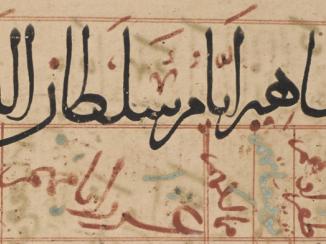
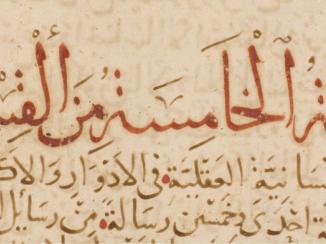
The QDL features the work of one anonymous Maghribī scribe who copied a medical compendium while in Cairo (547-548/1152-1153). Another QDL manuscript made by a Maghribī scribe around the late thirteenth century is a copy of Firdaws al-ḥikmah – a medical encyclopaedia originally compiled by Persian physician ʻAlī ibn Sahl Rabban al-Ṭabarī (d. c. 240/855). Ownership statements inside the encyclopaedia show that, not long after its creation, it had become the property of a Jewish scholar living on the shores of the Caspian Sea.
Meanwhile, an Arabic version of Ptolemy’s (c. 90-c. 168 CE) Almagest made by a third such anonymous Maghribī scribe in 686/1287, bears witness to the widespread dissemination of classical learning among Maghribī scholars. Collectively, these records provide compelling evidence of the movement and transmission of Arabic knowledge between al-Andalus, the Maghrib, and regions further afield.

Maghribī Afterlives
From the eleventh century onward, the dissemination of Andalusī scholarship across the wider Arabic-speaking world was furthered by conflict between the Christian kingdoms of the north and Islamic polities in the Peninsula. Many families and individuals relocated to North Africa, including, for example, the forebears of the geographer al-Idrīsī (d. 560/1165), the gastronome Ibn Razīn al-Tujībī (d. 692/1293), and the mathematician and algebraist al-Qalaṣādī (d. 891/1486). The resulting intellectual exchanges are sometimes explicitly recorded in scientific texts. In the introduction to his treatise on sundial construction, the Moroccan al-Tūzarī (fl. c. 854/1450) states that he composed it in response to the queries of an un-named Andalusī academic.

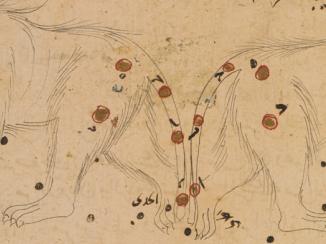
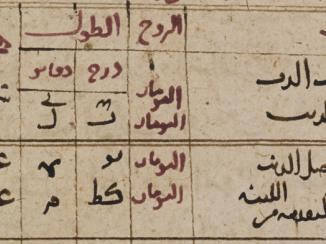
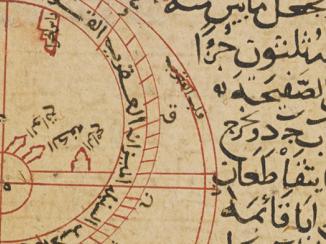
Andalusī scholars and their descendants continued to play a significant role in the intellectual scene in North Africa, creating, verifying, observing, and explicating scientific knowledge, and disseminating this learning in manuscript form. The volume shown above, a compilation of fourteen texts on astronomy, astronomical observation, and timekeeping, is one of a large group of predominantly seventeenth- and eighteenth-century manuscripts acquired by the American diplomat William Brown Hodgson (d. 1871), probably in the 1820s in Algeria.
After the culmination of the Christian conquest of the Iberian Peninsula in 897/1492, the Arabic language in Spain followed a very different path.

Andalusī and Maghribī Scholarship on The Qatar Digital Library
The QDL contains a wide selection of manuscripts on scientific and technical topics by Andalusī and Maghribī scholars. Below is an illustrative list of examples:
Medicine and pharmacology:
- A volume from al-Jāmiʻ fī al-adwīyah al-mufradah, an alphabetically arranged encyclopaedia of simple drugs (Or 11614) by Ibn Samajūn (d. Córdoba, c. 400/1010)
- Kitāb al-taysīr fī al-mudāwāt wa-al-tadbīr, a medical compendium on drug therapy, dietetics, and pharmacopoeia (Or 9128), and Kitāb al-aghdhīyah, a treatise on dietetics (Or 5927, ff 68r-100r), both by the physician Ibn Zuhr (d. Seville, 557/1162)
- Four complete or partial copies of al-Jāmiʻ li-mufradāt al-adwiyah wa-al-aghdhiyah, a comprehensive pharmacological treatise (Or 5839, Or 6429, Or 3131, and IO Islamic 1142), and one copy of Kitāb al-mughnī fī al-adwiyah al-mufradah, a treatise on simple drugs (Or 2408), by the botanist Ibn al-Bayṭār (b. Málaga, d. Damascus, 646/1248) who became royal pharmacist to the Ayyubids.
Astronomy and astronomical instrumentation:
- Treatises on the astrolabe Ancient instrument for astronomical observations. by Ibn al-Samḥ (d. Granada, 426/1035; Add MS 9602, ff 25v-55v) and Abū al-Ṣalt (b. Dénia, d. Béjaïa, Algeria, 529/1134; Or 5479, ff 2r-36v)
- A treatise on the instrument known as the equitorium (al-ṣafīḥah al-zījīyah), by al-Zarqālī (d. Córdoba, 493/1100; Add MS 7473, ff 103r-107v)
- A copy of two treatises on gnomonics (the construction and use of sundials) by Ibn al-Raqqām (d. Granada, 715/1315), probably dating to his lifetime (Or 9587)
- A collection of treatises on astronomical instruments, many by Maghribī authors (Add MS 9598)
- An Arabic version of Ptolemy’s Almagest, copied in an unusual Maghribī hand (Add MS 7474)
- Commentary on a poem on astronomical timekeeping by al-Dādasī (d. Fez, c. 1094/1683; Add MS 9604).
Mathematics and algebra:
- Kashf al-astār ʻan ʻilm ḥurūf al-ghubār, by al-Qalaṣādī (b. Baza, near Granada, d. Béja, Tunisia, 891/1486; Add MS 9639, ff 114r-120v).
- Three copies of commentaries on a versified treatise on algebra by Ibn al-Yāsamīn (d. 601/1204).
Agriculture:
- A comprehensive agricultural treatise, Kitāb al-filāḥah, by Ibn al-ʻAwwām (fl. late twelfth century CE, probably Seville region), in an eighteenth-century copy probably written by a Spaniard (Add MS 10461).
Cookery:
- Fiḍālat al-khiwān fī ṭayyibāt al-ṭaʻām wa-al-alwān, a treatise on cookery by Ibn Razīn al-Tujībī (b. Murcia, d. Tunis, 692/1293; Or 5927, ff 101r-204v).
Related Articles