Overview
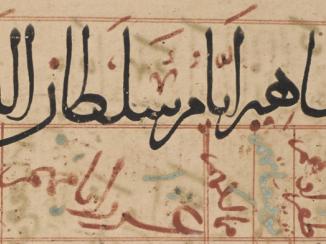
The Book of Generosity in Understanding Melodies (Kitāb al-inʿām bi-maʿrifat al-anghām) is a unique work on musical notation composed in Damascus, Syria by a music theorist named Shams al-Dīn al-Ṣaydāwī (d. 1506). This short text presents a system for understanding the relationships between different Arabic musical modes (called anghām in the text, in contrast to the word usually used today, maqām). It also offers instructions about how to play them, using both written descriptions and unique and colourful graphic diagrams.
The text’s versified instructions, unusual diagrams, and sometimes ambiguous terminology, as well as the incomplete state of the British Library manuscript (Or 13019, which is probably the earliest surviving copy), combine to make its interpretation very difficult. In preparation for publishing this manuscript on QDL, the British Library/Qatar Foundation Partnership team sought the perspective of someone intimately familiar with the Arabic musical tradition to shed light on the text’s practical character. In March 2022, Maya Youssef, a musician, composer, and educator from Damascus, came to the British Library in London to explore this manuscript in person.
Archive items in this article


Maya received a traditional Arabic musical education and specialises in playing the qānūn, a horizontal instrument with fixed strings, similar to a zither. The qānūn often forms part of Arabic musical ensembles and is usually only played by men. In addition to her virtuoso performance skills, Maya’s own musical compositions express her experiences and identity as an artist, a mother, and a Syrian witnessing her homeland’s civil war from afar.
So how did Maya respond to al-Ṣaydāwī’s text? Were the names and terminology used more than five hundred years ago still meaningful to her? Did his statements about modes make sense to her? Could she understand or interpret the complicated and enigmatic instructions contained in the text and its diagrams?
The following film presents an introduction to the manuscript and its text by Jenny Norton-Wright (Arabic Scientific Manuscript Curator), as well as a dialogue between her and Maya: