

Overview
On 30 May 1921, the British Museum acquired fragments of one Syriac and one Arabic manuscript from F. W. Bickel, an antiquities dealer in Zürich who specialised in Christian oriental manuscripts.
The fragmentary Arabic manuscript was recorded in the British Museum acquisition register, with a typically brief description: ‘Or. 8857. A fragment of a work on the calendar, followed by some prescriptions. 33ff. XIth. cent. 8o Arabic’. The manuscript was obviously old – fifth/eleventh century AH/CE according to the register – but details about its contents were scanty, and nothing was said about its provenance.
Archive items in this article


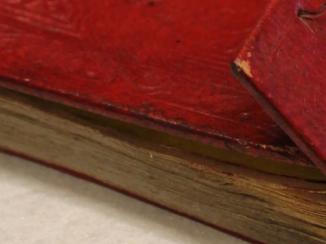
When these thirty-three paper folios entered the Museum, they were evidently in disarray. Nothing suggests that they arrived in a binding. Worse, not only had the sewing that once held the quires A booklet formed of a single gathering of nested bifolia. together disintegrated, but the loose bifolia A single sheet of paper, parchment, or other writing support folded in half to form two folios. had also broken apart along their spine-folds to become individual folios. At some point, probably shortly after their acquisition, all thirty-three folios were mounted on paper guards and sewn into a new binding with little regard for their original order, but perhaps preserving the order in which they had arrived at the Museum.

Contextualising the Manuscript and Reordering its Quires
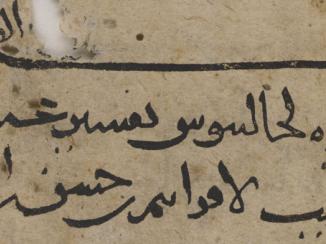
The manuscript is written in a squat and angular script with “Kufic” features, typical of the Abbasid Bookhand used during roughly the third/ninth to fifth/eleventh centuries. Apart from this script and the archaic paper, other features also help to define the time and place the manuscript was copied.
Chief amongst these are the manuscript’s quire signatures Notation written as an instruction to the binder indicating the correct order of the quires. . In this manuscript, there are two different quire signatures Notation written as an instruction to the binder indicating the correct order of the quires. on the first and last folio of each quire A booklet formed of a single gathering of nested bifolia. , written using two separate systems of letters with numerical values: Greek and Georgian. The use of these two notation systems alongside an Arabic text written in Abbasid Bookhand with distinctive punctuation marks is indicative of the multi-ethnic and multilingual artisans in Syrian, Palestinian, and Egyptian monastic scriptoria of the early Abbasid period. The particular combination here strongly suggests that the manuscript was produced in the scriptorium of the Monastery of St Catherine, Sinai, during the late-fourth/tenth and early-fifth/eleventh century. It may even have been produced earlier, by one of the scribes around Thomas of Fusṭāṭ (Tūmā al-Fusṭāṭī), whose scribal workshop produced many early Christian Arabic manuscripts at the Monastery of St Catherine at the turn of the third/ninth to the fourth/tenth century.

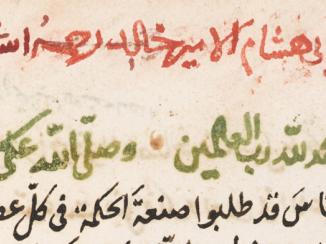
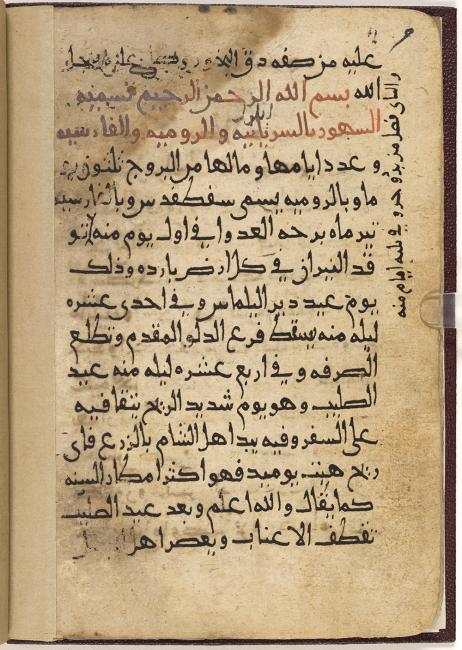
Left: Or 8857, f. 17r | Right: Or 8857, f. 10v
The folios’ original order can be recovered because they are numbered with Coptic epact numerals. This is an alphabetic numerical notation system not restricted to the Coptic community, known in Arabic as ‘register letters’ (ḥurūf al-zimām). The Coptic foliation and the quire signatures show that Or 8857 comprises five quaternions ( quires A booklet formed of a single gathering of nested bifolia. 5-9) containing folios 37-71 of a larger manuscript of unknown extent.
Diverse Monastic Reading Material
This fragment preserves a variety of texts on subjects more or less obviously suited to the monks of the Monastery of St Catherine. They include several prayers, three recipes for incense, The Book of Seasons (Kitāb al-azminah), and a fragment of an astrological text.
The prayers on the first eleven folios are clearly appropriate in a monastic context, although certain features in them may seem jarring to the modern eye. One prayer ends with the invocation ‘O Lord of the Worlds!’ (yā Rabb al-ʿĀlamīn, f. 18v), and another is preceded by the basmala (bi-sm Allāh al-Raḥmān al-Raḥīm, f. 22r). Both of these phrases occur in the Qurʿān and appear distinctly Islamic today. However, during this early period, and for centuries after Or 8857 was copied, these phrases were used in common by Arabic-speaking adherents of all the Abrahamic faiths. The prayers are followed by recipes for incense, and while incense does not necessarily imply church ritual, the Trinitarian formula ‘In the name of the Father, the Son, and the Holy Spirit’ (bi-sm al-Ab wa-al-Ibn wa-rūḥ al-qudus) with which the recipes begin attests to their Christian context.

The last two texts seem less typical of a library for monks. The Book of Seasons is a sort of almanac containing information about the calendar, the heavens, weather phenomena, human illness and health, and agricultural matters as they pertain to the twelve months of the year. This literary genre was based on ancient Arab astral and meteorological lore, in which titles like the Book of Seasons or the Book of Asterisms (Kitāb al-anwāʾ) are common. It provided important guides for living in harmony with the natural rhythms of the year, which would have been especially useful for monastic communities surviving in often harsh and semi-isolated conditions. One of the earliest authors of this genre was Abū Zakarīyā Yūḥannā ibn Māsawayh (d. 243/857), a Nestorian Christian hospital director at Baghdad, personal physician to the Abbasid caliphs, and teacher of the Nestorian physician and translator Ḥunayn ibn Isḥāq (d. 260/873).
Related Articles



The fragment ends with an anonymous introductory text on astrology, including an unusual method for determining a person’s ascendant not by observing their natal horoscope chart, but through numerological analysis of their name and that of their mother. While this text may seem the least appropriate in a monastery, there was considerable legal and theological disagreement about which of the various astrological practices were licit or illicit. Generally, knowledge of the planets’ influences on the environment and the human body was considered an important part of maintaining good health and wellbeing.
Fragments Reunited
In 1910, the future Pope Pius XI (reg. 1922-39), then Ambrogio Damiano Achille Ratti (Prefect of the Biblioteca Ambrosiana, 1907-14), purchased a group of manuscripts from a dealer in Munich. Amongst these was an early Arabic manuscript of 227 folios, now known as Milan, Biblioteca Ambrosiana, X 201 sup. A number of distinctive features shared between this manuscript and Or 8857 (such as the archaic script, number of lines per page, Greek and Georgian quire signatures Notation written as an instruction to the binder indicating the correct order of the quires. , and Coptic foliation) indicate that they are both fragments of the same manuscript.
The contents of the Milan fragment also combine Christian material with texts on herbal remedies, medicine, astrology, and related topics. The first thirty-six folios of the original manuscript are missing, as are twenty-five folios between the two fragments, and an unknown number of folios at the end. However, the very substantial 260 folios of this important manuscript that have survived provide a window into the reception of Arabic scientific literature by Christian monastic communities of the Abbasid period.
Thanks to international digitisation efforts and technologies, the two fragments can now be virtually reunited.
Acknowledgements
Thanks to Dr Adrien de Fouchier, OP (Biblioteca Apostolica Vaticana) and Dr Stefano Serventi (Biblioteca Ambrosiana) for their generous help and advice.
Special thanks to British Library Digital Research team members Adi Keinan-Schoonbaert and James Misson for their technical support and encouragement.