Overview
Other articles in this series: Part 1
Oil in the India Office Records
Several hundred India Office The department of the British Government to which the Government of India reported between 1858 and 1947. The successor to the Court of Directors. files and volumes from the early to mid-twentieth century relate to oil in the Gulf and beyond. Many more discuss the wider implications of oil discovery and extraction in the region, mostly from a British imperialist perspective. This article highlights some of the most notable oil-related records pertaining to specific countries. Part one of this article looks at Bahrain, Kuwait, Qatar, and Iran. This part covers Iraq, Oman, Saudi Arabia, and the United Arab Emirates (UAE).

Iraq
The first oil concession in Iraq was granted in 1925 to the Turkish Petroleum Company, later renamed the Iraq Petroleum Company (IPC), and oil was struck in 1927. Relevant material on the QDL includes three related volumes dated 1904-17 (prior to the formation of the modern Iraqi state) and a further two volumes dated 1918-21. All five touch on potential oil concessions in the country. A file dated 1932-35 discusses the operations of the British Oil Development Company and the Iraq Petroleum Company. It covers the latter’s pipeline, which opened in January 1935 and connected its oil field at Kirkuk with the Palestinian port of Haifa. Both companies also feature in another file containing correspondence and official agreements relating to oil conventions with the Iraqi Government dated 1938-39.

Oman
Oman is represented on the QDL most notably in the multiple records created by the Muscat Political Agency. One Agency An office of the East India Company and, later, of the British Raj, headed by an agent. file covers the interest shown by the Anglo-Persian Oil Company (APOC) in acquiring exclusive prospecting rights in Muscat and Oman. It includes a copy of an oil concession agreement signed by the Company and Sultan Taymur bin Faysal Al Bu Sa‘id in 1925, but nothing came from this agreement. Two other concessions were agreed in 1937 (one for Muscat and one for Dhofar) between Petroleum Concessions Limited and Taymur bin Faysal’s son and successor Sa‘id bin Taymur. Several files document the negotiations leading up to this agreement, as well as the discussions and developments that followed during the period 1937-49. Oil reserves were eventually discovered at the Yibal oil field in 1962.
Saudi Arabia
The first oil concession in what would later become Saudi Arabia was concluded in 1923. It was granted to Major Frank Holmes of the Eastern and General Syndicate and covered the Al Hasa region. No developments came from this agreement but, as was the case in Qatar, the discovery of oil in Bahrain in 1932 sparked renewed interest in oil prospects. In May 1933, the Saudi Arabian Government and the Standard Oil Company of California (SoCal) signed a second concession for the same region. SoCal assigned the concession to its subsidiary, the California Arabian Standard Oil Company (CASOC). Commercial quantities of oil were discovered five years later in Dhahran.
There are comparatively few records on the QDL regarding oil in Saudi Arabia after its formation in 1932. However, those few provide plenty of detail. One file covers the oil negotiations, the signing of the concession, the discovery of oil, and CASOC’s operations thereafter. Two Bahrain Agency files also discuss the concession and CASOC’s activities in Al Hasa, while three other files discuss the possibility of further oil concessions in other parts of Saudi Arabia.

United Arab Emirates
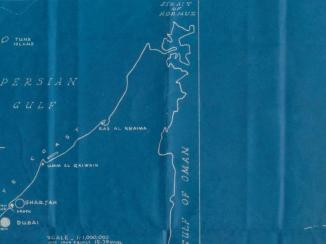
Oil was discovered in the United Arab Emirates in Abu Dhabi in 1958. However, earlier oil concessions for the Trucial Coast A name used by Britain from the nineteenth century to 1971 to refer to the present-day United Arab Emirates. (as the individual shaikhdoms were collectively referred to by British officials) were agreed and signed during the 1930s and 1940s. Several records on the QDL discuss oil exploration (and the granting of oil concessions) along the Trucial Coast A name used by Britain from the nineteenth century to 1971 to refer to the present-day United Arab Emirates. between 1934 and 1946. These include two files from the Bahrain Political Agency An office of the East India Company and, later, of the British Raj, headed by an agent. , one from the Trucial Coast Agency and two other records from elsewhere in the IOR collection.
Other records cover and contain copies of specific concessions and related agreements with Petroleum Concessions Limited (part of the IPC group), including the following:
- The first Dubai oil concession, signed in May 1937 by Shaikh Saʻid bin Maktum bin Hasher Al Maktum, along with related agreements
- The first Abu Dhabi concession, signed in January 1939 by Shaikh Shakhbut bin Sultan bin Zayid Al Nahyan, along with related agreements
- An initial agreement for oil exploration in Ajman, made in March 1939 with Shaikh Rashid bin Humayd al-Na‘imi, and an oil concession signed by him in January 1951
- The Umm al-Qaywayn oil concession, signed in March 1945 by Shaikh Ahmad bin Rashid Al Mu‘alla, plus related agreements
- The second Ra’s al-Khaymah concession (following the cancellation of the first concession), signed in June 1945 by Shaikh Sultan bin Salim al-Qasimi
- The Sharjah oil concession, signed in September 1937 by Shaikh Sultan bin Saqr al-Qasimi, along with a related agreement.
Related Articles





Far From Exhaustive
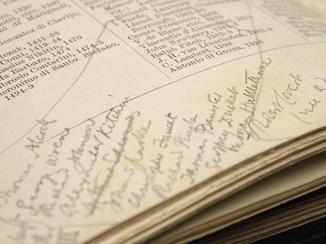
Nearly 230 IOR records are cited across both parts of this article, yet this is not exhaustive. There are many more, several of which relate to more than one country in the region. One notable example is these five volumes, ranging in date from 1933 to around 1964 and containing copies of the oil concessions for Bahrain, Kuwait, Qatar, Ajman, Dubai, Sharjah, and Umm al-Qaywayn.
Conclusion: A transformation in the Gulf and a decline in British influence
The records highlighted in this series trace the beginnings of a transformation in the Gulf. They also document another pivotal development. A common thread throughout the various oil negotiations is the active role played by the British Government, as it sought to maintain its imperialist dominance by ensuring that British-owned oil companies secured concessions wherever possible. It was not always successful in doing so, however, most notably in Saudi Arabia. The presence of American-owned CASOC in Saudi Arabia marked the beginning of a significant shift in the balance of geopolitics, with the United States taking an increasing interest in the region from the mid-1930s onwards. By the end of the Second World War, British influence was in decline, and soon afterwards the United States would supplant Britain as the region’s predominant imperialist power.