Overview
Other articles in this series: Part 2.
A volume of the East India Company’s ‘Miscellaneous Marine Records’ includes a journal of the voyage of the French ship Le Content from Brest to South America in 1720-23. This is the oldest French-language source in the India Office The department of the British Government to which the Government of India reported between 1858 and 1947. The successor to the Court of Directors. Records available on the Qatar Digital Library.
The Napoleonic Wars
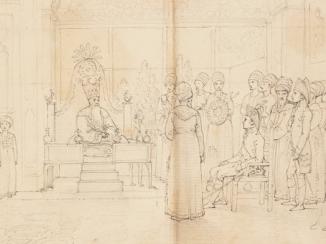
A high concentration of French-language material originates from the Revolutionary and Napoleonic Wars. These include the words of Bonaparte himself, both in his 1798 proclamation in Egypt, and in his later letter to the Shah of Iran, Fath ‘Ali Shah Qajar.
Particularly intriguing are French letters intercepted by the East India Company. Among these are letters captured from the French Consul in Baghdad on Revolutionary French diplomacy with the Ottoman Empire and Muscat, as well as an 1802 letter from a Frenchman in Afghanistan. Harford Jones, the Company’s Resident in Baghdad, was confident that he would ‘be able to obtain [s]ight and [c]opies’ of all this French traveller’s correspondence that passed through Baghdad (IOR/L/PS/9/76/245, f. 1r). Equally, one 1805 letter shows that Domenico Choch, a former employee of Jones’s at the Baghdad Residency An office of the East India Company and, later, of the British Raj, established in the provinces and regions considered part of, or under the influence of, British India. , came to Paris and sold British intelligence to French Foreign Minister Talleyrand.
Later, a haul of letters was captured in Bushehr from Jean Robbio, an envoy of the Governor of the ‘Isle of France’ [Mauritius]. The contents included an anonymous letter from a man stranded in Muscat pleading for rescue from a Frenchman in India, as well as a map of Zanzibar.
Archive items in this article



The Restoration Monarchy to the Third Republic
French-language sources from the Restoration Monarchy are more scattered, but there are some striking examples. For instance, an 1819 declaration by the Governor of Ile Bourbon [Réunion] describes the capture of a British ship trafficking enslaved people by a French sailor who was subsequently abandoned on a rock by a mutinous crew. A testimony by a French ship’s captain in 1829 relays the movements of a Greek corsair in the Red Sea. Particularly noteworthy is a letter of friendship from King Louis-Philippe in 1835 to Ranjit Singh, Maharajah of the Sikh Empire, whose army employed a number of former Napoleonic soldiers.
Moving into the time of the Second Empire, the private papers of Lewis Pelly contain a copy of an 1858 article from La Revue des Deux Mondes, calling for the establishment of a French colony in Asia ‘to conserve our rank in the world’ (Mss Eur F126/21, f. 12v). From the same period, there are letters from the French navy on French relations with Zanzibar, as well as papers from 1861 issued to Arab dhows in the name of Napoleon III at Nosy Be in the French colony of Madagascar. These provide early examples of a key theme in the records: the use of the French flag by ships in the Indian Ocean to circumvent British searches for enslaved people or arms.

French relations with Muscat also feature prominently in the records. France’s small but tenacious presence may have spared Muscat from even deeper British colonial penetration. Much French-language material concerns the use of the French flag on dhows by subjects of the Sultan of Muscat, which Britain viewed as an infringement on their ally Sultan’s sovereignty and took to arbitration in the Hague. During this time, Muscat also became an entrepot for arms and ammunition in the Indian Ocean, which British forces could not stop thanks to the 1845 treaty between Muscat and France. The trade in arms appears repeatedly in French-language sources in the years before the First World War, including the activities of the notorious French arms dealer Antonin Goguyer.
France’s increasing interest in Iran is also discernible. In 1883, French engineer Félix Vauvilliers proposed an irrigation scheme between Mohammerah [Korramshahr] and Kermanshah to Iran’s Qajar rulers. Meanwhile, Fabius Boital laid out railway construction schemes to Lord Curzon in 1900. Curzon’s private papers include a copy of the Revue Franco-Persane from the same year, promoting French economic and political relations with Iran, and also covering the Iranian presence at the Paris Exhibition Universelle and the visit of Mozaffar al-Din Shah Qajar to France.

Reflecting the intensifying globalisation of the period, the records also include copies of a 1908 treaty between France and Ethiopia, and a 1911 letter from the French Vice-Consul in Bushehr mentioning the presence of French firms trading in pearls at Dubai and Bahrain.
The First World War and its Aftermath
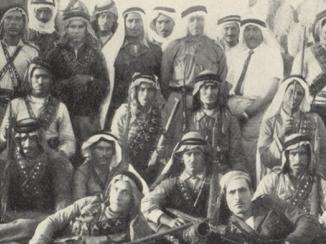
Many French-language records concern the First World War and shed light on some surprising aspects of the conflict. In 1914, the French Ambassador in London asked for an exception to the British ban on workers emigrating from Aden in order to relieve Adeni workers in French Madagascar. A year later, the Ambassador wrote describing French supplies being sent to the Idrisi Emirate of Asir to fight the Ottoman Empire in south Arabia. In 1918, Lyon silk producers complained of restrictions on wool exports to France from Iraq after its occupation by Britain. Other wartime French documents concern the French military mission to the Hijaz, discussions between France, Britain, and Russia on the invention of post-Ottoman states, the Arab Revolt, and the 1918 Anglo-French declaration on “liberating” Iraq and Syria.
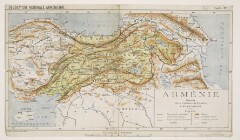
Much of the French-language material relates to the post-war recreation of West Asia, when France and Britain reshaped the region in their own interests. Many documents relate to mandates, new borders, the installation of new rulers, the Kurdish question, and the later Treaty of Lausanne with the new Turkish Republic. One unusual document from 1919 is a map made by Zadig Khanzadian, an Armenian cartographer in the French navy. It depicts a proposed Armenian state in Cilicia and was presented by the Armenian National Delegation to the Versailles peace conference.
Related Articles




Later in the 1930s, treaties document early French relations with new states, including ‘Hedjaz, Nejd and Dependencies’ [Saudi Arabia] (IOR/L/PS/12/2061, f. 34r), Syria, Lebanon, and the Imamate of Yemen. This period also saw requests from both Air France and private French aviators to access airfields in Britain’s Gulf protectorates on their routes to Asia.
The Second World War and After
Among the Second World War records are a handful in French. These include: an Anglo-Iranian Oil Company certificate, which records oil exports from Abadan to Marseille just before the German occupation of France; a proclamation in Beirut from November 1941 by General Georges Catroux, the Free French Plenipotentiary in the Levant A geographical area corresponding to the region around the eastern Mediterranean Sea. , on the independence of Lebanon; and a 1942 letter from the French Government-in-Exile in London, on permission for Free French forces to enter Egypt and their future demobilisation.
Beginning with ships and ending with aircraft, the latest French document dates from February 1946 and is an agreement between Britain and the post-war Provisional Government of the French Republic, regulating overflight and landing rights in British-controlled territories including Bahrain.
France, the Gulf, and Beyond
French-language sources from the India Office The department of the British Government to which the Government of India reported between 1858 and 1947. The successor to the Court of Directors. Records on the QDL reflect the long-standing French presence in the Gulf, West Asia, and wider Indian Ocean, alongside and frequently in competition with Britain. They shed light on the histories of the region and of French colonialism and foreign policy. Part 2 explores French-language records arising from contexts beyond France.