
Overview
Other articles in this series: Part 1; Part 2.
Colophons give voice to the otherwise silent world of scribes. Through them, we learn names, lineages, places, working conditions, and even personal hopes or laments. These small statements humanise the manuscript tradition and reveal the lived experiences behind it.
The Scribe as a Presence
If the scribe mentions himself, he will often introduce himself with the phrase ʻalá yad(ay) or bi-yad(ay) (على يد[ي] or بيد[ي] – ‘by the hand(s) of’) and precede his name with appropriate signs of humility using some combination of the following terms of abasement:
Archive items in this article



In a tour de force of self-deprecation, the scribe of a manuscript from early eighth/fourteenth-century Tabriz describes himself as ‘the feeble and weak servant to God the Most High, Who is cognisant of the sins and faults of all His servants, the one who sins against himself, who is known by his sin and is hopeful of the mercy of his Much-Forgiving Lord, the most wretched of God’s servants and the most in want of His forgiveness and mercy, ‘Umar ibn Muḥammad ibn Sallām ibn ‘Abd Allāh al-Irbīlī – God forgive him and pass over his faults!’

Names, Nisbas, and Lineages
Colophons in Arabic manuscripts often preserve rich information about the scribe. A scribe’s name may include:
- Nisbas – descriptive affiliations, often geographical (e.g. al-Baṣrī, al-Qummī – البصري، القمي), but also professional or otherwise social (e.g., membership of a legal school or Sufi ṭarīqah)
- Family lineage, expressed through patronymics or extended genealogies.
Taken together, these elements are invaluable for reconstructing scholarly and intellectual networks. In Add MS 7470, for instance, the scribe goes further by explicitly claiming descent from the work’s author, underscoring the cultural value placed on genealogical and scholarly lineage in manuscript transmission.
Authorial Holographs
Occasionally, a colophon Section at the end of a manuscript text. reveals that the scribe is the author. Such a manuscript copied by the hand of the text’s author is called an authorial holograph or autograph. A handbook on dream interpretation is a rare authorial holograph from Mamluk Egypt. The author and scribe humbles himself with the title ‘little servant of the scholarly community’ (khuwaydim ahl al-ʿilm – خويدم اهل العلم).

Places and Poetry
The scribe may also record where he transcribed a manuscript. Although sometimes specific details of mosques, madrasahs, or personal libraries are mentioned, scribes more commonly mention only the city in which they worked. Cities were, however, often referred to by honorific titles like those in the table below, along with prayers for their safety and protection:

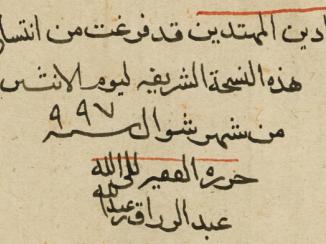
After all the details scribes leave in colophons, they occasionally add notes to the effect that their writing will outlive them. Here’s a poetic example of this genre that appears at either side of a colophon Section at the end of a manuscript text. from 1097/1686: ‘The script glistens upon the paper for eternity, while its scribe lies rotting in the earth’.
Related Articles
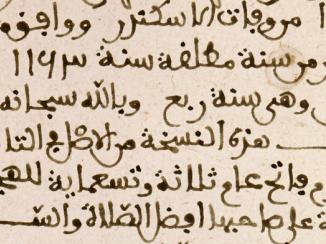

Colophons are more than administrative statements. They are personal, cultural, and historical testimonies. They capture voices otherwise lost, revealing the scribes who shaped the intellectual world of the Arabic manuscript tradition. Through them, the past speaks – sometimes humbly, sometimes poetically, always vividly.