
Overview
Other articles in this series: Part 1; Part 3.
Colophons frequently preserve the only explicit date in a manuscript. Yet interpreting these dates is often complex: scribes used multiple calendar systems, variable month naming conventions, and approximate formulae that require careful decoding. Understanding these elements allows us to situate manuscripts more accurately within historical time.
Calendars in Arabic Manuscripts
Although most colophon Section at the end of a manuscript text. dates in the Arabic manuscripts on the Qatar Digital Library employ the Islamic hijrī era (AH), other calendars are sometimes used. Scribes indicated which era is being used by defining the year (سنة) in the colophon Section at the end of a manuscript text. date with either an adjective or a prepositional phrase. The most common of these are listed in the table below.
Archive items in this article


To convert dates between calendars, Theo S. Beers’ Calendar Converter for Near East Historians has the main calendars needed for most situations. If a larger selection of calendars is needed, the mighty Calendar Calculator 2 comparison tool on Nikolaus A. Bär’s Chronologie und Kalender website can solve most problems.

Islamic Months and Their Epithets
Colophons in Arabic manuscripts tend to use Islamic months. When the names of months are illegible, knowing their traditional honorific epithets can help narrow down the possibilities.

The Islamic (and Jewish) day begins at sunset, so if a scribe specifies the night of a given date, the corresponding CE date would be that of the previous day. Also, although the Islamic months each have a traditionally assigned number of days (see table below), the actual number of days in any lunar month in any particular geographical location was based on the visibility of the new crescent moon. Since the number of days in the month is thus variable in practice by up to two days, when establishing a corresponding date in another calendrical system, it is best to be guided by the weekday when one is specified. This is because the seven-day cycle of the week was common and invariable in all major calendrical systems within the Arabic-speaking world, whether the days in the cycle were called by names based on their planetary associations as in Sanskrit, English, and many other European languages, or by names based on their ordinal number names as in, for example, Arabic, Persian, Turkish, and Greek.

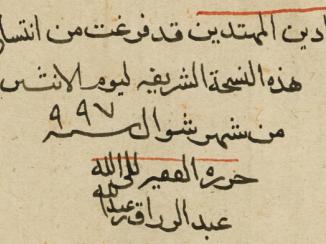
Finally, it should be mentioned that the particle ‘li-’ (لـ-) is sometimes used in date formulae instead of fī (في) in the sense of ‘at the time of’. This use of ‘li-’ can be seen in the colophon Section at the end of a manuscript text. of a manuscript copied in 997 AH: ‘… I completed transcribing / this noble copy on Monday / in the month of Shawwāl in the year 997’ (... قد فرغت من انتساخ / هذه النسخة الشريفة ليوم الأثنين / من شهر شوال سنة ٩٩٧, Add MS 7470, f. 110r, lines 2-4).

Approximate Dating Through ‘Decades’
Dates in colophons can be somewhat imprecise, like that in Add MS 7470 above, which says only that it was completed on a Monday in the month of Shawwāl without specifying the day of the month. Another way an approximate date can be given is by breaking the month into three ten-day periods or ‘decades’. In practice, when such a decade is combined with the name of a weekday, the date can be deduced. For Muḥarram, the decade system works as follows:


Sometimes, instead of using a number for the day of the month, a scribe will specify the first, middle, or last day of the month:

Days, Nights, and Counting Systems
Scribes sometimes also indicate dates by referring to the nights elapsed from or remaining in a given month. In these cases, the verbs khalā or maḍá (خَلَا, مَضَى – ‘pass, elapse’) and baqiya (بَقِيَ – ‘remain’) are used to state how many nights have elapsed (for the first half of the month) and how many days remain (for the second half). Here is an example of how this form of dating works for the month of Muḥarram:

In practice, however, this system was not always rigidly applied. Scribes sometimes speak of days rather than nights elapsed or remaining. They do not always introduce the number of nights or days with the particle ‘li-’ (لـ), nor do they always switch at the middle of the month from counting up nights/days elapsed to counting down those remaining.
Related Articles


Dating a manuscript may appear straightforward, but colophons reveal a world of overlapping calendars, flexible month structures, and approximate formulae. When decoded carefully, these systems illuminate not only chronology but also the cultural settings in which manuscripts were produced.
* Transcribing colophons isn’t always easy, and sometimes we get it wrong – as we did in the catalogue records for these two manuscripts!