
Overview
Other articles in this series: Part 2; Part 3.
For many readers, the instinct when approaching a manuscript is to seek “the original” – a text written by the hand of its author. An author’s own draft (dustūr) of a text, which may either be a rough draft (musawwadah) or a polished fair copy (mubayyaḍah), is known to codicologists and philologists as an authorial holograph or autograph. Yet such manuscripts are exceedingly rare in the Arabic tradition before the Mongol invasions of the seventh century AH/thirteenth century CE, and most surviving manuscripts are instead copies (nusakh, sing. nuskhah) of copies, single links in chains of transmission that are often long and untraceable. Understanding when, where, and by whom these manuscripts were produced depends not primarily on the main text, but on paratexts: marginalia, ownership notes, and, crucially, the colophon Section at the end of a manuscript text. .
What Is a Colophon?
A colophon Section at the end of a manuscript text. appears at the end of a manuscript or at the conclusion of each major textual unit, marking the completion of transcription. Here, authors regularly marked their work as complete often with humble thanksgiving, blessings, and prayers. Following this, scribes – less often authors – sometimes say something of the context in which the text was produced. These words at the end of a text, and often visually distinct from it, are called the colophon Section at the end of a manuscript text. . When a colophon Section at the end of a manuscript text. is added by a text’s author, it is referred to as ‘authorial’; when it is the work of the scribe, it is ‘scribal’.
Archive items in this article




Its earliest appearances are in the second/ninth century, when they tended to be brief and functional. In later periods they became longer, more elaborate, and increasingly stylised. Over time, colophons came to include a wide range of information: the title and author of the work, the name and humility formulae of the author or scribe, dates and places of copying, details of dictation or transmission, prayers, eulogies, and sometimes even biographical or historical narratives. By the eighth/fourteenth century, the colophon Section at the end of a manuscript text. had reached a high point of complexity and rhetorical ornamentation.
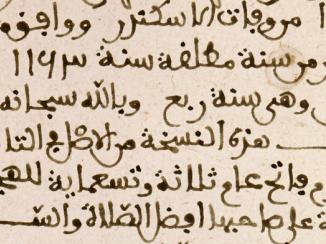
Occasionally, the scribe provided information about the manuscripts from which they had copied, the libraries that held these manuscripts, and the patrons for whom they worked. However, the basic data researchers routinely hope to find in a colophon Section at the end of a manuscript text. are the date and perhaps place a copy was completed, and maybe some details about the scribe, often an otherwise unknown figure. The language of colophons is somewhat formulaic, but there is enough variation that, when combined with the less calligraphic, more cursive handwriting often adopted in colophons, modern readers are faced with some difficulties. It is useful to be familiar with the words, phrases, and features frequently encountered in colophons.

How Scribes Mark ‘Completion’
A colophon Section at the end of a manuscript text. usually begins with a statement marking completion of a transcription. This can be extremely simple, such as a single or multiple letter mīms (م) standing for tamma (تمّ – ‘completed’) or tammām (تمام – ‘complete’) or the letter hāʾ (هـ) for intahá (انتهى – ‘ended’). The table below lists some vocabulary found in colophons to indicate completion (verbal noun/maṣdar in brackets). Brief statements consisting of a single verb from columns 2 or 3 are common, as are longer phrases in which a verb from column 2 is combined with a verbal noun from column 3 (e.g., نجز التنميق – ‘[he] completed the transcription…’ if the scribe is mentioned, or ‘the transcription was completed’ if not). When a transcription date is given, the statement may include a verb from column 1, a verbal noun from column 2, and perhaps another from column 3 (e.g., وقع الفراغ من تحريره... – ‘the completion of its transcription occurred… [on such-and-such a date]’).

What Colophons Tell Us
Colophons may reveal:
- information about the exemplar (aṣl) from which a manuscript was copied
- names and self-representations of scribes, authors, and their patrons
- places and institutional settings of production, such as mosques, madrasahs, or Sufi convents.
Together, these elements help reconstruct patterns of textual transmission, scholarly authority, and manuscript circulation across regions.
Case Studies and Variation
Colophons across Arabic manuscripts on the Qatar Digital Library range from brief technical statements to highly informative records:
- Add MS 7470 contains a scribe’s claim to direct descent from the author (f. 110r, lines 2-11)
- IO Islamic 3810 describes the scribe’s comparison against the author’s draft (dustūr) (f. 105r, lines 14-20)
- Add MS 7527 includes a poetic momento mori reflecting on life’s evanescence (f. 170r, lines 16-24).
Related Articles


For codicologists, the end of a manuscript is often where its most significant evidence lies. Colophons are not afterthoughts; they are windows onto the scribes, institutions, and intellectual cultures that shaped the manuscript tradition. They give the Arabic codex A collection of pages, usually gathered into quires, and bound between covers. its human depth, reminding us that behind every text lies the hand and life of a scribe.