Overview
Gertrude Bell was an archaeologist, explorer, and political officer. In the latter role, she became a notable figure in the history of British imperialist state-building in the Middle East. Frequently disparaged and looked down upon by some of her male peers, she stood out as both a trailblazing woman in a man’s world and a conformist to the logic of British imperialism while it redefined Mesopotamia after the First World War.
Archive items in this article




Formative Years
Born into a very wealthy northeastern family that had made its money through industrial innovation, Bell attended the recently founded Oxford women’s college, Lady Margaret Hall in 1883. She was the first woman to graduate in Modern History with a first from Oxford, but, being a woman, she was only retrospectively awarded a formal degree by the university in 1920. Bell’s mother died when she was very young, her father remarried, and Bell’s letters to him remained a constant throughout her life. This early maternal loss, the distance from her father, and her non-conformist life choices for the era have encouraged researchers to examine her formative years closely, in an effort to understand how they influenced her later work and relationships.
The Lure of “The East”
Through her uncle, Frank Lascelles, who was the British Ambassador to what was still known as Persia, Bell travelled to Tehran for the first time in 1892. She wrote of her journey eastwards: ‘in some respects it is even easier than in Europe. You will find in the East habits of intercourse less fettered by artificial chains, and a wider tolerance born of greater diversity’ (Bell, The Desert and the Sown, p. x). There she found freedom from the expectations imposed on women of her class in England. She became fluent in several languages and played a major role in the redrawing of the Middle East following the collapse of the Ottoman Empire.

In 1911, Bell travelled to Damascus, making detailed notes on architectural features and then to Hail in central Arabia. Her movements attracted the attention of Ottoman intelligence: ‘When the Ottoman authority in Mesopotamia was weakened by the beginning of WW1 she was seen more as a political agent A mid-ranking political representative (equivalent to a Consul) from the diplomatic corps of the Government of India or one of its subordinate provincial governments, in charge of a Political Agency. of the British imperial machinery and a spy’ (Maddern).

The Ottoman Empire entered the First World War in October 1914 on the side of Germany and Austria-Hungary. In November 1915, Bell was asked to go to work in a group that was to become the Arab Bureau responsible for British military intelligence in the Middle East.
Political Career
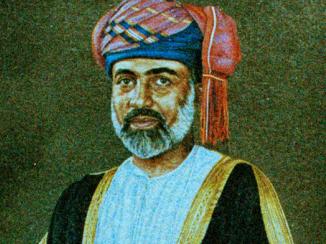
Her grasp of the local ethnic, political, and geographical landscape, combined with her linguistic abilities and connections to those in power, led to her appointment as a Political Officer at Basra. There she was responsible for analysing developments in the region. In 1916, she visited Muhammarah in Persia and gave her view of Shaikh Khaz’al in a letter to her father. She also authored a report assessing the uprising against the Sultan of Muscat and Oman.
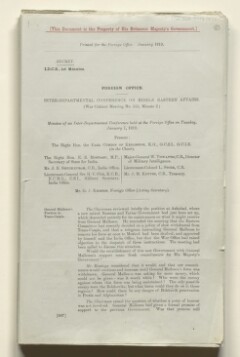
In 1917, Bell briefed Harry St John Bridger Philby before his mission to Najd. Two years later, she participated in the Interdepartmental Conference on Middle Eastern Affairs, and in 1921 she attended the Cairo Conference, both pivotal moments for British policy in the region. Though respected by many who worked closely with her, she was subjected to misogyny including from Mark Sykes, of the infamous Sykes-Picot agreement.
An Oriental Secretary for Iraq
Following the collapse of the Ottoman Empire, the League of Nations granted Britain the mandate for Mesopotamia. The British Empire presented itself as a liberator from Turkish rule, but the Iraqi population revolted in 1920 against British plans for governance. Within a few years, Britain had established both the Iraqi monarchy and the modern Iraqi state.
Although Bell was appointed as Oriental Secretary in 1923, she had already been serving in this role since 1917 under Sir Percy Cox, who became the High Commissioner for Iraq. One of the most critical issues at the time was British policy towards the Kurds. Within British officialdom, opinion was divided. One camp, including Major Ely Soane, favoured giving the Kurds a high degree of autonomy, even independence, while the other, led by Cox and Bell, believed it imperative to incorporate the Kurdish regions of Sulaymaniyah and Erbil into the new Iraqi state under King Faysal.

From Cox and Bell’s perspective, this integration served a purpose. Since the majority of Kurds were Sunni, they would, along with the Sunni Arabs, counterbalance the majority Shia population. Some British officials viewed this sectarian balance as essential to legitimise King Faysal’s rule. This approach became known as the Sharifian solution, whereby the family of the Sharif of Mecca would be pro-British monarchs in the new states of the Middle East. Bell sought to implement this policy, though at the end she regretted the hasty nature of Britain’s decisions. In a letter to her stepmother, dated April 1916, she wrote: ‘Politically, too, we rushed into the business with our usual disregard for a comprehensive political scheme’ (Newcastle, GB/1/1/1/1/25/14).
In 1922, King Faysal appointed Bell as Honorary Director of Antiquities, where she found solace in her later years. In a letter to her father, dated May 1926, she confided that she was busying herself with reading so as to better understand how to arrange Iraq’s first national museum. A permanent building was established just a few months before her death that year. Due to her role in investigating Iraq’s heritage, founding what would become its national museum, Bell is generally held in high esteem in Iraqi archaeological circles.
Related Articles





Death and legacy
Gertrude Bell died two days before her fifty-eighth birthday in 1926 from an overdose of sleeping pills. She reportedly died lonely and despondent but in the knowledge that she had scaled the heights of British imperialist officialdom, a space usually barred to women of her time. While her unique achievements suggest that she was in one sense ahead of her time, her views indicate that she was still very much a product of it. Bell was a complex and contradictory character whose life and legacy continue to deserve scholarly attention.