Overview
On 25 March 1935, the former Sultan of Muscat and Oman, Sayyid Taymur bin Faysal Al Bu Sa‘id, boarded the Italian ocean liner SS Conte Verde at Bombay [Mumbai], destined for Japan. Throughout his journey he was under British surveillance, being the subject of several reports by the Intelligence Bureau of the Government of India and the Special Branch of the Straits Settlements Police, Singapore. These reports tell us that, before reaching Japan, Taymur spent a month in Shanghai staying at the Embassy Hotel with a Jewish companion named Moalim Saleh Hayim. While there, they frequently met – always in ‘complete secrecy’ (IOR/R/15/6/217, f. 6r) – with Ibrahim Omar Alsagoff, allegedly a Japanese representative in the Kingdom of Saudi Arabia. According to British records, ‘[n]othing is known as to what transpired at these meetings’ (IOR/R/15/6/217, f. 6r).
British officials thought that Sayyid Taymur’s ‘wanderings’ were ‘rather mysterious’ (IOR/R/15/6/217, f. 4r), and they harboured concerns that they might have a ‘sinister political significance’ (IOR/L/PS/12/2988, f. 135r). They further thought it possible that Taymur’s visit was connected to ‘the growing solicitude of the Japanese in attracting to Japan Muslim preceptors from Islamic countries’ (IOR/R/15/6/217, f. 7r). His movements were closely monitored as a result.
Archive items in this article


The “Civilising” West
This ‘growing’ relationship between Japan and Asia’s Muslims, which caused British officials such anxiety in 1935, was not new. Since the 1890s, an intellectual collaboration between the two had been taking place, fuelled by their shared goal of liberation from Western domination, articulated through such transnational visions as Pan-Islamism and Pan-Asianism.
In the latter half of the nineteenth century, some Japanese and other non-Western elites had with some ambivalence begun to accept the Western notion of a universal civilization, epitomised and legitimised by European technology and wealth. Such an acceptance is reflected in many of the social reforms of the period, carried out in both the Ottoman Empire and in Japan. Following the Meiji Restoration in 1868, enormous changes took place in Japan over a short time. This followed the adoption of Western ideas of production and governance, including the abolition of feudalism, rapid industrialization, and the establishment of a centralised government.
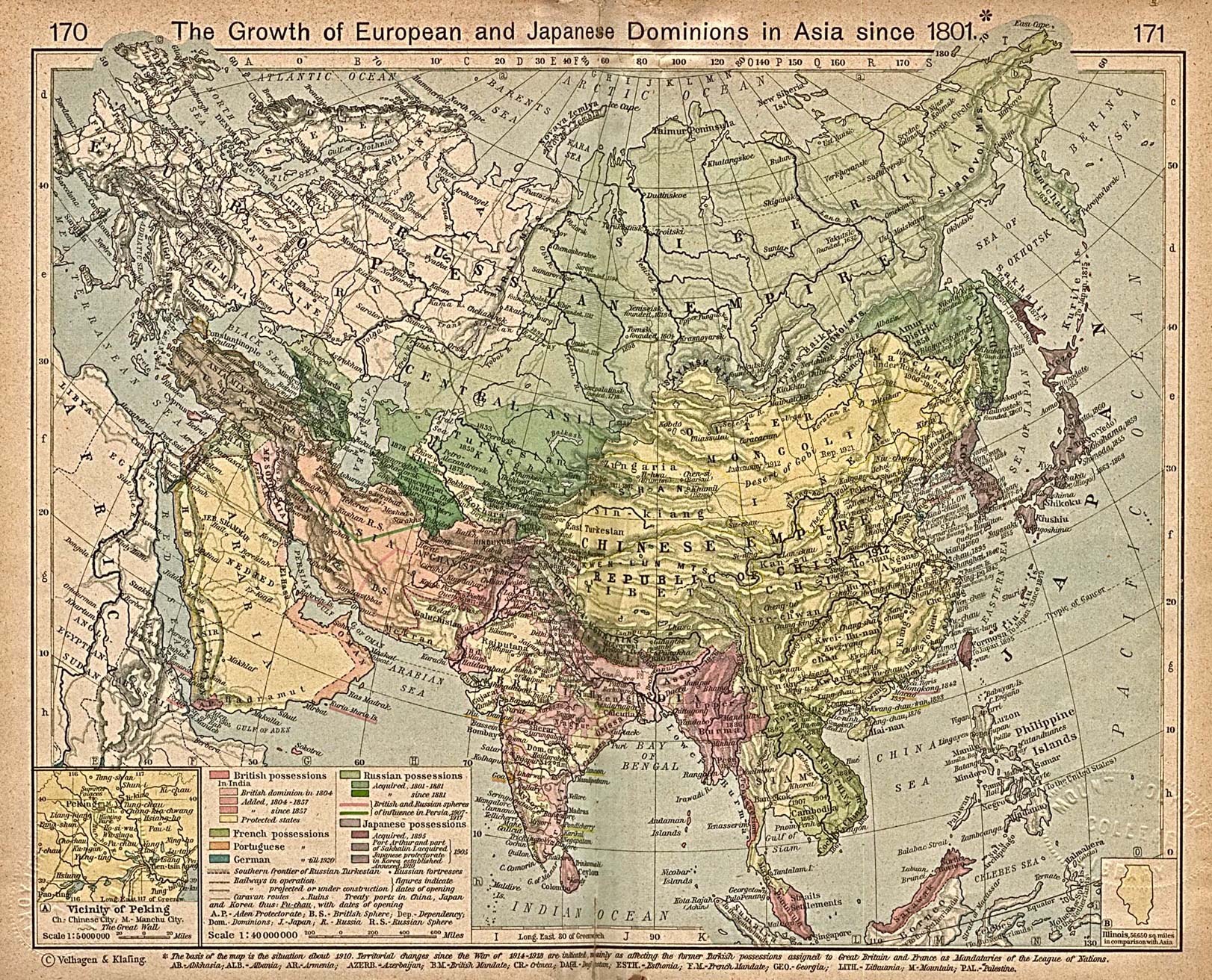
Among such elites, however, there was a growing sense of Western double standards at play. The use of extraordinary violence by so-called “civilised” peoples and the scramble to establish colonies in Africa and elsewhere quickly eroded any legitimacy that the West and its ideas may have had. When attempts were made to justify and naturalise global hierarchies and power discrepancies using spurious theories of racial superiority and social Darwinism, elites in Africa and Asia began to look for alternative visions of transnational and civilisational order.
Pan-Asianism: A unifying response to Western imperialism
With its roots in the 1870s, Pan-Asianism flourished at the beginning of the 1900s as a unifying response to Western imperialism and racial hierarchies. While the technological superiority of the West was evident (even if Japan’s rapid modernisation had shown it to be only temporary), pan-Asianists laid claim to a moral and spiritual heritage that they believed far surpassed that of Europe and the United States. This heritage was founded in and expressed through the continent’s three major religions: Buddhism, Hinduism, and Islam. This emphasis on a shared religious identity often brought pan-Asianists and pan-Islamists together.
In the heady days following the 1905 Japanese victory over Russia, Japan became a beacon of hope and an example of what could be achieved without the need for Western colonisation or supervision. Intellectuals, revolutionaries, and political thinkers from across the colonised world flocked to Tokyo for education and inspiration. Throughout this period, however, the Japanese Government formally distanced itself from such movements, eager to appease the great powers it had recently joined at the world’s top table. This changed with Japan’s international isolation following the Manchurian Incident in 1931, and when its leaders understood how useful Pan-Asianism might be for realising their own imperialist ambitions.

With much of the global Muslim population under some form of British subjugation, Japan fostered relationships with pan-Islamists and Muslim revolutionaries everywhere to bring them into a religion-based pan-Asianist movement with Japan at its head. This was why Sayyid Taymur was under surveillance in 1935. It is also why, four years later, the Government of India’s Intelligence Bureau took a renewed interest in a Japanese individual who had gone by several names and who was then believed to be planning a trip to Saudi Arabia.
British fears of a ‘New Order in Asia’
A memorandum of 18 May 1939, circulated to British political agencies in the Gulf and Jeddah, draws attention to a Japanese man variously known as ‘Muto’, ‘Kawamura’, or ‘Chuan Chung Yima’ (IOR/R/15/2/539, f. 32r). Describing him as a Japanese agent, British authorities believed that he had been sent to China by the Japanese government to ‘extend anti-British propaganda under a cloak of religion’ (IOR/R/15/2/539, f. 32r) and that he would next travel to Arabia. Instructions were given to look out for and treat such individuals with suspicion. This was not only because Japan was expected to side with Germany in any forthcoming war, but also because of its perceived ‘expansionist policy […] for creating a “New Order in Asia”’ that posed a very real threat to Britain’s empire in India.
Related Articles










Japan’s defeat during the Second World War caused a decline in Pan-Asianism’s popularity. European imperialist powers, exhausted after years of war, began to give way to nationalist movements across the globe. At the same time, many colonised peoples saw communism as a new transnational vision that made sense of the past and present and gave hope regardless of race or creed.
No evidence of ‘any subversive activity’
British interest in and suspicion of Sayyid Taymur also quickly dissipated. As the Director of the Special Branch of the Straits Settlements Police reported at the beginning of 1936, there was ‘nothing to show that he [was] engaged [in] any subversive activity’, and he believed him to be loyal to Britain (IOR/R/15/6/217, f. 16r). His travels to places such as China and Japan were thought to be in service of ‘some small commercial venture’, and his trips to the latter attributed to ‘a Japanese geisha girl who fell in love with him […] and has been urging him to return to her’ (IOR/R/15/6/217, f. 16r). This was almost certainly Kiyoko Oyama, whom Taymur married later that same year.