
![Report of the Special Mission to Egypt under Lord Milner, and related papers [‎160v] (323/473)](https://iiif.qdl.qa/iiif/images/81055/vdc_100000001491.0x000295/Mss Eur F112_260_0323.jp2/full/!1200,1200/0/default.jpg "Report of the Special Mission to Egypt under Lord Milner, and related papers [‎160v] (323/473)")
Report of the Special Mission to Egypt under Lord Milner, and related papers [160v] (323/473)
The record is made up of 1 file (237 folios). It was created in 15 May 1920-14 Oct 1921. It was written in English. The original is part of the British Library: India Office The department of the British Government to which the Government of India reported between 1858 and 1947. The successor to the Court of Directors. Records and Private Papers Documents collected in a private capacity. .
Transcription
This transcription is created automatically. It may contain errors.
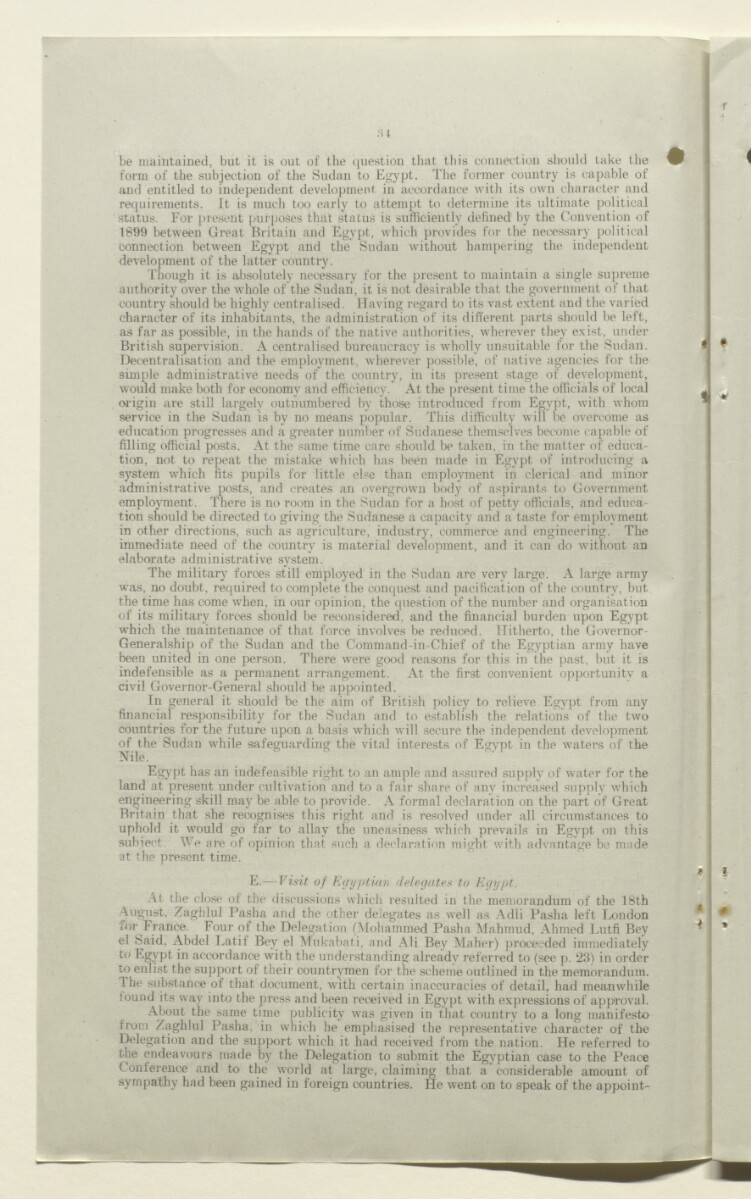
3 4
be maintained, but it is out of the question that this connection should take the
form of the subjection of the Sudan to Egypt. The former country is capable of
and entitled to independent development in accordance with its own character and
requirements. It is much too early to attempt to determine its ultimate political
status. For present purposes that status is sufficiently defined by the Convention of
1899 between Great Britain and Egypt, which provides for the necessary political
connection between Egypt and the Sudan without hampering the independent
development of the latter country.
Though it is absolutely necessary for the present to maintain a single supreme
authority over the whole of the Sudan, it is not desirable that the government of that
country should be highly centralised. Having regard to its vast extent and the varied
character of its inhabitants, the administration of its different parts should be left,
as far as possible, in the hands of the native authorities, wherever they exist, under
British supervision. A centralised bureaucracy is wholly unsuitable for the Sudan.
Decentralisation and the employment, wherever possible, of native agencies for the
simple administrative needs of the country, in its present stage of development,
would make both for economy and efficiency. At the present time the officials of local
origin are still largely outnumbered by those introduced from Egypt, with whom
service in the Sudan is by no means popular. This difficulty will be overcome as
education progresses and a greater number of Sudanese themselves become capable of
filling official posts. At the same time care should be taken, in the matter of educa
tion, not to repeat the mistake which has been made in Egypt of introducing a
system which fits pupils for little else than employment in clerical and minor
administrative posts, and creates an overgrown body of aspirants to Government
employment. There is no room in the Sudan for a host of petty officials, and educa
tion should be directed to giving the Sudanese a capacity and a taste for employment
in other directions, such as agriculture, industry, commerce and engineering. The
immediate need of the country is material development, and it can do without an
elaborate administrative system.
The military forces still employed in the Sudan are very large. A large army
was, no doubt, required to complete the conquest and pacification of the country, but
the time has come when, in our opinion, the question of the number and organisation
of its military forces should be reconsidered, and the financial burden upon Egypt
which the maintenance of that force involves be reduced. Hitherto, the Governor-
Generalship of the Sudan and the Command-in-Chief of the Egyptian army have
been united in one person. There were good reasons for this in the past, but it is
indefensible as a permanent arrangement. At the first convenient opportunitv a
civil Governor-General should be appointed.
In general it should be the aim of British policy to relieve Egypt from any
financial responsibility for the Sudan and to establish the relations of the two
countries for the future upon a basis which will secure the independent development
of the Sudan while safeguarding the vital interests of Egypt in the waters of the
Nile.
Egypt has an indefeasible right to an ample and assured supply of water for the
land at present under cultivation and to a fair share of any increased supply which
engineering skill may be able to provide. A formal declaration on the part of Great
Britain that she recognises this right and is resolved under all circumstances to
uphold it would go far to allay the uneasiness which prevails in Egypt on this
subject. We are of opinion that such a declaration might with advantage be made
at the present time.
E.— Visit of Egyptian delegates to Egypt.
At the close of the discussions which resulted in the memorandum of the 18th
August, Zaghlul
Pasha
An Ottoman title used after the names of certain provincial governors, high-ranking officials and military commanders.
and the other delegates as well as Adli
Pasha
An Ottoman title used after the names of certain provincial governors, high-ranking officials and military commanders.
left London
xor h ranee. Four of the Delegation (Mohammed
Pasha
An Ottoman title used after the names of certain provincial governors, high-ranking officials and military commanders.
Mahmud, Ahmed Lutfi Bey
el Said, Abdel Latif Bey el Mukabati, and All Bey Maher) proceeded immediately
Egypt in accordance with the understanding already referred to (see p. 23) in order
to enlist the support of their countrymen for the scheme outlined in the memorandum.
Ihe substance of that document, with certain inaccuracies of detail, had meanwhile
found its way into the press and been received in Egypt with expressions of approval.
About the same time publicity was given in that country to a long manifesto
from Zaghlul
Pasha
An Ottoman title used after the names of certain provincial governors, high-ranking officials and military commanders.
, in which he emphasised the representative character of the
Delegation and the support which it had received from the nation. He referred to
the endeavours made by the Delegation to submit the Egyptian case to the Peace
Conference and to the world at large, claiming that a considerable amount of
sympathy had been gained in foreign countries. He went on to speak of the appoint-
About this item
- Content
The file contains official correspondence, memoranda, and reports relating to political affairs in Egypt. The correspondents and authors are officials at the Foreign Office (Lord Curzon was Secretary of State for Foreign Affairs at the time), War Office, Air Ministry, Admiralty, Colonial Office, Board of Trade, Board of Education, as well as those within the Egyptian civil service.
The file contains copies of reports of the Special Mission to Egypt (folios 1-7, 75-93, and 175-194), led by Lord Alfred Milner, whose purpose was to investigate and advise following the Egyptian Revolution of 1919. Much of the content of the file is in response to the findings and recommendations of the Mission and discusses the possibilities of a political settlement with Egypt.
- Extent and format
- 1 file (237 folios)
- Arrangement
The file is arranged in chronological order, from the front to the rear.
- Physical characteristics
Foliation: the foliation sequence (used for referencing) commences at the front cover with 1, and terminates at the inside back cover with 235; these numbers are written in pencil, are circled, and are located in the top right corner of the recto The front of a sheet of paper or leaf, often abbreviated to 'r'. side of each folio. The file has one foliation anomaly, f 76a.
- Written in
- English in Latin script View the complete information for this record
Use and share this item
- Share this item
Report of the Special Mission to Egypt under Lord Milner, and related papers [160v] (323/473), British Library: India Office Records and Private Papers, Mss Eur F112/260, in Qatar Digital Library <https://www.qdl.qa/archive/81055/vdc_100080131820.0x00007c> [accessed 30 July 2026]
https://www.qdl.qa/en/archive/81055/vdc_100080131820.0x00007c
Copy and paste the code below into your web page where you would like to embed the image.
<meta charset="utf-8"><a href="https://www.qdl.qa/en/archive/81055/vdc_100080131820.0x00007c">Report of the Special Mission to Egypt under Lord Milner, and related papers [‎160v] (323/473)</a> <a href="https://www.qdl.qa/en/archive/81055/vdc_100080131820.0x00007c"> <img src="https://iiif.qdl.qa/iiif/images/81055/vdc_100000001491.0x000295/Mss Eur F112_260_0323.jp2/full/!280,240/0/default.jpg" alt="" /> </a>
This record has a IIIF manifest available as follows. If you have a compatible viewer you can drag the icon to load it.https://www.qdl.qa/en/iiif/81055/vdc_100000001491.0x000295/manifestOpen in Universal viewerOpen in Mirador viewerMore options for embedding images
Copyright: How to use this content
- Reference
- Mss Eur F112/260
- Title
- Report of the Special Mission to Egypt under Lord Milner, and related papers
- Pages
- front, front-i, 2r:39v, 42r:50v, 53r:76v, 76ar:76av, 77r:140v, 143r:143v, 144ar, 144r:235v
- Author
- East India Company, the Board of Control, the India Office, or other British Government Department
- Usage terms
- Open Government Licence