
![Report of the Special Mission to Egypt under Lord Milner, and related papers [‎161r] (324/473)](https://iiif.qdl.qa/iiif/images/81055/vdc_100000001491.0x000295/Mss Eur F112_260_0324.jp2/full/!1200,1200/0/default.jpg "Report of the Special Mission to Egypt under Lord Milner, and related papers [‎161r] (324/473)")
Report of the Special Mission to Egypt under Lord Milner, and related papers [161r] (324/473)
The record is made up of 1 file (237 folios). It was created in 15 May 1920-14 Oct 1921. It was written in English. The original is part of the British Library: India Office The department of the British Government to which the Government of India reported between 1858 and 1947. The successor to the Court of Directors. Records and Private Papers Documents collected in a private capacity. .
Transcription
This transcription is created automatically. It may contain errors.
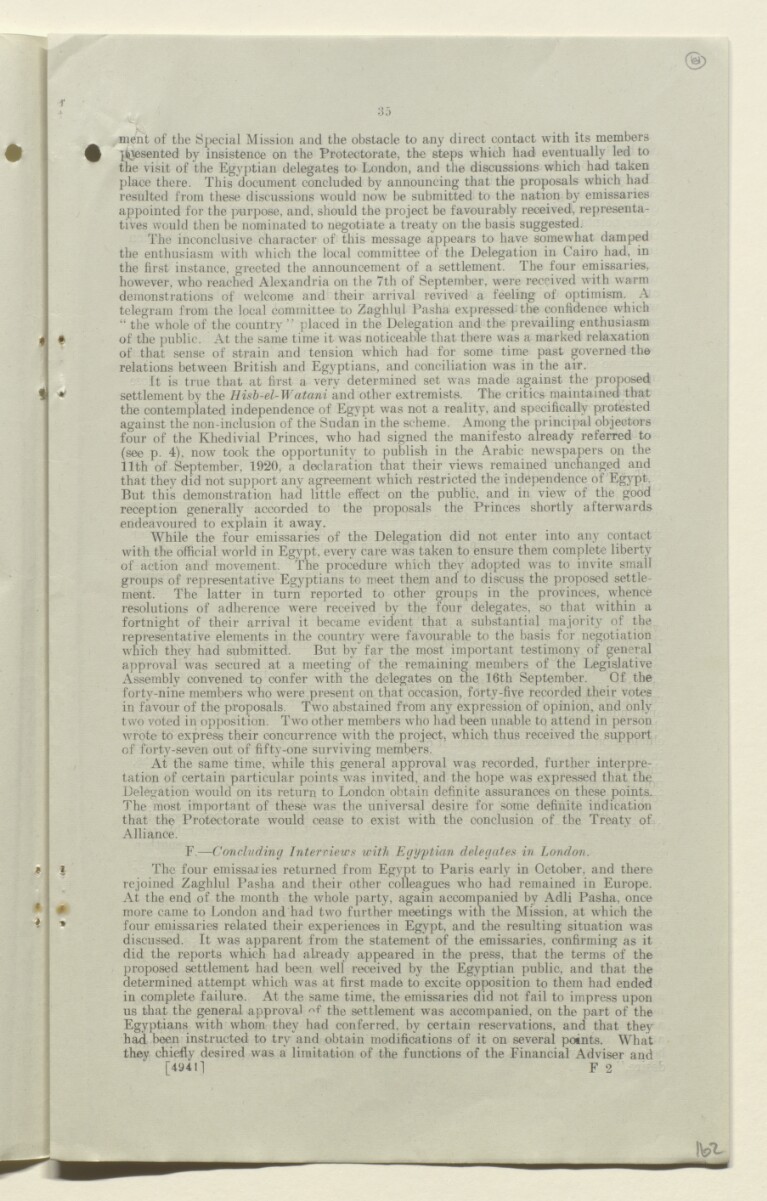
ment of the Special Mission and the obstacle to any direct contact with its members
^ ji^vesented by insistence on the Protectorate, the steps which had eventually led to
the visit of the Egyptian delegates to London, and the discussions which had taken
place there. This document concluded by announcing that the proposals which had
resulted from these discussions would now be submitted to the nation by emissaries
appointed for the purpose, and, should the project be favourably received, representa
tives would then be nominated to negotiate a treaty on the basis suggested.
The inconclusive character of this message appears to have somewhat damped
the enthusiasm with which the local committee of the Delegation in Cairo had, in
the first instance, greeted the announcement of a settlement. The four emissaries,
however, who reached Alexandria on the 7th of September, were received with warm
demonstrations of welcome and their arrival revived a feeling of optimism. A
telegram from the local committee to Zaghlul
Pasha
An Ottoman title used after the names of certain provincial governors, high-ranking officials and military commanders.
expressed the confidence which
“ the whole of the country placed in the Delegation and the prevailing enthusiasm
of the public. At the same time it was noticeable that there was a marked relaxation
of that sense of strain and tension which had for some time past governed the
relations between British and Egyptians, and conciliation was in the air.
It is time that at first a very determined set was made against the proposed
settlement by the Hisb-el-Watani and other extremists. The critics maintained that
the contemplated independence of Egypt was not a reality, and specifically protested
against the non-inclusion of the Sudan in the scheme. Among the principal objectors
four of the Khedivial Princes, who had signed the manifesto already referred to
(see p. 4), now took the opportunity to publish in the Arabic newspapers on the
11th of September, 1920, a declaration that their views remained unchanged and
that they did not support any agreement which restricted the independence of Egypt.
But this demonstration had little effect on the public, and in view of the good
reception generally accorded to the proposals the Princes shortly afterwards
endeavoured to explain it away.
While the four emissaries of the Delegation did not enter into any contact
with the official world in Egypt, every care was taken to ensure them complete liberty
of action and movement. The procedure which they adopted was to invite small
groups of representative Egyptians to meet them and to discuss the proposed settle
ment. The latter in turn reported to other groups in the provinces, whence
resolutions of adherence were received by the four delegates, so that within a
fortnight of their arrival it became evident that a substantial majority of the
representative elements in the country were favourable to the basis for negotiation
which they had submitted. But by far the most important testimony of general
approval was secured at a meeting of the remaining members of the Legislative
Assembly convened to confer with the delegates on the 16th September. Of the
forty-nine members who were present on that occasion, forty-five recorded their votes
in favour of the proposals. Two abstained from any expression of opinion, and only
two voted in opposition. Two other members who had been unable to attend in person
wrote to express their concurrence with the project, which thus received the support
of forty-seven out of fifty-one surviving members.
At the same time, while this general approval was recorded, further interpre
tation of certain particular points was invited, and the hope was expressed that the
Delegation would on its return to London obtain definite assurances on these points.
The most important of these was the universal desire for some definite indication
that the Protectorate would cease to exist with the conclusion of the Treaty of
Alliance.
F .—Concluding Interviews with Egyptian delegates in London.
The four emissaries returned from Egypt to Paris early in October, and there
rejoined Zaghlul
Pasha
An Ottoman title used after the names of certain provincial governors, high-ranking officials and military commanders.
and their other colleagues who had remained in Europe.
At the end of the month the whole party, again accompanied by Adli
Pasha
An Ottoman title used after the names of certain provincial governors, high-ranking officials and military commanders.
, once
more came to London and had two further meetings with the Mission, at which the
four emissaries related their experiences in Egypt, and the resulting situation was
discussed. It was apparent from the statement of the emissaries, confirming as it
did the reports which had already appeared in the press, that the terms of the
proposed settlement had been well received by the Egyptian public, and that the
determined attempt which was at first made to excite opposition to them had ended
in complete failure. At the same time, the emissaries did not fail to impress upon
us that the general approval ^ the settlement was accompanied, on the part of the
Egyptians with whom they had conferred, by certain reservations, and that they
had been instructed to try and obtain modifications of it on several points. What
they chiefly desired was a limitation of the functions of the Financial Adviser and
[4941] F 2
About this item
- Content
The file contains official correspondence, memoranda, and reports relating to political affairs in Egypt. The correspondents and authors are officials at the Foreign Office (Lord Curzon was Secretary of State for Foreign Affairs at the time), War Office, Air Ministry, Admiralty, Colonial Office, Board of Trade, Board of Education, as well as those within the Egyptian civil service.
The file contains copies of reports of the Special Mission to Egypt (folios 1-7, 75-93, and 175-194), led by Lord Alfred Milner, whose purpose was to investigate and advise following the Egyptian Revolution of 1919. Much of the content of the file is in response to the findings and recommendations of the Mission and discusses the possibilities of a political settlement with Egypt.
- Extent and format
- 1 file (237 folios)
- Arrangement
The file is arranged in chronological order, from the front to the rear.
- Physical characteristics
Foliation: the foliation sequence (used for referencing) commences at the front cover with 1, and terminates at the inside back cover with 235; these numbers are written in pencil, are circled, and are located in the top right corner of the recto The front of a sheet of paper or leaf, often abbreviated to 'r'. side of each folio. The file has one foliation anomaly, f 76a.
- Written in
- English in Latin script View the complete information for this record
Use and share this item
- Share this item
Report of the Special Mission to Egypt under Lord Milner, and related papers [161r] (324/473), British Library: India Office Records and Private Papers, Mss Eur F112/260, in Qatar Digital Library <https://www.qdl.qa/archive/81055/vdc_100080131820.0x00007d> [accessed 25 August 2026]
https://www.qdl.qa/en/archive/81055/vdc_100080131820.0x00007d
Copy and paste the code below into your web page where you would like to embed the image.
<meta charset="utf-8"><a href="https://www.qdl.qa/en/archive/81055/vdc_100080131820.0x00007d">Report of the Special Mission to Egypt under Lord Milner, and related papers [‎161r] (324/473)</a> <a href="https://www.qdl.qa/en/archive/81055/vdc_100080131820.0x00007d"> <img src="https://iiif.qdl.qa/iiif/images/81055/vdc_100000001491.0x000295/Mss Eur F112_260_0324.jp2/full/!280,240/0/default.jpg" alt="" /> </a>
This record has a IIIF manifest available as follows. If you have a compatible viewer you can drag the icon to load it.https://www.qdl.qa/en/iiif/81055/vdc_100000001491.0x000295/manifestOpen in Universal viewerOpen in Mirador viewerMore options for embedding images
Copyright: How to use this content
- Reference
- Mss Eur F112/260
- Title
- Report of the Special Mission to Egypt under Lord Milner, and related papers
- Pages
- front, front-i, 2r:39v, 42r:50v, 53r:76v, 76ar:76av, 77r:140v, 143r:143v, 144ar, 144r:235v
- Author
- East India Company, the Board of Control, the India Office, or other British Government Department
- Usage terms
- Open Government Licence