
![Report of the Special Mission to Egypt under Lord Milner, and related papers [‎160r] (322/473)](https://iiif.qdl.qa/iiif/images/81055/vdc_100000001491.0x000295/Mss Eur F112_260_0322.jp2/full/!1200,1200/0/default.jpg "Report of the Special Mission to Egypt under Lord Milner, and related papers [‎160r] (322/473)")
Report of the Special Mission to Egypt under Lord Milner, and related papers [160r] (322/473)
The record is made up of 1 file (237 folios). It was created in 15 May 1920-14 Oct 1921. It was written in English. The original is part of the British Library: India Office The department of the British Government to which the Government of India reported between 1858 and 1947. The successor to the Court of Directors. Records and Private Papers Documents collected in a private capacity. .
Transcription
This transcription is created automatically. It may contain errors.
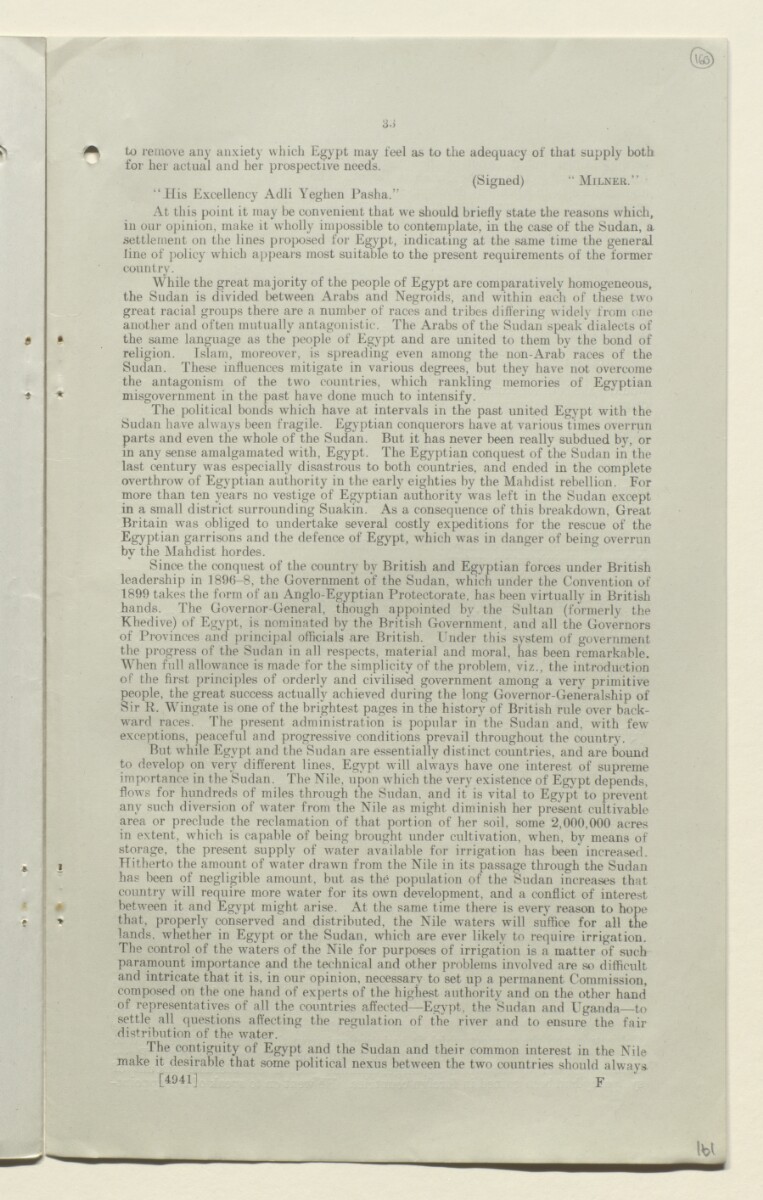
to remove any anxiety which Egypt may feel as to the adequacy of that supply both
for her actual and her prospective needs.
(Signed) “ Milner.”
“ His Excellency Adli Yeghen
Pasha
An Ottoman title used after the names of certain provincial governors, high-ranking officials and military commanders.
.”
At this point it may be convenient that we should briefly state the reasons which,
in our opinion, make it wholly impossible to contemplate, in the case of the Sudan, a
settlement on the lines proposed for Egypt, indicating at the same time the general
line of policy which appears most suitable to the present requirements of the former
country.
While the great majority of the people of Egypt are comparatively homogeneous,
the Sudan is divided between Arabs and Negroids, and within each of these two
great racial groups there are a number of races and tribes differing widely from one
another and often mutually antagonistic. The Arabs of the Sudan speak dialects of
the same language as the people of Egypt and are united to them by the bond of
religion. Islam, moreover, is spreading even among the non-Arab races of the
Sudan. These influences mitigate in various degrees, but they have not overcome
the antagonism of the two countries, which rankling memories of Egyptian
misgovernment in the past have done much to intensify.
The political bonds which have at intervals in the past united Egypt with the
Sudan have always been fragile. Egyptian conquerors have at various times overrun
parts and even the whole of the Sudan. But it has never been really subdued by, or
in any sense amalgamated with, Egypt. The Egyptian conquest of the Sudan in the
last century was especially disastrous to both countries, and ended in the complete
overthrow of Egyptian authority in the early eighties by the Mahdist rebellion. For
more than ten years no vestige of Egyptian authority was left in the Sudan except
in a small district surrounding Suakin. As a consequence of this breakdown, Great
Britain was obliged to undertake several costly expeditions for the rescue of the
Egyptian garrisons and the defence of Egypt, which was in danger of being overrun
by the Mahdist hordes.
Since the conquest of the country by British and Egyptian forces under British
leadership in 1896-8, the Government of the Sudan, which under the Convention of
1899 takes the form of an Anglo-Egyptian Protectorate, has been virtually in British
hands. The Governor-General, though appointed by the Sultan (formerly the
Khedive) of Egypt, is nominated by the British Government, and all the Governors
of Provinces and principal officials are British. Under this system of government
the progress of the Sudan in all respects, material and moral, has been remarkable.
When full allowance is made for the simplicity of the problem, viz., the introduction
o*‘ the first principles of orderly and civilised government among a very primitive
people, the great success actually achieved during the long Governor-Generalship of
Sir R. Wingate is one of the brightest pages in the history of British rule over back
ward races. The present administration is popular in the Sudan and. with few
exceptions, peaceful and progressive conditions prevail throughout the country.
But while Egypt and the Sudan are essentially distinct countries, and are bound
to develop on very different lines. Egypt will always have one interest of supreme
importance in the Sudan. The Nile, upon which the very existence of Egypt depends,
flows for hundreds of miles through the Sudan, and it is vital to Egypt to prevent
any such diversion of water from the Nile as might diminish her present cultivable
area or preclude the reclamation of that portion of her soil, some 2,000,000 acres
in extent, which is capable of being brought under cultivation, when, by means of
storage, the present supply of water available for irrigation has been increased.
Hitherto the amount of water drawn from the Nile in its passage through the Sudan
has been of negligible amount, but as the population of the Sudan increases that
country will require more water for its own development, and a conflict of interest
between it and Egypt might arise. At the same time there is every reason to hope
that, properly conserved and distributed, the Nile waters will suffice for all the
lands, whether in Egypt or the Sudan, which are ever likely to require irrigation.
The control of the waters of the Nile for purposes of irrigation is a matter of such
paramount importance and the technical and other problems involved are so difficult
and intricate that it is, in our opinion, necessary to set up a permanent Commission,
composed on the one hand of experts of the highest authority and on the other hand
of representatives of all the countries affected—Egypt, the Sudan and Uganda—to
settle all questions affecting the regulation of the river and to ensure the fair
distribution of the water.
The contiguity of Egypt and the Sudan and their common interest in the Nile
make it desirable that some political nexus between the two countries should always
[4941] y
About this item
- Content
The file contains official correspondence, memoranda, and reports relating to political affairs in Egypt. The correspondents and authors are officials at the Foreign Office (Lord Curzon was Secretary of State for Foreign Affairs at the time), War Office, Air Ministry, Admiralty, Colonial Office, Board of Trade, Board of Education, as well as those within the Egyptian civil service.
The file contains copies of reports of the Special Mission to Egypt (folios 1-7, 75-93, and 175-194), led by Lord Alfred Milner, whose purpose was to investigate and advise following the Egyptian Revolution of 1919. Much of the content of the file is in response to the findings and recommendations of the Mission and discusses the possibilities of a political settlement with Egypt.
- Extent and format
- 1 file (237 folios)
- Arrangement
The file is arranged in chronological order, from the front to the rear.
- Physical characteristics
Foliation: the foliation sequence (used for referencing) commences at the front cover with 1, and terminates at the inside back cover with 235; these numbers are written in pencil, are circled, and are located in the top right corner of the recto The front of a sheet of paper or leaf, often abbreviated to 'r'. side of each folio. The file has one foliation anomaly, f 76a.
- Written in
- English in Latin script View the complete information for this record
Use and share this item
- Share this item
Report of the Special Mission to Egypt under Lord Milner, and related papers [160r] (322/473), British Library: India Office Records and Private Papers, Mss Eur F112/260, in Qatar Digital Library <https://www.qdl.qa/archive/81055/vdc_100080131820.0x00007b> [accessed 28 July 2026]
https://www.qdl.qa/en/archive/81055/vdc_100080131820.0x00007b
Copy and paste the code below into your web page where you would like to embed the image.
<meta charset="utf-8"><a href="https://www.qdl.qa/en/archive/81055/vdc_100080131820.0x00007b">Report of the Special Mission to Egypt under Lord Milner, and related papers [‎160r] (322/473)</a> <a href="https://www.qdl.qa/en/archive/81055/vdc_100080131820.0x00007b"> <img src="https://iiif.qdl.qa/iiif/images/81055/vdc_100000001491.0x000295/Mss Eur F112_260_0322.jp2/full/!280,240/0/default.jpg" alt="" /> </a>
This record has a IIIF manifest available as follows. If you have a compatible viewer you can drag the icon to load it.https://www.qdl.qa/en/iiif/81055/vdc_100000001491.0x000295/manifestOpen in Universal viewerOpen in Mirador viewerMore options for embedding images
Copyright: How to use this content
- Reference
- Mss Eur F112/260
- Title
- Report of the Special Mission to Egypt under Lord Milner, and related papers
- Pages
- front, front-i, 2r:39v, 42r:50v, 53r:76v, 76ar:76av, 77r:140v, 143r:143v, 144ar, 144r:235v
- Author
- East India Company, the Board of Control, the India Office, or other British Government Department
- Usage terms
- Open Government Licence