
!['Mesopotamia Commission. Report of the Commission Appointed by Act of Parliament to Enquire into the Operations of War in Mesopotamia, together with a Special Report by Commander J Wedgwood, DSO, MP, and Appendices. London: HMSO, 1917.' [‎67v] (134/248)](https://iiif.qdl.qa/iiif/images/81055/vdc_100000000912.0x0000b2/IOR_L_PS_20_257_0134.jp2/full/!1200,1200/0/default.jpg "'Mesopotamia Commission. Report of the Commission Appointed by Act of Parliament to Enquire into the Operations of War in Mesopotamia, together with a Special Report by Commander J Wedgwood, DSO, MP, and Appendices. London: HMSO, 1917.' [‎67v] (134/248)")
'Mesopotamia Commission. Report of the Commission Appointed by Act of Parliament to Enquire into the Operations of War in Mesopotamia, together with a Special Report by Commander J Wedgwood, DSO, MP, and Appendices. London: HMSO, 1917.' [67v] (134/248)
The record is made up of 1 volume (122 folios). It was created in 1906-1918. It was written in English. The original is part of the British Library: India Office The department of the British Government to which the Government of India reported between 1858 and 1947. The successor to the Court of Directors. Records and Private Papers Documents collected in a private capacity. .
Transcription
This transcription is created automatically. It may contain errors.
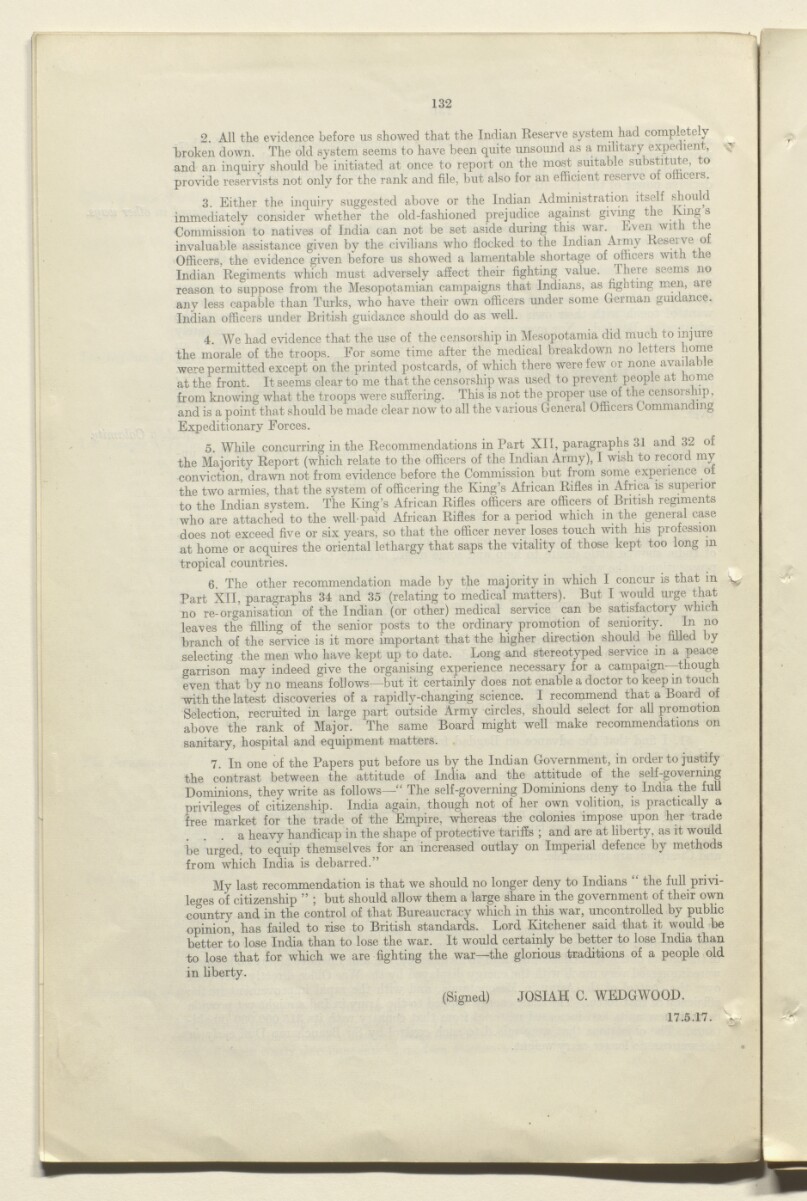
132
2. All the evidence before us showed that the Indian Reserve system had completely
broken down. The old system seems to have been quite unsound as a military expedient,
and an inquiry should be initiated at once to report on the most suitable substitute, to
provide reservists not only for the rank and file, but also for an efficient reserve of officers.
3. Either the inquiry suggested above or the Indian Administration itself should
immediately consider whether the old-fashioned prejudice against giving the King s
Commission to natives of India can not be set aside during this war. Even with tne
invaluable assistance given by the civilians who flocked to the Indian Army Reserve ot
Officers, the evidence given before us showed a lamentable shortage of officers with t le
Indian Regiments which must adversely affect their fighting value, there seems no
reason to suppose from the Mesopotamian campaigns that Indians, as fighting men, are
any less capable than Turks, who have their own officers under some German guidance.
Indian officers under British guidance should do as well.
4. We had evidence that the use of the censorship in Mesopotamia did much to injure
the morale of the troops. For some time after the medical breakdown no letters home
were permitted except on the printed postcards, of which there were few or none available
at the front. It seems clear to me that the censorship was used to prevent people at home
from knowing what the troops were suffering. This is not the proper use of the censorship,
and is a point that should be made clear now to all the various General Officers Commanding
Expeditionary Forces.
5. While concurring in the Recommendations in Part XII, paragraphs 31 and 32 of
the Majority Report (which relate to the officers of the Indian Army), I wish to recoid my
conviction, drawn not from evidence before the Commission but from some experience ot
the two armies, that the system of officering the King’s African Rifles in Africa is superior
to the Indian system. The King’s African Rifles officers are officers of British regiments
who are attached to the well-paid African Rifles for a period which in the general case
does not exceed five or six years, so that the officer never loses touch with his profession
at home or acquires the oriental lethargy that saps the vitality of those kept too long m
tropical countries.
6. The other recommendation made by the majority in which I concur is that in
Part XII, paragraphs 34 and 35 (relating to medical matters). But I would urge that
no re-organisation of the Indian (or other) medical service can be satisfactory which
leaves the filling of the senior posts to the ordinary promotion of seniority. In no
branch of the service is it more important that the higher direction should be filled by
selecting the men who have kept up to date. Long and stereotyped service m a peace
garrison may indeed give the organising experience necessary for a campaign—though
even that by no means follows—but it certainly does not enable a doctor to keep in touch
with the latest discoveries of a rapidly-changing science. I recommend that a Board of
Selection, recruited in large part outside Army circles, should select for all promotion
above the rank of Major. The same Board might well make recommendations on
sanitary, hospital and equipment matters.
7. In one of the Papers put before us by the Indian Government, in order to justify
the contrast between the attitude of India and the attitude of the self-governing
Dominions, they write as follows—“ The self-governing Dominions deny to India the full
privileges of citizenship. India again, though not of her own volition, is practically a
free market for the trade of the Empire, whereas the colonies impose upon her trade
a heavy handicap in the shape of protective tariffs ; and are at libeity, as it would
be urged, to equip themselves for an increased outlay on Imperial defence by methods
from which India is debarred.”
My last recommendation is that we should no longer deny to Indians “ the full privi
leges of citizenship ” ; but should allow them a large share in the government of their own
country and in the control of that Bureaucracy which in this war, uncontrolled by public
opinion, has failed to rise to British standards. Lord Kitchener said that it would be
better to lose India than to lose the war. It would certainly be better to lose India than
to lose that for which we are fighting the war—the glorious traditions of a people old
in liberty.
(Signed) JOSIAH C. WEDGW OOD.
17.5.17. \
About this item
- Content
A signed proof, folios 1-100, plus additional material, folios 101-124. The cover bears the signature of Sir Arthur Hirtzel, Assistant Under-Secretary of State. The report has been annotated in blue pencil at various points.
Contents:
- 'Part I. Preface.
- 'Part II. Origin of Mesopotamia [Iraq] Expedition.'
- 'Part III. Advance from Basra to Kurna.'
- 'Part IV. The Advance to Amara [Al-'Amārah] and Kut [Al-Kūt].'
- 'Part V. Correspondence and Telegrams as to Advance on Baghdad.'
- 'Part VI. The Advance from Kut to Ctesiphon.'
- 'Part VII. Operations for Relief of Kut.'
- 'Part VIII. Armament, Equipment, Reinforcements, &c.'
- 'Part IX. Transport.'
- 'Part X. Medical Breakdown.'
- 'Part XI. Causes Contributing to the Errors of Judgement and Shortcomings of Responsible Authorities.'
- 'Part XII. Findings and Conclusions. Recommendations.'
- 'Separate Report by Commander J Wedgwood, DSO, MP.'
- 'Appendix I. Vincent-Bingley Report.'
- 'Appendix II. Memorandum by Sir Beauchamp Duff.'
- 'Appendix III. Colonel Hehir's Account of the Siege of Kut-el-Amara.'
Additional material:
- Folio 101. Manuscript note [by Arthur Hirtzel] on net military expenditure.
- Folios 102-109. Copy of the East India (Army Administration), Further Papers regarding the Administration of the Army in India , 1906.
- Folios 110-115. Manuscript notes, titled 'Suggested redraft & amplification of second half of parag 1' [unknown hand].
- Folio 116. A clipping from the Daily Telegraph , Wednesday 4 July 1917, featuring an article titled 'Mesopotamia. Ex-Viceroy's Statement. The Medical Breakdown.'
- Folios 117-124. An expanded typescript version of Hirtzel's manuscript notes (folio 101).
- Extent and format
- 1 volume (122 folios)
- Arrangement
A table of contents can be found at folio 4v.
An index can be found at folios 93-97.
- Physical characteristics
Foliation: the foliation sequence commences at the front cover with 1, and terminates at the last folio with 124; these numbers are written in pencil, are circled, and are located in the top right corner of the recto The front of a sheet of paper or leaf, often abbreviated to 'r'. side of each folio. An additional foliation sequence is present in parallel between ff 110-115; these numbers are also written in pencil, but are not circled. Pagination: the file also contains an original printed pagination sequence. The volume comprises a stitched pamphlet, and other stitched and loose-leaf material.
- Written in
- English in Latin script View the complete information for this record
Use and share this item
- Share this item
'Mesopotamia Commission. Report of the Commission Appointed by Act of Parliament to Enquire into the Operations of War in Mesopotamia, together with a Special Report by Commander J Wedgwood, DSO, MP, and Appendices. London: HMSO, 1917.' [67v] (134/248), British Library: India Office Records and Private Papers, IOR/L/PS/20/257, in Qatar Digital Library <https://www.qdl.qa/archive/81055/vdc_100036338403.0x000087> [accessed 22 June 2026]
https://www.qdl.qa/en/archive/81055/vdc_100036338403.0x000087
Copy and paste the code below into your web page where you would like to embed the image.
<meta charset="utf-8"><a href="https://www.qdl.qa/en/archive/81055/vdc_100036338403.0x000087">'Mesopotamia Commission. Report of the Commission Appointed by Act of Parliament to Enquire into the Operations of War in Mesopotamia, together with a Special Report by Commander J Wedgwood, DSO, MP, and Appendices. London: HMSO, 1917.' [‎67v] (134/248)</a> <a href="https://www.qdl.qa/en/archive/81055/vdc_100036338403.0x000087"> <img src="https://iiif.qdl.qa/iiif/images/81055/vdc_100000000912.0x0000b2/IOR_L_PS_20_257_0134.jp2/full/!280,240/0/default.jpg" alt="" /> </a>
This record has a IIIF manifest available as follows. If you have a compatible viewer you can drag the icon to load it.https://www.qdl.qa/en/iiif/81055/vdc_100000000912.0x0000b2/manifestOpen in Universal viewerOpen in Mirador viewerMore options for embedding images
Copyright: How to use this content
- Reference
- IOR/L/PS/20/257
- Title
- 'Mesopotamia Commission. Report of the Commission Appointed by Act of Parliament to Enquire into the Operations of War in Mesopotamia, together with a Special Report by Commander J Wedgwood, DSO, MP, and Appendices. London: HMSO, 1917.'
- Pages
- front, front-i, 2r:115v, 117r:124v
- Author
- East India Company, the Board of Control, the India Office, or other British Government Department
- Usage terms
- Open Government Licence