
Overview
When war broke out in September 1939, the Gulf was a remote yet strategically vital part of Britain’s imperialist network. Though far from the main theatres of combat, the region’s ports, oil installations, and shipping lanes became critical nodes in the global struggle. The India Office The department of the British Government to which the Government of India reported between 1858 and 1947. The successor to the Court of Directors. Records preserved on the Qatar Digital Library trace how the war unfolded on the Gulf’s shores.
A Maritime Frontier
The early years of the war brought sudden instability to the northern Gulf. In 1941 Britain intervened militarily in Iraq after a pro-Axis government seized power in Baghdad and, alongside Soviet forces, invaded Iran. British communications report that German nationals fled Tehran at this time. These operations reshaped the security climate across the wider Gulf. Even though fighting did not reach the Arabian coast, the presence of Axis agents in the region made maritime vigilance essential.
Britain had to secure a long and exposed Gulf coastline with limited naval resources. The capture of enemy cargoes or vessels raised issues of jurisdiction: should they be tried under Admiralty law in Bombay [Mumbai], or could cases be heard locally? Prize courts were judicial bodies established to adjudicate matters related to the capture of enemy vessels, cargo, and other property during wartime. That they could sit in the Gulf itself is only one indication of the region’s significant wartime role.
Archive items in this article




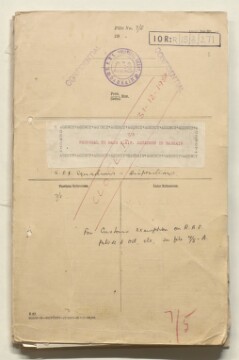

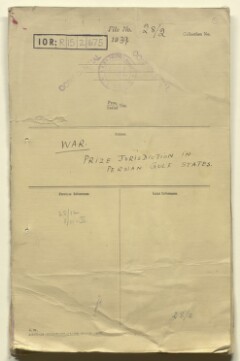


In addition to property, Britain issues instructions for dealing with the subjects of enemy powers. For instance, ‘enemy aliens’ found aboard ‘neutral’ vessels in the Gulf could be removed if ‘engaged […] in collection of military intelligence, in propaganda, or in subversive activities in enemy interests’; if they were shown to be ‘bona fide’ members of the crew then they would not be removed.

Enemy Eyes in the Sky
The war’s reach extended into the air. In the early hours of 19 October 1940 an Italian air raid targeted the Bahrain Petroleum Company (BAPCO) refinery in Bahrain. The bombs, however, fell more than half a mile away from the refinery enclosure, causing ‘no damage or casualties’ (IOR/R/15/2/669, f. 3r). The Government of Bahrain issued a notice to its citizens urging calm and obedience while assuring them of British measures for defence. The Ruler of Sharjah wrote to the Ruler of Bahrain in support, saying ‘this is by the grace of God who turned their bad intentions on their own heads and they have met with failure and evil results’ (IOR/R/15/2/669, f. 34r).
Had German advances at El Alamein or Stalingrad succeeded, both Allied and commercial planners anticipated the need for emergency ‘denial operations’ to destroy oil infrastructure rather than allow it to fall into enemy hands (Macris, p.103). Bahrain’s refinery supplied aviation fuel for British forces across the Middle East and India, and airfields were equally integral links in the Allied war machine. Even before the outbreak of war, the RAF had understood the strategic value of Bahrain’s position and was seeking to establish a squadron base there as early as 1935.

In October 1940, the Political Agent A mid-ranking political representative (equivalent to a Consul) from the diplomatic corps of the Government of India or one of its subordinate provincial governments, in charge of a Political Agency. in Bahrain, Major Reginald Alban, requested that Shaikh Hamad, Ruler of Bahrain, extend customs duty exemptions on petrol and oil for RAF aircraft landing in Bahrain for the duration of the war. His request emphasizes that the RAF’s objectives include ‘the protection of Bahrain’ (IOR/L/PS/12/1998, f. 6r). Shaikh Hamad agreed.
Oil, Strategy, and Imperialist Calculations
British political officers had long predicted the rising importance of Gulf oil. In a prescient 1938 memorandum, Major Trenchard Fowle, the Political Resident A senior ranking political representative (equivalent to a Consul General) from the diplomatic corps of the Government of India or one of its subordinate provincial governments, in charge of a Political Residency. , envisaged a chain of oilfields ‘from Koweit [sic] to Muscat’ that would be under British control (IOR/R/15/2/762, f. 46r). It was in part due to the ‘possibility of oil being found’ that the British Government committed to defending Qatar from outside attack, since this was deemed important for ‘Empire oil fuel supplies’ (IOR/L/PS/12/3936, f. 9r). Writing to the Air Officer Commanding in Iraq, Fowle particularly recommends cultivating the Shaik of Qatar’s tribal loyalty, noting that ‘the Shaik’s fear of and antipathy towards the Saudi Government […] should serve to ensure a reasonable standard of co-operation by him in any defensive measures’ (IOR/L/PS/12/3936, f. 23r).

British efforts to secure oil resources increasingly intersected with emerging American interests in the region, particularly in Saudi Arabia, laying the groundwork for post-war Anglo-American tensions over influence and energy security in the Gulf.
Trade and Defence Measures
Wartime economic controls were another key dimension. British officials tried to curb the flow of goods that might otherwise reach enemy markets through smuggling. Weekly reports from the Persian Gulf The historical term used to describe the body of water between the Arabian Peninsula and Iran. War Trade Bureau summarised attempts to regulate imports, exports, and re-exports between the Gulf and Iran, particularly sugar, textiles, and petrol.
Likewise, the Political Resident A senior ranking political representative (equivalent to a Consul General) from the diplomatic corps of the Government of India or one of its subordinate provincial governments, in charge of a Political Residency. introduced new Defence Regulations in 1939 aimed at maintaining public order and security in the Gulf. These regulations applied to territories under the Shaikhdoms of Kuwait, Bahrain, Qatar, and the Sultanate of Muscat and Oman. They included provisions for controlling enemy aliens, restricting trade with enemy entities, and securing strategic locations. For example, the Political Resident A senior ranking political representative (equivalent to a Consul General) from the diplomatic corps of the Government of India or one of its subordinate provincial governments, in charge of a Political Residency. could declare an area as a ‘protected place’ to ‘prevent the entry of unauthorized persons’ (IOR/R/15/2/166, f. 62v).
From 1941, the Gulf and Iran also formed a vital transit corridor for American Lend-Lease supplies bound for the Soviet Union. Lend-Lease was a program through which the US provided military aid to its allies (without immediate payment) to support their fight against Axis powers.
Information and Propaganda
By 1944, as Allied fortunes improved, British attention shifted from defence to political influence. Propaganda efforts are well documented in British correspondence from this time. Among these wartime initiatives, information and propaganda networks across the region produced magazines in different languages, including Al Arab and Al Nafir targeting Gulf audiences.

These initiatives make sense when viewed against the wider wartime landscape. Political reshuffling in Iraq and Iran had shown how quickly the region could be destabilised by external propaganda. British officials therefore saw information control as a crucial complement to legal, military, and economic measures.
Aftermath and Conclusion
Following the Second World War, there were critical shortages of essential goods and infrastructure in the Gulf, particularly Kuwait and Bahrain. For instance, the Kuwait Electric Supply Company faced delays in receiving new electric supply equipment, with orders placed in early 1946 delayed by up to eighteen months. This led to concerns that ‘the existing plant in Kuwait is inadequate to meet present demands’, far less the demands likely to arise with the expansion of the Kuwait Oil Company (IOR/L/PS/12/1010, f. 121r). Trade relations were also a focus. Muscat merchants were keen to resume importing goods like cotton and cement from Japan, but British authorities preferred imports to come from Commonwealth countries and the United Kingdom.
Alongside the expansion of British wartime controls, the conflict also focused American strategic attention on the Gulf for the first time, driven by concerns over oil security and wartime logistics. This contributed to a sustained American presence in the region after 1945.
Related Articles
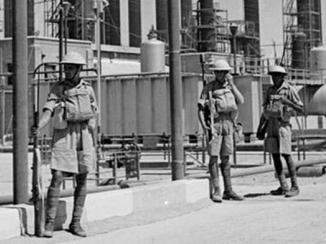
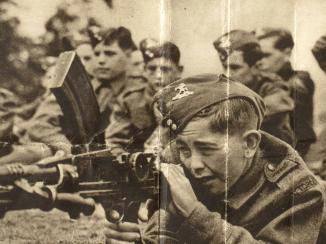


The Second World War did not bring large-scale combat to the Gulf, but it reshaped the region’s political and strategic landscape. The QDL’s records on prize law, defence measures, trade control, and propaganda reveal how this global war transformed the Gulf from a quiet corner of empire into a vital corridor of oil, air power, and communication – a role it still holds today.