
Overview
The development of photography in the nineteenth century coincided with the rapid expansion of colonialism. The camera was employed in every aspect of the colonial mission over extensive periods of time to record and control people, land, sea, and trade. Much like the gun, the camera is used to ‘shoot’, ‘take’, and ‘capture’.
Archive items in this article


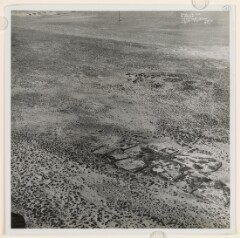
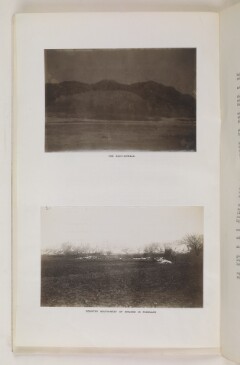
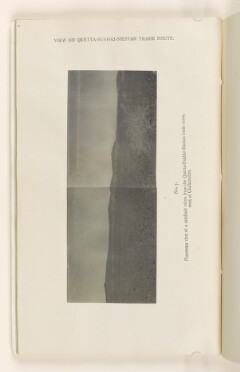


From top, running left to right they show:
Chahsundan in Western Pakistan. Photographer unknown, 1901. Mss Eur F111/377, f. 32v
Mount Khvajah in Sistan. Photographer unknown, 1894. Mss Eur F111/298, f 9 1
Hong Kong. Photographer unknown, 1898. The National Archives, CO 1069-480-15. Used under the terms of CC BY-NC
Jebel Tubaik. Photographer unknown, 1920s. The National Archives, CO 1069-732-11. Used under the terms of CC BY-NC
Walvis Bay in Namibia. Photographer unknown, 1898. The National Archives, CO 1069-212-3. Used under the terms of CC BY-NC
Straight lines
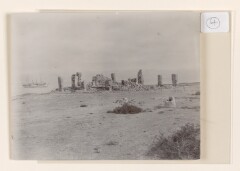
Landscape photographs in colonial records are often unassuming. These photographs of straight lines and empty landscapes seem harmless. When people are included, they are in the distance, appearing as anonymous and interchangeable characters on the colonial stage. They sometimes include ruins, becoming depictions of lands that yearn for their former glory. Such images appear in the records of all the European empires, rendering Africa, India, the Middle East, Asia, the Caribbean – places of vastly different cultures and topographies – as if they are the same, thanks to the camera. Instead of individual geographies, a great diversity of peoples and lands are imprisoned together in the same category of “other”.
Moreover, colonial landscape photographs are significant because of what is not there. In Australia in 1904, the photographer John Lindt described the landscape there as being like ‘the morning of time’ (qtd. in Hore). Using this biblical quotation elicits a comparison between these geographies and God’s creation of the world. With so much apparent emptiness, the Christian colonialist imagination can work to fill these landscapes, and the photographs serve to legitimise the “need” for a “civilising” colonial mission. This idea allows the camera to disguise ‘the ancestral ownership and continuing presence of First Nations peoples, turning their homelands into a wilderness through a photographic sleight of hand’ (Hore).

From top left, they depict:
Musandam, Oman. Captured by Wilfrid Malleson, 1906. IOR/L/PS/20/C260, f 49 2
Cyprus. Photographer unknown, 1890-1910. The National Archives, CO 1069-695-1. Used under the terms of CC BY-NC
Starling Inlet, Hong Kong. Photographer unknown, 1898. The National Archives, CO 1069-452-06. Used under the terms of CC BY-NC
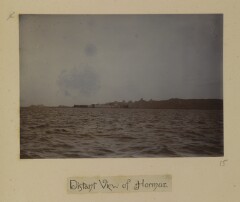
Hormuz Island. Photographer unknown, 1903. Photo 49/1/15
Tristan Island. Photographer unknown, 1903. The National Archives, CO 1069-775-2. Used under the terms of CC BY-NC
Sea and Air
The gap between what is real and what is photographed can also be exacerbated by physical conditions. For instance, the various technological limits of film cameras, from their invention in 1826 and throughout the twentieth century, increased the chance of images being poorly exposed and out-of-focus. The position of the photographer could also compound the gap. Both aerial photographs and those taken from on board ships necessarily involved a literal distance between the photographer and the land. These were, moreover, more technologically challenging photographs, making it more likely that the resulting images were blurry or poorly exposed. Consequently, these photographs of distant lands taken from on board ships routinely present an endless homogenous coast, ripe for conquest.
These factors all contributed to creating what Edward Said in Orientalism terms an ‘imaginative geography’, which can then be perceived in a way to suit the colonial mind-set. This mind-set decides not only what should and should not be photographed, but also how it should be depicted. Flattening and emptying place after place in image after image, colonial photography set and reinforced the parameters for how places “should” be photographed. The visual tropes persist today in modern tourism photography. Reduced to a digestible series of lines, places are rendered “knowable”, and once known, they can be understood and controlled.

From top left, they depict:
Nibak, between Saudi Arabia and Qatar. Photographed by the Royal Air Force, 1935. IOR/R/15/1/606, f. 81r
Kaduna town, Nigeria. Photographer unknown, 1930. The National Archives, CO 1069-62-99. Used under the terms of CC BY-NC
Beni Bu Ali Fort, Oman. Captured by RAF, 1932. IOR/R/15/1/444, f. 128kr
Palestine. Captured by American Colony (Jerusalem). Photo Department, photographer, c. 1900-20. Library of Congress, Prints & Photographs Division, LC-DIG-matpc-05583. Public domain
The Colonial Past
A photograph is never just one thing. It can be cropped, changed, and decontextualised to suit personal and/or political motivations. Attempting to describe a photograph as something singular ignores its many parts. Instead of seeing photographs as colonial objects, we should instead ask whether we can identify a colonial past within them. Only then can we begin to see how pervasive and insidious colonialism was, and how its effects are still felt and underestimated today. As anthropologist and art historian Christopher Pinney puts it, ‘colonialism refuses historiographical compartmentalization’ (p. 382). Then as now, it extends ever outwards, through supposedly empty spaces, beyond their horizons, and into the future.
Related Articles


From top left, they depict:
The Old Portuguese Fort or Qal‘at al-Bahrain. Photographer unknown, c. 1870. Photo 355/1/39
Fort Apollonia in Beyin, Ghana. Photographer unknown, 1901. The National Archives, CO 1069-34-1. Used under the terms of CC BY-NC
Ruins of a mess house in Basaidu. Photographer unknown, 1901. Mss Eur F111/354, f. 4r
Ruins at the Copper mines, in the Virgin Islands. Photographer unknown, 1887. The National Archives, CO 1069-408-9. Used under the terms of CC BY-NC