
![Annotated Copy of <em>Persia and the Persian Question</em> by George Curzon, with Inserted Papers [‎438r] (878/1814)](https://iiif.qdl.qa/iiif/images/81055/vdc_100000001491.0x00033b/Mss Eur F111_33_0890.jp2/full/!1200,1200/0/default.jpg "Annotated Copy of <em>Persia and the Persian Question</em> by George Curzon, with Inserted Papers [‎438r] (878/1814)")
Annotated Copy of Persia and the Persian Question by George Curzon, with Inserted Papers [438r] (878/1814)
The record is made up of 2 volumes with inserts (898 folios). It was created in 1892-1924. It was written in English, Urdu and German. The original is part of the British Library: India Office The department of the British Government to which the Government of India reported between 1858 and 1947. The successor to the Court of Directors. Records and Private Papers Documents collected in a private capacity. .
Transcription
This transcription is created automatically. It may contain errors.
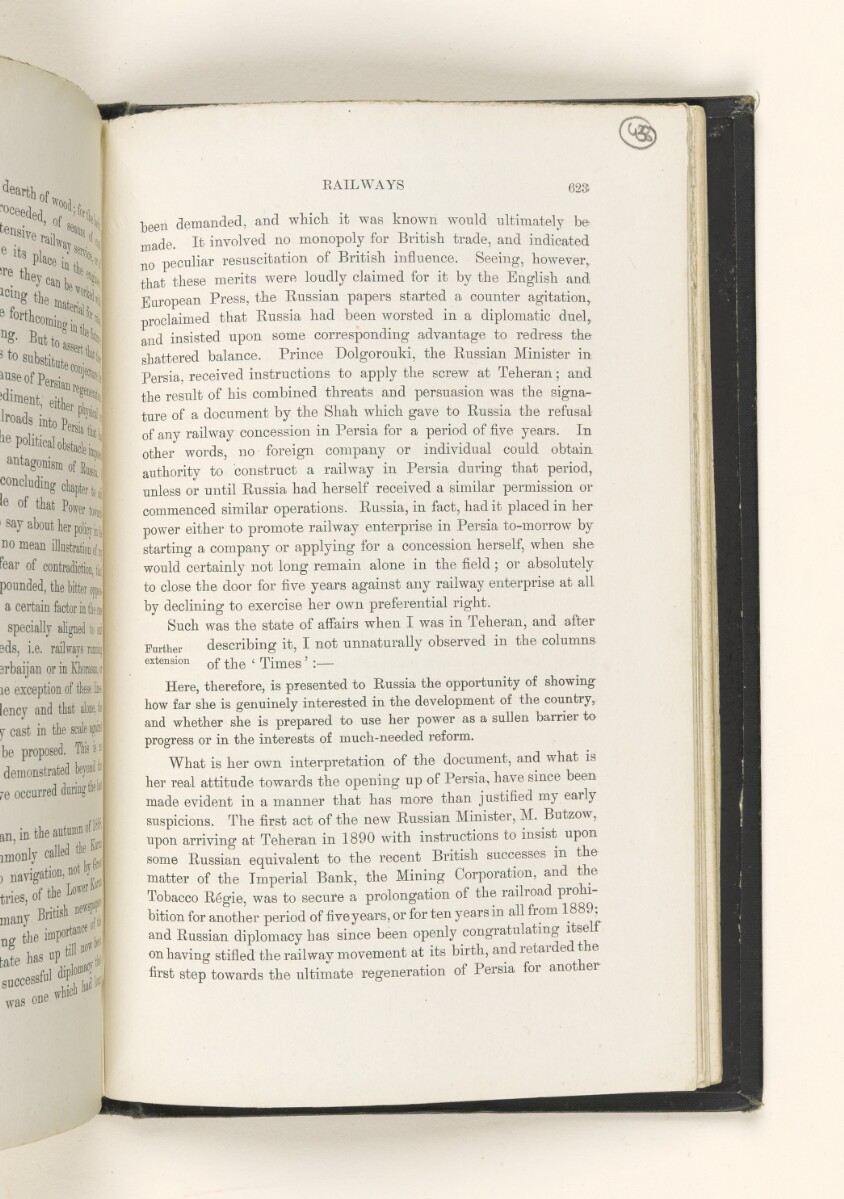
RAILWAYS
623
concluding chapfe. |, j
e of that Power ta
say about her polity n
no mean illustrationt! t
fear of contradict* 1 *
pounded, the bitter op
a certain factor in Ice
specially aligned to at
sds, i.e. railways riiif
srbaijan or in Kkaat
re exception of these k
[ency and that alone, 4
y cast in the scale ag*
be proposed. This is -
demonstrated bey«l*
/e occurred during tl* 1 -
laeen demanded, and which it was known would ultimately be
made. It involved no monopoly for British trade, and indicated
n o peculiar resuscitation of Britisli influence. Seeing, however,
that these merits were loudly claimed for it by the English and
European Press, the Russian papers started a counter agitation^
proclaimed that Russia had been worsted in a diplomatic duel y
and insisted upon some corresponding advantage to redress the
shattered balance. Prince Dolgorouki, the Russian Minister in
Persia, received instructions to apply the screw at Teheran; and
the result of his combined threats and persuasion was the signa
ture of a document by the Shah which gave to Russia the refusal
of any railway concession in Persia for a period of five years. In
other words, no foreign company or individual could obtain
authority to construct a railway in Persia during that period,
unless or until Russia had herself received a similar permission or
commenced similar operations. Russia, in fact, had it placed in her
power either to promote railway enterprise in Persia to-morrow by
starting a company or applying for a concession herself, when she
would certainly not long remain alone in the field ; or absolutely
to close the door for five years against any railway enterprise at all
by declining to exercise her own preferential right.
Such was the state of affairs when I was in Teheran, and after
Further describing it, I not unnaturally observed in the columns
extension of t p e < Times 5 :—
Here, therefore, is presented to Russia the opportunity of showing
how far she is genuinely interested in the development of the country,
and whether she is prepared to use her power as a sullen barrier to
progress or in the interests of much-needed reform.
What is her own interpretation of the document, and what is
her real attitude towards the opening up of Persia, have since been
made evident in a manner that has more than justified my early
suspicions. The first act of the new Russian Minister, M. Butzow,
upon arriving at Teheran in 1890 with instructions to insist upon
some Russian equivalent to the recent British successes in the
matter of the Imperial Bank, the Mining Corporation, and the
Tobacco Regie, was to secure a prolongation of the railroad prohi
bition for another period of five years, or for ten years in all from 1889,
and Russian diplomacy has since been openly congratulating itse
on having stifled the railway movement at its birth, and ictaide t e
first step towards the ultimate regeneration of Persia for anot er
About this item
- Content
These two volumes are George Curzon's own personal annotated copies of both volumes of his book Persia and the Persian Question , which was published in 1892. Alongside the volumes are various loose papers relating to Persia [Iran], consisting of the following: received correspondence; newspaper cuttings; publishers' press releases; cuttings from various booksellers' catalogues; various journal and magazine articles; two items of printed official British correspondence; several prints of photographs and sketches; and a few handwritten notes by Curzon.
In most cases these papers, which range in date from 1892 to 1924, relate to the chapters in the book where they were originally inserted, suggesting that they were kept by Curzon with the intention of using them to inform a revised edition of the book.
Of particular note among the small amount of correspondence are two letters received by Curzon in 1914 and 1915 from retired schoolmaster and Islamic scholar Sayyid Mazhar Hasan Musawi of Saharanpur, Uttar Pradesh, India (ff 5-9 and ff 44-53). These letters, which are written in Urdu and are accompanied by English translations, discuss in detail several inaccuracies found in the Urdu version of Persia and the Persian Question .
The various prints of photographs and sketches, which were originally inserted into volume two, are of different locations in the Gulf region. Several of these appear to have been produced in preparation for the publication of the second volume of John Gordon Lorimer's Gazetteer of the Persian Gulf The historical term used to describe the body of water between the Arabian Peninsula and Iran. , Oman and Central Arabia (i.e. the 'Geographical and Statistical' section) in 1908, as they are identical to the versions found in that volume.
Also of note among the loose papers are an illustrated article from Country Life dated 5 June 1920, entitled 'The People of Persia' (ff 36-37), and a printed family tree of the Shah of Persia [Aḥmad Shah Qājār], produced in preparation of his visit to Britain in 1919 (f 233).
Volume one of Persia and the Persian Question contains a map of Persia, Afghanistan and Beluchistan [Balochistan], which is folded inside the front cover (f 1).
The German language material consists of a publisher's press release for two books authored by German archaeologist Ernst Emil Herzfeld (ff 29-30).
- Extent and format
- 2 volumes with inserts (898 folios)
- Physical characteristics
Foliation: this shelfmark consists of two physical volumes. The foliation sequence commences at the first folio of volume one (1-463), and terminates at the last folio of volume two (ff 464-898); these numbers are written in pencil, are circled, and are located in the top right corner of the recto The front of a sheet of paper or leaf, often abbreviated to 'r'. side of each folio. Each volume contains a large number of loose leaves, which have been foliated in the order that they were inserted into the volume; for conservation reasons, these loose folios have been removed from the volume and stored separately. The foliation sequence does not include the front and back covers of the two volumes.
Pagination: the file also contains an original printed pagination sequence.
- Written in
- English, Urdu and German in Latin and Arabic script View the complete information for this record
Use and share this item
- Share this item
Annotated Copy of Persia and the Persian Question by George Curzon, with Inserted Papers [438r] (878/1814), British Library: India Office Records and Private Papers, Mss Eur F111/33, in Qatar Digital Library <https://www.qdl.qa/archive/81055/vdc_100157213846.0x000055> [accessed 27 August 2026]
https://www.qdl.qa/en/archive/81055/vdc_100157213846.0x000055
Copy and paste the code below into your web page where you would like to embed the image.
<meta charset="utf-8"><a href="https://www.qdl.qa/en/archive/81055/vdc_100157213846.0x000055">Annotated Copy of <em>Persia and the Persian Question</em> by George Curzon, with Inserted Papers [‎438r] (878/1814)</a> <a href="https://www.qdl.qa/en/archive/81055/vdc_100157213846.0x000055"> <img src="https://iiif.qdl.qa/iiif/images/81055/vdc_100000001491.0x00033b/Mss Eur F111_33_0890.jp2/full/!280,240/0/default.jpg" alt="" /> </a>
This record has a IIIF manifest available as follows. If you have a compatible viewer you can drag the icon to load it.https://www.qdl.qa/en/iiif/81055/vdc_100000001491.0x00033b/manifestOpen in Universal viewerOpen in Mirador viewerMore options for embedding images
Copyright: How to use this content
- Reference
- Mss Eur F111/33
- Title
- Annotated Copy of Persia and the Persian Questionby George Curzon, with Inserted Papers
- Pages
- 54r:135v, 147r:149v, 158r:180v, 183r:221v, 224r:224v, 227r:246v, 248r:257v, 259r:260v, 268r:362v, 364r:364v, 367r:388v, 390r:400v, 402r:416v, 419r:432v, 434r:444v, 448r:462v, 464r:471v, 475r:481v, 483r:513v, 516r:525v, 527r:544v, 546r:563v, 566r:598v, 600r:622v, 624r:656v, 658r:665v, 667r:675v, 678r:684v, 687r:688v, 691r:691v, 693r:693v, 695r:708v, 711r:721v, 724r:726v, 728r:729v, 731r:736v, 742r:742v, 746r:757v, 759r:761v, 763r:763v, 765r:765v, 772r:777v, 780r:789v, 793r:794v, 797r:809v, 811r:821v, 825r:840v, 843r:898v
- Author
- Curzon, George Nathaniel, 1st Marquess Curzon of Kedleston
- Usage terms
- Public Domain