
![Annotated Copy of <em>Persia and the Persian Question</em> by George Curzon, with Inserted Papers [‎289v] (581/1814)](https://iiif.qdl.qa/iiif/images/81055/vdc_100000001491.0x00033b/Mss Eur F111_33_0592.jp2/full/!1200,1200/0/default.jpg "Annotated Copy of <em>Persia and the Persian Question</em> by George Curzon, with Inserted Papers [‎289v] (581/1814)")
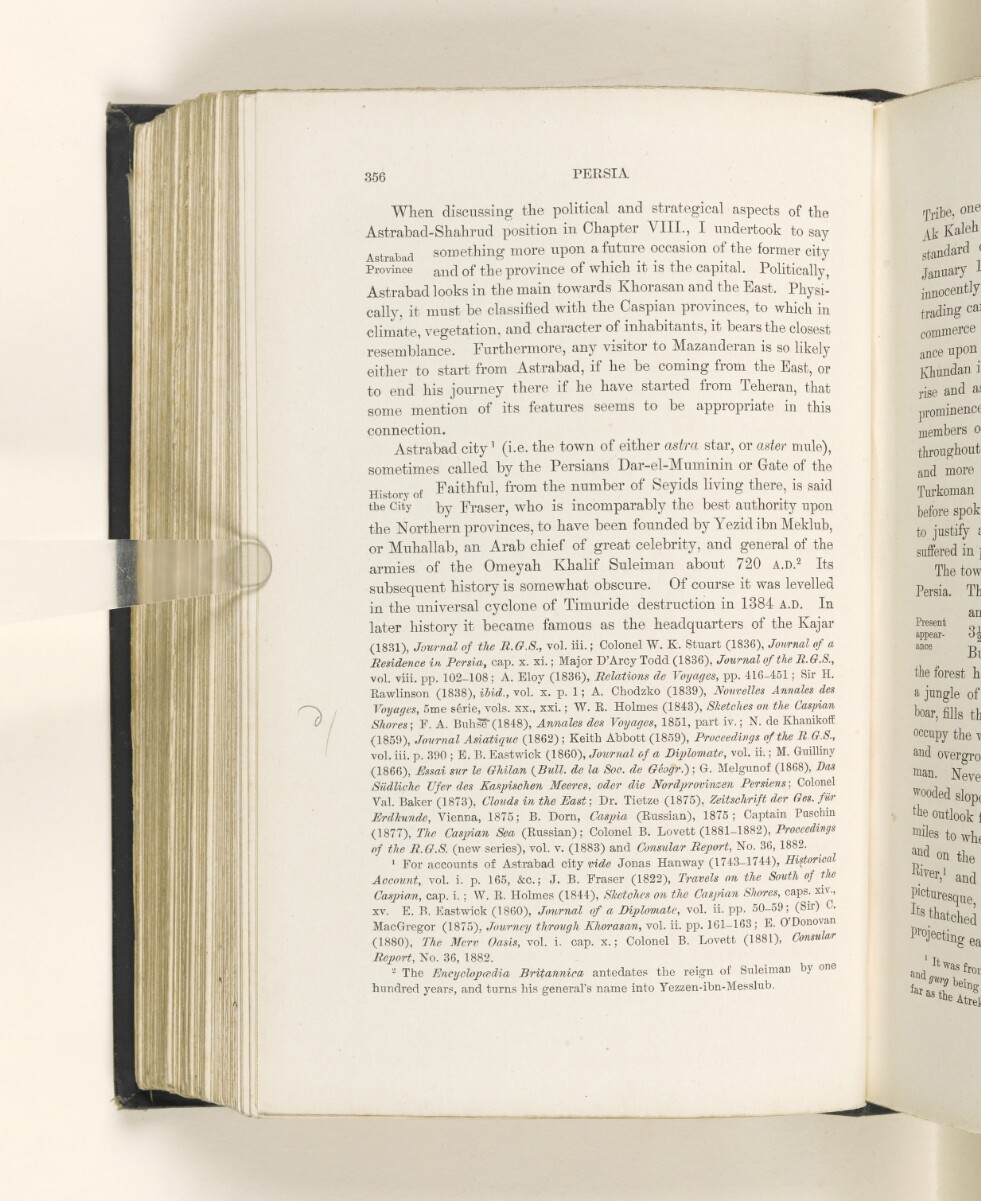
Annotated Copy of Persia and the Persian Question by George Curzon, with Inserted Papers [289v] (581/1814)
The record is made up of 2 volumes with inserts (898 folios). It was created in 1892-1924. It was written in English, Urdu and German. The original is part of the British Library: India Office The department of the British Government to which the Government of India reported between 1858 and 1947. The successor to the Court of Directors. Records and Private Papers Documents collected in a private capacity. .
Transcription
This transcription is created automatically. It may contain errors.
356 PERSIA
When discussing the political and strategical aspects of the
Astrabad-Shahrnd position in Chapter VIII., I undertook to say
Astrabad something more upon a future occasion of the former city
Province and of the province of which it is the capital. Politically,
Astrabad looks in the main towards Khorasan and the East. Physi
cally, it must be classified with the Caspian provinces, to which in
climate, vegetation, and character of inhabitants, it bears the closest
resemblance. Furthermore, any visitor to Mazanderan is so likely
either to start from Astrabad, if he be coming from the East, or
to end his journey there if he have started from Teheran, that
some mention of its features seems to be appropriate in this
connection.
Astrabad city 1 (i.e. the town of either astra star, or aster mule),
sometimes called by the Persians Far-el-jVfuminm or Gate of the
TT . , , Faithful, from the number of Seyids living there, is said
the City Ry Fraser, who is incomparably the best authority upon
the Northern provinces, to have been founded by YezidibnMeklub,
or Muhallab, an Arab chief of great celebrity, and general of the
armies of the Omeyah Khalif Suleiman about 720 a.d . 2 Its
subsequent history is somewhat obscure. Of course it was levelled
in the universal cyclone of Timuride destruction in 1384 a.d. In
later history it became famous as the headquarters of the Kajar
(1831), Journal of the R.G.S., vol. iii.; Colonel W. K. Stuart (1836), Journal of a
Residence in Persia, cap. x. xi.; Major D’ArcyTodd (1836), Journal of the R.G.S.,
vol. viii. pp. 102-108; A. Eloy (1836), Relations de Voyages, pp. 416-451; Sir H.
Rawlinson (1838), Hid., vol. x. p. 1; A. Chodzko (1839), Nouvelles Annales des
Voyages, 5 me serie, vols. xx., xxi.; W. R. Holmes (1843), Sketches on the Caspian
Shores', F. A. BuhsT(1848), Annales des Voyages, 1851, part iv.; N. de Khanikoff
(1859), Journal Asiatique (1862) ; Keith Abbott (1859), Proceedings of the R.G.S.,
vol. iii. p. 390 ; E. B. Eastwick (1860), Journal of a Diplomate, vol. ii.; M. Guilliny
(1866), JEssai sur le Ghila.n {Bull, de la Soc. de Geogr.) ; G. Melgunof (1868), Pas
Sudliehe TJfer des Kaspisehen Meeres, oder die Nordprovinzen Persiens ; Colonel
Val. Baker (1873), Clouds in the East', Dr. Tietze (1875), Zeitschrift der Ges. fur
Erdhunde, Vienna, 1875; B. Dorn, Caspia (Russian), 1875; Captain Puschin
(1877), The Caspian Sea (Russian); Colonel B. Lovett (1881-1882),
of the R.G.S. (new series), vol. v. (1883) and Consular Report, No. 36, 1882.
1 For accounts of Astrabad city vide Jonas Hanway (1743-1744), Historical
Account, vol. i. p. 165, &c.; J. B. Fraser (1822), Travels on the South of the
Caspian, cap. i. ; W. R. Holmes (1844), Sketches on the Caspian Shores, caps, xiv.,
xv. E. B. Eastwick (1860), Journal of a Diplomate, vol. ii. pp. 50-59; (Sir) C.
MacGregor (1875), Journey through Khorasan, vol. ii. pp. 161-163; E. O Donovan
(1880), The Merv Oasis, vol. i, cap. x.; Colonel B. Lovett (1881), Consular
Report, No. 36, 1882.
2 The Encyclopcedia Britannica antedates the reign of Suleiman b} one
hundred years, and turns his general’s name into Yezzen-ibn-Messlub,
Tribe, one
K aleh
standard <
January 1
innocently
trading cai
commerce
a nce upon
KFundan i
rise and a^
prominence
members o
throughout
and more
Turkoman
before spok
to justify c
suffered in ]
The tow
Persia. Th
an
Present 0
appear-
anee
the forest h;
a jungle of
boar, fills th
occupy the v
and overgro
man. Neve:
wooded slop(
Ihe outlook 1
mi les to whc
an d on the
^ 1Ver ) 1 and
Pictiire S q lle)
its thatched
Ejecting e a
About this item
- Content
These two volumes are George Curzon's own personal annotated copies of both volumes of his book Persia and the Persian Question , which was published in 1892. Alongside the volumes are various loose papers relating to Persia [Iran], consisting of the following: received correspondence; newspaper cuttings; publishers' press releases; cuttings from various booksellers' catalogues; various journal and magazine articles; two items of printed official British correspondence; several prints of photographs and sketches; and a few handwritten notes by Curzon.
In most cases these papers, which range in date from 1892 to 1924, relate to the chapters in the book where they were originally inserted, suggesting that they were kept by Curzon with the intention of using them to inform a revised edition of the book.
Of particular note among the small amount of correspondence are two letters received by Curzon in 1914 and 1915 from retired schoolmaster and Islamic scholar Sayyid Mazhar Hasan Musawi of Saharanpur, Uttar Pradesh, India (ff 5-9 and ff 44-53). These letters, which are written in Urdu and are accompanied by English translations, discuss in detail several inaccuracies found in the Urdu version of Persia and the Persian Question .
The various prints of photographs and sketches, which were originally inserted into volume two, are of different locations in the Gulf region. Several of these appear to have been produced in preparation for the publication of the second volume of John Gordon Lorimer's Gazetteer of the Persian Gulf The historical term used to describe the body of water between the Arabian Peninsula and Iran. , Oman and Central Arabia (i.e. the 'Geographical and Statistical' section) in 1908, as they are identical to the versions found in that volume.
Also of note among the loose papers are an illustrated article from Country Life dated 5 June 1920, entitled 'The People of Persia' (ff 36-37), and a printed family tree of the Shah of Persia [Aḥmad Shah Qājār], produced in preparation of his visit to Britain in 1919 (f 233).
Volume one of Persia and the Persian Question contains a map of Persia, Afghanistan and Beluchistan [Balochistan], which is folded inside the front cover (f 1).
The German language material consists of a publisher's press release for two books authored by German archaeologist Ernst Emil Herzfeld (ff 29-30).
- Extent and format
- 2 volumes with inserts (898 folios)
- Physical characteristics
Foliation: this shelfmark consists of two physical volumes. The foliation sequence commences at the first folio of volume one (1-463), and terminates at the last folio of volume two (ff 464-898); these numbers are written in pencil, are circled, and are located in the top right corner of the recto The front of a sheet of paper or leaf, often abbreviated to 'r'. side of each folio. Each volume contains a large number of loose leaves, which have been foliated in the order that they were inserted into the volume; for conservation reasons, these loose folios have been removed from the volume and stored separately. The foliation sequence does not include the front and back covers of the two volumes.
Pagination: the file also contains an original printed pagination sequence.
- Written in
- English, Urdu and German in Latin and Arabic script View the complete information for this record
Use and share this item
- Share this item
Annotated Copy of Persia and the Persian Question by George Curzon, with Inserted Papers [289v] (581/1814), British Library: India Office Records and Private Papers, Mss Eur F111/33, in Qatar Digital Library <https://www.qdl.qa/archive/81055/vdc_100157213844.0x0000bc> [accessed 1 August 2026]
https://www.qdl.qa/en/archive/81055/vdc_100157213844.0x0000bc
Copy and paste the code below into your web page where you would like to embed the image.
<meta charset="utf-8"><a href="https://www.qdl.qa/en/archive/81055/vdc_100157213844.0x0000bc">Annotated Copy of <em>Persia and the Persian Question</em> by George Curzon, with Inserted Papers [‎289v] (581/1814)</a> <a href="https://www.qdl.qa/en/archive/81055/vdc_100157213844.0x0000bc"> <img src="https://iiif.qdl.qa/iiif/images/81055/vdc_100000001491.0x00033b/Mss Eur F111_33_0592.jp2/full/!280,240/0/default.jpg" alt="" /> </a>
This record has a IIIF manifest available as follows. If you have a compatible viewer you can drag the icon to load it.https://www.qdl.qa/en/iiif/81055/vdc_100000001491.0x00033b/manifestOpen in Universal viewerOpen in Mirador viewerMore options for embedding images
Copyright: How to use this content
- Reference
- Mss Eur F111/33
- Title
- Annotated Copy of Persia and the Persian Questionby George Curzon, with Inserted Papers
- Pages
- 54r:135v, 147r:149v, 158r:180v, 183r:221v, 224r:224v, 227r:246v, 248r:257v, 259r:260v, 268r:362v, 364r:364v, 367r:388v, 390r:400v, 402r:416v, 419r:432v, 434r:444v, 448r:462v, 464r:471v, 475r:481v, 483r:513v, 516r:525v, 527r:544v, 546r:563v, 566r:598v, 600r:622v, 624r:656v, 658r:665v, 667r:675v, 678r:684v, 687r:688v, 691r:691v, 693r:693v, 695r:708v, 711r:721v, 724r:726v, 728r:729v, 731r:736v, 742r:742v, 746r:757v, 759r:761v, 763r:763v, 765r:765v, 772r:777v, 780r:789v, 793r:794v, 797r:809v, 811r:821v, 825r:840v, 843r:898v
- Author
- Curzon, George Nathaniel, 1st Marquess Curzon of Kedleston
- Usage terms
- Public Domain