
![Annotated Copy of <em>Persia and the Persian Question</em> by George Curzon, with Inserted Papers [‎275r] (552/1814)](https://iiif.qdl.qa/iiif/images/81055/vdc_100000001491.0x00033b/Mss Eur F111_33_0563.jp2/full/!1200,1200/0/default.jpg "Annotated Copy of <em>Persia and the Persian Question</em> by George Curzon, with Inserted Papers [‎275r] (552/1814)")
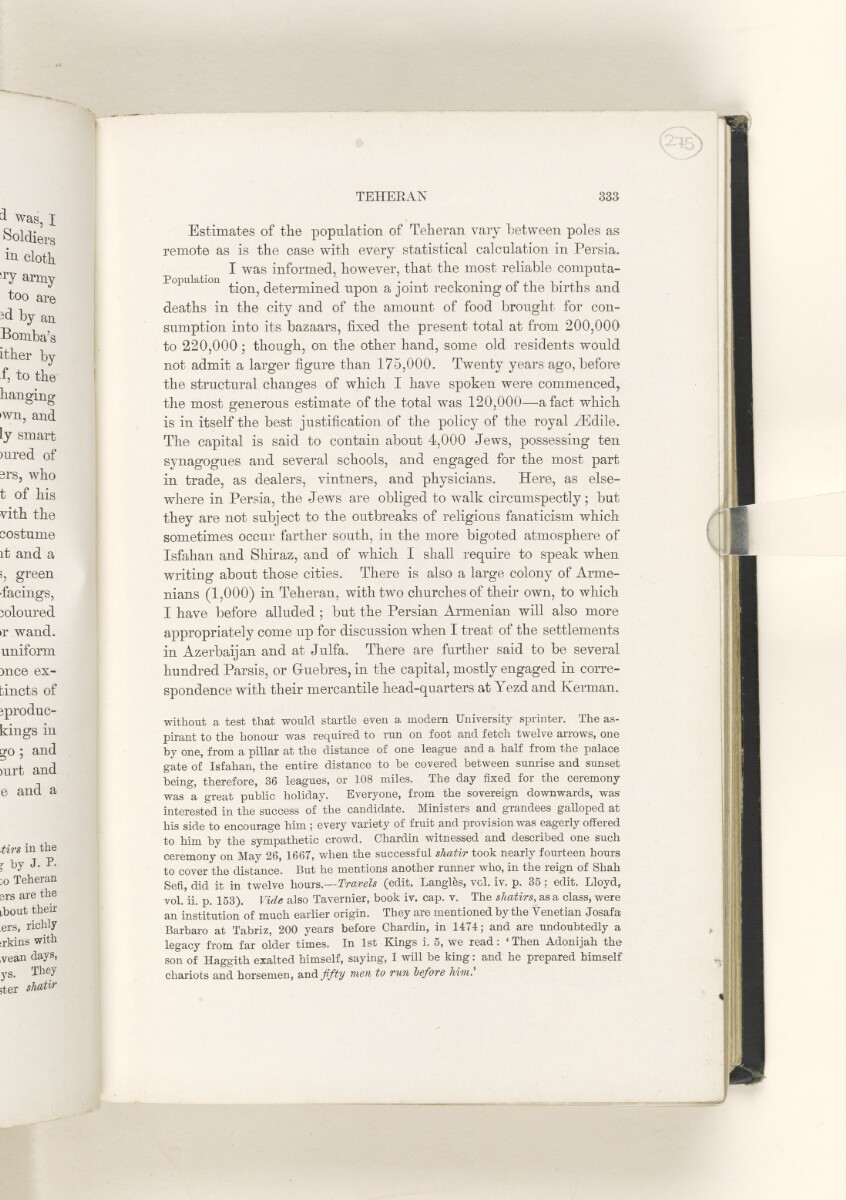
Annotated Copy of Persia and the Persian Question by George Curzon, with Inserted Papers [275r] (552/1814)
The record is made up of 2 volumes with inserts (898 folios). It was created in 1892-1924. It was written in English, Urdu and German. The original is part of the British Library: India Office The department of the British Government to which the Government of India reported between 1858 and 1947. The successor to the Court of Directors. Records and Private Papers Documents collected in a private capacity. .
Transcription
This transcription is created automatically. It may contain errors.
TEHERAN
333
Estimates of the population of Teheran vary between poles as
remote as is the case with every statistical calculation in Persia.
I was informed, however, that the most reliable computa-
Population determined upon a joint reckoning of the births and
deaths in the city and of the amount of food brought for con
sumption into its bazaars, fixed the present total at from 200,000
to 220,000 ; though, on the other hand, some old residents would
not admit a larger figure than 175,000. Twenty years ago, before
the structural changes of which I have spoken were commenced,
the most generous estimate of the total was 120,000—a fact which
is in itself the best justification of the policy of the royal HEdile.
The capital is said to contain about 4,000 Jews, possessing ten
synagogues and several schools, and engaged for the most part
in trade, as dealers, vintners, and physicians. Here, as else-
where in Persia, the Jews are obliged to walk circumspectly; but
they are not subject to the outbreaks of religious fanaticism which
sometimes occur farther south, in the more bigoted atmosphere of
Isfahan and Shiraz, and of which I shall require to speak when
writing about those cities. There is also a large colony of Arme
nians (1,000) in Teheran, with two churches of their own, to which
I have before alluded ; but the Persian Armenian will also more
appropriately come up for discussion when I treat of the settlements
in Azerbaijan and at Julfa. There are further said to be several
hundred Parsis, or Guebres, in the capital, mostly engaged in corre
spondence with their mercantile head-quarters at Yezd and Kerman.
without a test that would startle even a modern University sprinter. The as
pirant to the honour was required to run on foot and fetch twelve anows, one
by one, from a pillar at the distance of one league and a half from the palace
gate of Isfahan, the entire distance to be covered between sunrise and sunset
being, therefore, 36 leagues, or 108 miles. The day fixed for the ceremony
was a great public holiday. Everyone, from the sovereign downwards, was
interested in the success of the candidate. Ministers and grandees galloped at
his side to encourage him ; every variety of fruit and provision was eagerly offered
to him by the sympathetic crowd. Chardin witnessed and described one such
ceremony on M!ny 26, 166T, when the successful shatiT took nearly fourteen hours
to cover the distance. But he mentions another runner who, in the reign of Shah
Sefi, did it in twelve hours.—Travels (edit. Bangles, vcl. iv. p. 35 ; edit. Lloyd,
vol. ii. p. 153). Vide also Tavernier, book iv. cap. v. The shatirs, as a class, were
an institution of much earlier origin. They are mentioned by the Venetian Josafa
Barbaro at Tabriz, 200 years before Chardin, in 1474; and are undoubtedly a
legacy from far older times. In 1st Kings i. 5, we read: ‘ Then Adonijah the
son of Haggith exalted himself, saying, I will be king: and he prepared himself
chariots and horsemen, and fifty men to run before him.
About this item
- Content
These two volumes are George Curzon's own personal annotated copies of both volumes of his book Persia and the Persian Question , which was published in 1892. Alongside the volumes are various loose papers relating to Persia [Iran], consisting of the following: received correspondence; newspaper cuttings; publishers' press releases; cuttings from various booksellers' catalogues; various journal and magazine articles; two items of printed official British correspondence; several prints of photographs and sketches; and a few handwritten notes by Curzon.
In most cases these papers, which range in date from 1892 to 1924, relate to the chapters in the book where they were originally inserted, suggesting that they were kept by Curzon with the intention of using them to inform a revised edition of the book.
Of particular note among the small amount of correspondence are two letters received by Curzon in 1914 and 1915 from retired schoolmaster and Islamic scholar Sayyid Mazhar Hasan Musawi of Saharanpur, Uttar Pradesh, India (ff 5-9 and ff 44-53). These letters, which are written in Urdu and are accompanied by English translations, discuss in detail several inaccuracies found in the Urdu version of Persia and the Persian Question .
The various prints of photographs and sketches, which were originally inserted into volume two, are of different locations in the Gulf region. Several of these appear to have been produced in preparation for the publication of the second volume of John Gordon Lorimer's Gazetteer of the Persian Gulf The historical term used to describe the body of water between the Arabian Peninsula and Iran. , Oman and Central Arabia (i.e. the 'Geographical and Statistical' section) in 1908, as they are identical to the versions found in that volume.
Also of note among the loose papers are an illustrated article from Country Life dated 5 June 1920, entitled 'The People of Persia' (ff 36-37), and a printed family tree of the Shah of Persia [Aḥmad Shah Qājār], produced in preparation of his visit to Britain in 1919 (f 233).
Volume one of Persia and the Persian Question contains a map of Persia, Afghanistan and Beluchistan [Balochistan], which is folded inside the front cover (f 1).
The German language material consists of a publisher's press release for two books authored by German archaeologist Ernst Emil Herzfeld (ff 29-30).
- Extent and format
- 2 volumes with inserts (898 folios)
- Physical characteristics
Foliation: this shelfmark consists of two physical volumes. The foliation sequence commences at the first folio of volume one (1-463), and terminates at the last folio of volume two (ff 464-898); these numbers are written in pencil, are circled, and are located in the top right corner of the recto The front of a sheet of paper or leaf, often abbreviated to 'r'. side of each folio. Each volume contains a large number of loose leaves, which have been foliated in the order that they were inserted into the volume; for conservation reasons, these loose folios have been removed from the volume and stored separately. The foliation sequence does not include the front and back covers of the two volumes.
Pagination: the file also contains an original printed pagination sequence.
- Written in
- English, Urdu and German in Latin and Arabic script View the complete information for this record
Use and share this item
- Share this item
Annotated Copy of Persia and the Persian Question by George Curzon, with Inserted Papers [275r] (552/1814), British Library: India Office Records and Private Papers, Mss Eur F111/33, in Qatar Digital Library <https://www.qdl.qa/archive/81055/vdc_100157213844.0x00009f> [accessed 8 July 2026]
https://www.qdl.qa/en/archive/81055/vdc_100157213844.0x00009f
Copy and paste the code below into your web page where you would like to embed the image.
<meta charset="utf-8"><a href="https://www.qdl.qa/en/archive/81055/vdc_100157213844.0x00009f">Annotated Copy of <em>Persia and the Persian Question</em> by George Curzon, with Inserted Papers [‎275r] (552/1814)</a> <a href="https://www.qdl.qa/en/archive/81055/vdc_100157213844.0x00009f"> <img src="https://iiif.qdl.qa/iiif/images/81055/vdc_100000001491.0x00033b/Mss Eur F111_33_0563.jp2/full/!280,240/0/default.jpg" alt="" /> </a>
This record has a IIIF manifest available as follows. If you have a compatible viewer you can drag the icon to load it.https://www.qdl.qa/en/iiif/81055/vdc_100000001491.0x00033b/manifestOpen in Universal viewerOpen in Mirador viewerMore options for embedding images
Copyright: How to use this content
- Reference
- Mss Eur F111/33
- Title
- Annotated Copy of Persia and the Persian Questionby George Curzon, with Inserted Papers
- Pages
- 54r:135v, 147r:149v, 158r:180v, 183r:221v, 224r:224v, 227r:246v, 248r:257v, 259r:260v, 268r:362v, 364r:364v, 367r:388v, 390r:400v, 402r:416v, 419r:432v, 434r:444v, 448r:462v, 464r:471v, 475r:481v, 483r:513v, 516r:525v, 527r:544v, 546r:563v, 566r:598v, 600r:622v, 624r:656v, 658r:665v, 667r:675v, 678r:684v, 687r:688v, 691r:691v, 693r:693v, 695r:708v, 711r:721v, 724r:726v, 728r:729v, 731r:736v, 742r:742v, 746r:757v, 759r:761v, 763r:763v, 765r:765v, 772r:777v, 780r:789v, 793r:794v, 797r:809v, 811r:821v, 825r:840v, 843r:898v
- Author
- Curzon, George Nathaniel, 1st Marquess Curzon of Kedleston
- Usage terms
- Public Domain