
![Annotated Copy of <em>Persia and the Persian Question</em> by George Curzon, with Inserted Papers [‎274v] (551/1814)](https://iiif.qdl.qa/iiif/images/81055/vdc_100000001491.0x00033b/Mss Eur F111_33_0562.jp2/full/!1200,1200/0/default.jpg "Annotated Copy of <em>Persia and the Persian Question</em> by George Curzon, with Inserted Papers [‎274v] (551/1814)")
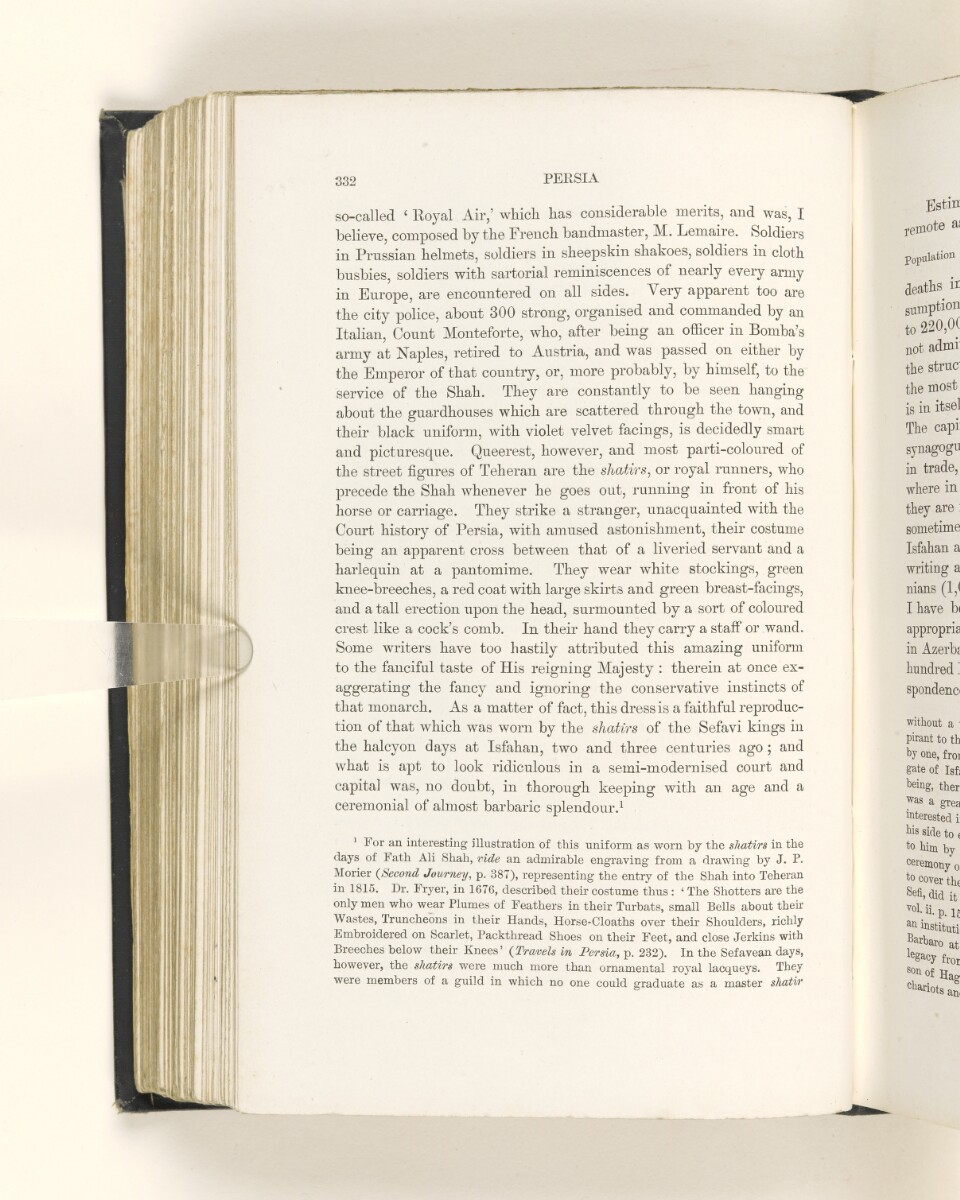
Annotated Copy of Persia and the Persian Question by George Curzon, with Inserted Papers [274v] (551/1814)
The record is made up of 2 volumes with inserts (898 folios). It was created in 1892-1924. It was written in English, Urdu and German. The original is part of the British Library: India Office The department of the British Government to which the Government of India reported between 1858 and 1947. The successor to the Court of Directors. Records and Private Papers Documents collected in a private capacity. .
Transcription
This transcription is created automatically. It may contain errors.
332 PERSIA
so-called £ Royal Air/ which has considerable merits, and was, I
believe, composed by the French bandmaster, M. Lemaire. Soldiers
in Prussian helmets, soldiers in sheepskin shakoes, soldiers in cloth
busbies, soldiers with sartorial reminiscences of nearly every army
in Europe, are encountered on all sides. Very apparent too are
the city police, about 300 strong, organised and commanded by an
Italian, Count Monteforte, who, after being an officer in Bomba’s
army at Naples, retired to Austria, and was passed on either by
the Emperor of that country, or, more probably, by himself, to the
service of the Shah. They are constantly to be seen hanging
about the guardhouses which are scattered through the town, and
their black uniform, with violet velvet facings, is decidedly smart
and picturesque. Queerest, however, and most parti-coloured of
the street figures of Teheran are the shatirs, or royal runners, who
precede the Shah whenever he goes out, running in front of his
horse or carriage. They strike a stranger, unacquainted with the
Court history of Persia, with amused astonishment, their costume
being an apparent cross between that of a liveried servant and a
harlequin at a pantomime. They wear white stockings, green
knee-breeches, a red coat with large skirts and green breast-facings,
and a tall erection upon the head, surmounted by a sort of coloured
crest like a cock’s comb. In their hand they carry a staff or wand.
Some writers have too hastily attributed this amazing uniform
to the fanciful taste of His reigning Majesty : therein at once ex
aggerating the fancy and ignoring the conservative instincts of
that monarch. As a matter of fact, this dress is a faithful reproduc
tion of that which was worn by the shatirs of the Sefavi kings in
the halcyon days at Isfahan, two and three centuries ago ; and
what is apt to look ridiculous in a semi-modernised court and
capita] was, no doubt, in thorough keeping with an age and a
ceremonial of almost barbaric splendour. 1 * *
1 For an interesting illustration of this uniform as worn by the shatirs in the
days of Fath Ali Shah, vide an admirable engraving from a drawing by J. P.
Morier (Second Journey, p. 387), representing the entry of the Shah into Teheran
in 1815. Dr. Fryer, in 1676, described their costume thus : 4 The Shotters are the
only men who wear Plumes of Feathers in their Turbats, small Bells about their
Wastes, Truncheons in their Hands, Horse-Cloaths over their Shoulders, richly
Embroidered on Scarlet, Packthread Shoes on their Feet, and close Jerkins with
Breeches below their Knees’ (Travels in Persia, p. 232). In the Sefavean days,
however, the shatirs were much more than ornamental royal lacqueys. They
were members of a guild in which no one could graduate as a master shatir
About this item
- Content
These two volumes are George Curzon's own personal annotated copies of both volumes of his book Persia and the Persian Question , which was published in 1892. Alongside the volumes are various loose papers relating to Persia [Iran], consisting of the following: received correspondence; newspaper cuttings; publishers' press releases; cuttings from various booksellers' catalogues; various journal and magazine articles; two items of printed official British correspondence; several prints of photographs and sketches; and a few handwritten notes by Curzon.
In most cases these papers, which range in date from 1892 to 1924, relate to the chapters in the book where they were originally inserted, suggesting that they were kept by Curzon with the intention of using them to inform a revised edition of the book.
Of particular note among the small amount of correspondence are two letters received by Curzon in 1914 and 1915 from retired schoolmaster and Islamic scholar Sayyid Mazhar Hasan Musawi of Saharanpur, Uttar Pradesh, India (ff 5-9 and ff 44-53). These letters, which are written in Urdu and are accompanied by English translations, discuss in detail several inaccuracies found in the Urdu version of Persia and the Persian Question .
The various prints of photographs and sketches, which were originally inserted into volume two, are of different locations in the Gulf region. Several of these appear to have been produced in preparation for the publication of the second volume of John Gordon Lorimer's Gazetteer of the Persian Gulf The historical term used to describe the body of water between the Arabian Peninsula and Iran. , Oman and Central Arabia (i.e. the 'Geographical and Statistical' section) in 1908, as they are identical to the versions found in that volume.
Also of note among the loose papers are an illustrated article from Country Life dated 5 June 1920, entitled 'The People of Persia' (ff 36-37), and a printed family tree of the Shah of Persia [Aḥmad Shah Qājār], produced in preparation of his visit to Britain in 1919 (f 233).
Volume one of Persia and the Persian Question contains a map of Persia, Afghanistan and Beluchistan [Balochistan], which is folded inside the front cover (f 1).
The German language material consists of a publisher's press release for two books authored by German archaeologist Ernst Emil Herzfeld (ff 29-30).
- Extent and format
- 2 volumes with inserts (898 folios)
- Physical characteristics
Foliation: this shelfmark consists of two physical volumes. The foliation sequence commences at the first folio of volume one (1-463), and terminates at the last folio of volume two (ff 464-898); these numbers are written in pencil, are circled, and are located in the top right corner of the recto The front of a sheet of paper or leaf, often abbreviated to 'r'. side of each folio. Each volume contains a large number of loose leaves, which have been foliated in the order that they were inserted into the volume; for conservation reasons, these loose folios have been removed from the volume and stored separately. The foliation sequence does not include the front and back covers of the two volumes.
Pagination: the file also contains an original printed pagination sequence.
- Written in
- English, Urdu and German in Latin and Arabic script View the complete information for this record
Use and share this item
- Share this item
Annotated Copy of Persia and the Persian Question by George Curzon, with Inserted Papers [274v] (551/1814), British Library: India Office Records and Private Papers, Mss Eur F111/33, in Qatar Digital Library <https://www.qdl.qa/archive/81055/vdc_100157213844.0x00009e> [accessed 4 July 2026]
https://www.qdl.qa/en/archive/81055/vdc_100157213844.0x00009e
Copy and paste the code below into your web page where you would like to embed the image.
<meta charset="utf-8"><a href="https://www.qdl.qa/en/archive/81055/vdc_100157213844.0x00009e">Annotated Copy of <em>Persia and the Persian Question</em> by George Curzon, with Inserted Papers [‎274v] (551/1814)</a> <a href="https://www.qdl.qa/en/archive/81055/vdc_100157213844.0x00009e"> <img src="https://iiif.qdl.qa/iiif/images/81055/vdc_100000001491.0x00033b/Mss Eur F111_33_0562.jp2/full/!280,240/0/default.jpg" alt="" /> </a>
This record has a IIIF manifest available as follows. If you have a compatible viewer you can drag the icon to load it.https://www.qdl.qa/en/iiif/81055/vdc_100000001491.0x00033b/manifestOpen in Universal viewerOpen in Mirador viewerMore options for embedding images
Copyright: How to use this content
- Reference
- Mss Eur F111/33
- Title
- Annotated Copy of Persia and the Persian Questionby George Curzon, with Inserted Papers
- Pages
- 54r:135v, 147r:149v, 158r:180v, 183r:221v, 224r:224v, 227r:246v, 248r:257v, 259r:260v, 268r:362v, 364r:364v, 367r:388v, 390r:400v, 402r:416v, 419r:432v, 434r:444v, 448r:462v, 464r:471v, 475r:481v, 483r:513v, 516r:525v, 527r:544v, 546r:563v, 566r:598v, 600r:622v, 624r:656v, 658r:665v, 667r:675v, 678r:684v, 687r:688v, 691r:691v, 693r:693v, 695r:708v, 711r:721v, 724r:726v, 728r:729v, 731r:736v, 742r:742v, 746r:757v, 759r:761v, 763r:763v, 765r:765v, 772r:777v, 780r:789v, 793r:794v, 797r:809v, 811r:821v, 825r:840v, 843r:898v
- Author
- Curzon, George Nathaniel, 1st Marquess Curzon of Kedleston
- Usage terms
- Public Domain