
!['Volume II. MEMORANDA REGARDING OTHER EXTERNAL AFFAIRS. 1905.' [‎60r] (124/228)](https://iiif.qdl.qa/iiif/images/81055/vdc_100000001491.0x000087/Mss Eur F112_450_0124.jp2/full/!1200,1200/0/default.jpg "'Volume II. MEMORANDA REGARDING OTHER EXTERNAL AFFAIRS. 1905.' [‎60r] (124/228)")
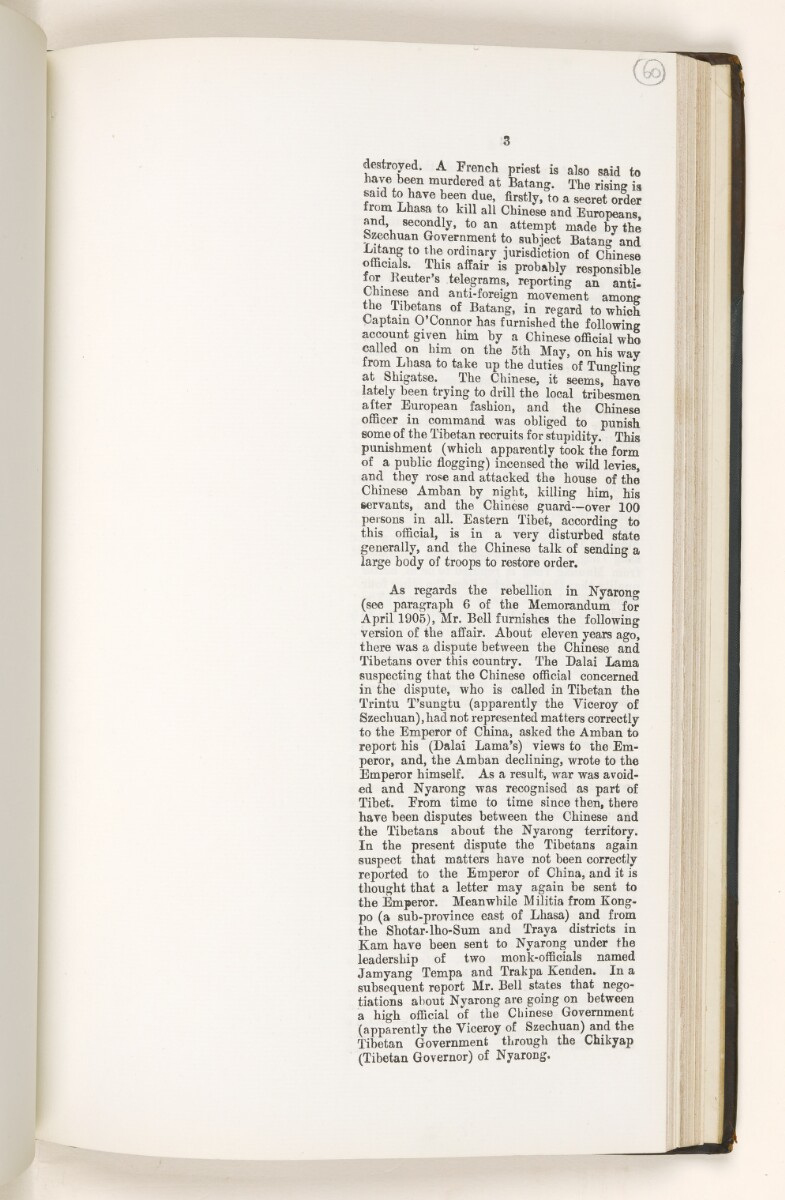
'Volume II. MEMORANDA REGARDING OTHER EXTERNAL AFFAIRS. 1905.' [60r] (124/228)
The record is made up of 1 volume (110 folios). It was created in 1905. It was written in English. The original is part of the British Library: India Office The department of the British Government to which the Government of India reported between 1858 and 1947. The successor to the Court of Directors. Records and Private Papers Documents collected in a private capacity. .
Transcription
This transcription is created automatically. It may contain errors.
3
destroyed. A French priest is also said to
have been murdered at Batang. The rising is
said to have been due, firstly, to a secret order
rom Lhasa to kill all Chinese and Europeans,
and, secondly, to an attempt made by the
fezechuan Government to subject Batang and
Litang to the ordinary jurisdiction of Chinese
officials. This affair is probably responsible
tor Keuter’s telegrams, reporting an anti-
Chinese and anti-foreign movement among
the Tibetans of Batang, in regard to which
Captain O’Connor has furnished the following
account given him by a Chinese official who
called on him on the 5th May, on his way
from Lhasa to take up the duties of Tungling
at Shigatse. The Chinese, it seems, have
lately been trying to drill the local tribesmen
after European fashion, and the Chinese
officer in command was obliged to punish
some of the Tibetan recruits for stupidity. This
punishment (which apparently took the form
of a public flogging) incensed the wild levies,
and they rose and attacked the house of the
Chinese Amban by night, killing him, his
servants, and the Chinese guard—over 100
persons in all. Eastern Tibet, according to
this official, is in a very disturbed state
generally, and the Chinese talk of sending a
large body of troops to restore order.
As regards the rebellion in Nyarong
(see paragraph 6 of the Memorandum for
April 1905), Mr. Bell furnishes the following
version of the affair. About eleven years ago,
there was a dispute between the Chinese and
Tibetans over this country. The Dalai Lama
suspecting that the Chinese official concerned
in the dispute, who is called in Tibetan the
Trintu T’sungtu (apparently the Viceroy of
Szechuan),had not represented matters correctly
to the Emperor of China, asked the Amban to
report his (Dalai Lama’s) views to the Em
peror, and, the Amban declining, wrote to the
Emperor himself. As a result, war was avoid
ed and Nyarong was recognised as part of
Tibet. From time to time since then, there
have been disputes between the Chinese and
the Tibetans about the Nyarong territory.
In the present dispute the Tibetans again
suspect that matters have not been correctly
reported to the Emperor of China, and it is
thought that a letter may again be sent to
the Emperor. Meanwhile Militia from Kong-
po (a sub-province east of Lhasa) and from
the Shotar-lho-Sum and Traya districts in
Kam have been sent to Nyarong under the
leadership of two monk-officials named
Jamyang Tempa and Trakpa Kenden. In a
subsequent report Mr. Bell states that nego
tiations about Nyarong are going on between
a high official of the Chinese Government
(apparently the Viceroy of Szechuan) and the
Tibetan Government through the Chikyap
(Tibetan Governor) of Nyarong.
About this item
- Content
The volume contains printed monthly memoranda of information received by the Government of India 'regarding external affairs other than those relating to the North-West Frontier Region of British India bordering Afghanistan. , Afghanistan, and Persia' for the months of January to March 1905 inclusive (folios 4-17); memoranda of information received 'regarding external affairs relating to Arabia' for the months of April to December 1905 inclusive (folios 18-54); and memoranda of information received 'regarding external affairs relating to the North-East Frontier, Burma, Siam, and China', for the months of April to December 1905 inclusive (folios 55-108). A note accompanying each memorandum states that they are 'based upon reports, the accuracy of which it is not always possible to guarantee'.
The combined 'other external affairs' reports (folios 4-17) relate to Arabia (Aden), Turkish Arabia A term used by the British officials to describe the territory roughly corresponding to, but not coextensive with, modern-day Iraq under the control of the Ottoman Empire. , the Persian Gulf The historical term used to describe the body of water between the Arabian Peninsula and Iran. , China, Tibet, and Bhutan; the Arabia memoranda (folios 18-54) relate to Aden, Turkish Arabia A term used by the British officials to describe the territory roughly corresponding to, but not coextensive with, modern-day Iraq under the control of the Ottoman Empire. , and the Persian Gulf The historical term used to describe the body of water between the Arabian Peninsula and Iran. ; and the North-East Frontier etc. memoranda (folios 55-108) relate to Tibet, Bhutan, China, Siam [Thailand], Nepal, Burma, and Assam.
Memoranda covering the Persian Gulf The historical term used to describe the body of water between the Arabian Peninsula and Iran. include intelligence reports concerning Maskat [Muscat], Koweit [Kuwait], Nejd [Najd], Bahrein [Bahrain], Katif [Al-Qatif], El Katr/Katar [Qatar], the Arab Coast, Musandim [Musandam], and the Pirate Coast.
The memoranda relating to Arabia include references to the following subjects: political intelligence, tribal affairs, relations with the Ottoman Government, frontier settlement, pearl fisheries, quarantine, and slavery.
The memoranda regarding affairs on and beyond the North-East Frontier of India cover a similar broad range of political and economic intelligence.
- Extent and format
- 1 volume (110 folios)
- Arrangement
The memoranda are arranged in chronological order within in each grouping from the front to the back of the volume.
- Physical characteristics
Foliation: the foliation sequence (used for referencing) commences at the inside front cover with 1 and terminates at the inside back cover with 112; these numbers are written in pencil, are circled, and are located in the top right corner of the recto The front of a sheet of paper or leaf, often abbreviated to 'r'. side of each folio.
- Written in
- English in Latin script View the complete information for this record
Use and share this item
- Share this item
'Volume II. MEMORANDA REGARDING OTHER EXTERNAL AFFAIRS. 1905.' [60r] (124/228), British Library: India Office Records and Private Papers, Mss Eur F112/450, in Qatar Digital Library <https://www.qdl.qa/archive/81055/vdc_100087951861.0x00007d> [accessed 29 August 2026]
https://www.qdl.qa/en/archive/81055/vdc_100087951861.0x00007d
Copy and paste the code below into your web page where you would like to embed the image.
<meta charset="utf-8"><a href="https://www.qdl.qa/en/archive/81055/vdc_100087951861.0x00007d">'Volume II. MEMORANDA REGARDING OTHER EXTERNAL AFFAIRS. 1905.' [‎60r] (124/228)</a> <a href="https://www.qdl.qa/en/archive/81055/vdc_100087951861.0x00007d"> <img src="https://iiif.qdl.qa/iiif/images/81055/vdc_100000001491.0x000087/Mss Eur F112_450_0124.jp2/full/!280,240/0/default.jpg" alt="" /> </a>
This record has a IIIF manifest available as follows. If you have a compatible viewer you can drag the icon to load it.https://www.qdl.qa/en/iiif/81055/vdc_100000001491.0x000087/manifestOpen in Universal viewerOpen in Mirador viewerMore options for embedding images
Copyright: How to use this content
- Reference
- Mss Eur F112/450
- Title
- 'Volume II. MEMORANDA REGARDING OTHER EXTERNAL AFFAIRS. 1905.'
- Pages
- front, back, spine, edge, head, tail, front-i, 2r:111v, back-i
- Author
- Curzon, George Nathaniel, 1st Marquess Curzon of Kedleston
- Copyright
- ©The British Library Board
- Usage terms
- Creative Commons Attribution Licence