
![Report of the Special Mission to Egypt under Lord Milner, and related papers [‎208v] (419/473)](https://iiif.qdl.qa/iiif/images/81055/vdc_100000001491.0x000295/Mss Eur F112_260_0419.jp2/full/!1200,1200/0/default.jpg "Report of the Special Mission to Egypt under Lord Milner, and related papers [‎208v] (419/473)")
Report of the Special Mission to Egypt under Lord Milner, and related papers [208v] (419/473)
The record is made up of 1 file (237 folios). It was created in 15 May 1920-14 Oct 1921. It was written in English. The original is part of the British Library: India Office The department of the British Government to which the Government of India reported between 1858 and 1947. The successor to the Court of Directors. Records and Private Papers Documents collected in a private capacity. .
Transcription
This transcription is created automatically. It may contain errors.
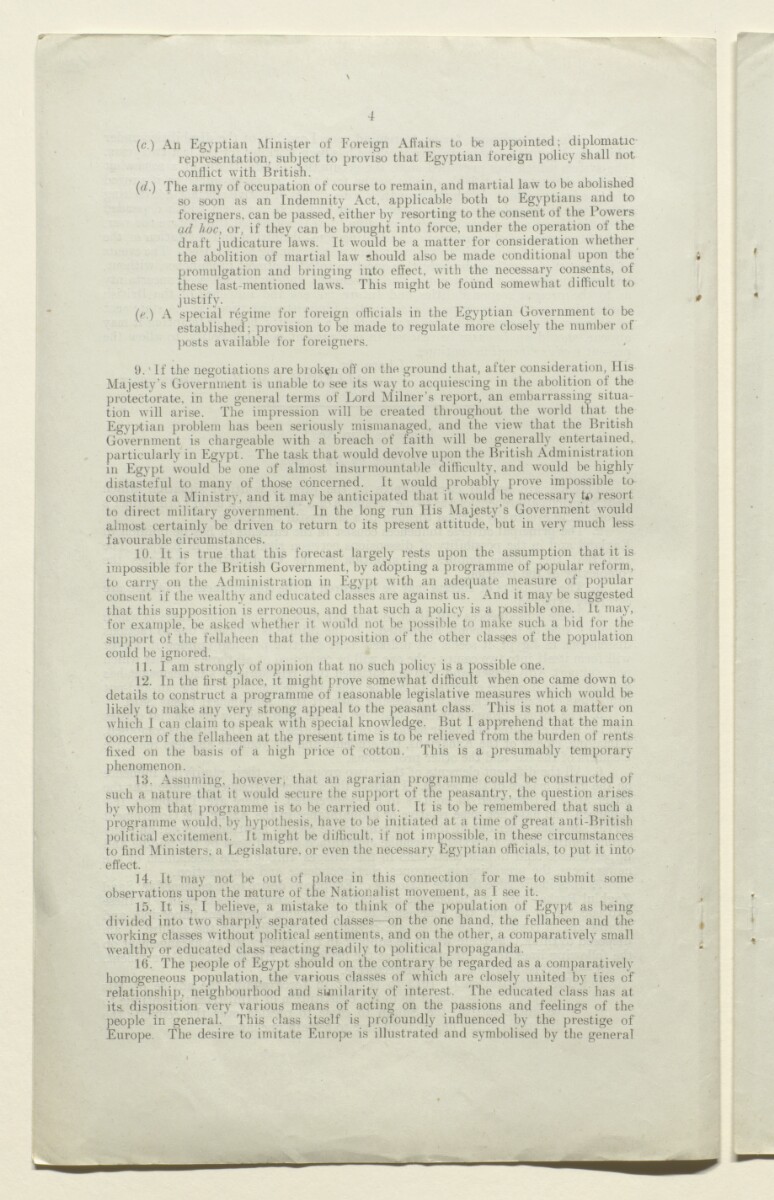
4
\
(c.) An Egyptian Minister of Foreign Affairs to be appointed; diplomatic
representation, subject to proviso that Egyptian foreign policy shall not
conflict with British.
(d.) The army of occupation of course to remain, and martial law to be abolished
so soon as an Indemnity Act, applicable both to Egyptians and to
foreigners, can be passed, either by resorting to the consent of the Powers
ad hoc, or, if they can be brought into force, under the operation of the
draft judicature laws. It would be a matter for consideration whether
the abolition of martial law should also be made conditional upon the
promulgation and bringing into effect, with the necessary consents, of
these last-mentioned laws. This might be found somewhat difficult to
justify.
(e.) A special regime for foreign officials in the Egyptian Government to be
established; provision to be made to regulate more closely the number of
}x>sts available for foreigners.
9. ' If the negotiations are broken off on the ground that, after consideration, His
Majesty's Government is unable to see its way to acquiescing in the abolition of the
protectorate, in the general terms of Lord Milner’s report, an embarrassing situa
tion will arise. The impression will be created throughout the world that the
Egyptian problem has been seriously mismanaged, and the view that the British
Government is chargeable with a breach of faith will be generally entertained,
particularly in Egypt. The task that would devolve upon the British Administration
in Egypt would be one of almost insurmountable difficulty, and would be highly
distasteful to many of those concerned. It would probably prove impossible to
constitute a Ministry, and it may be anticipated that it would be necessary tp resort
to direct military government. In the long run His Majesty’s Government would
almost certainly be driven to return to its present attitude, but in very much less
favourable circumstances.
10 . It is true that this forecast largely rests upon the assumption that it is
impossible for the British Government, by adopting a programme of popular reform,
to carry on the Administration in Egypt with an adequate measure of popular
consent if the wealthy and educated classes are against us. And it may be suggested
that this supposition is erroneous, and that such a policy is a possible one. It may,
for example, be asked whether it would not be possible to make such a bid for the
support of the
fellaheen
Arabic for ‘peasant’. It was used by British officials to refer to agricultural workers or to members of a social class employed primarily in agricultural labour.
that the opposition of the other classes of the population
could be ignored.
11 . I am strongly of opinion that no such policy is a possible one.
12. In the first place, it might prove somewhat difficult when one came down to
details to construct a programme of icasonable legislative measures which would be
likely to make any very strong appeal to the peasant class. This is not a matter on
which I can claim to speak with special knowledge. But I apprehend that the main
concern of the
fellaheen
Arabic for ‘peasant’. It was used by British officials to refer to agricultural workers or to members of a social class employed primarily in agricultural labour.
at the present time is to be relieved from the burden of rents
fixed on the basis of a high price of cotton. This is a presumably temporary
phenomenon.
13. Assuming, however, that an agrarian programme could be constructed of
such a nature that it would secure the support of the peasantry, the question arises
by whom that programme is to be carried out. It is to be remembered that such a
programme would, by hypothesis, have to be initiated at a time of great anti-British
political excitement. It might be difficult, if not impossible, in these circumstances
to find Ministers, a Legislature, or even the necessary Egyptian officials, to put it into
efiect.
14. It may not be out of place in this connection for me to submit some
observations upon the nature of the Nationalist movement, as I see it.
15. It is, I believe, a mistake to think of the population of Egypt as being
divided into two sharply separated classes—on the one hand, the
fellaheen
Arabic for ‘peasant’. It was used by British officials to refer to agricultural workers or to members of a social class employed primarily in agricultural labour.
and the
working classes without political sentiments, and on the other, a comparatively small
wealthy or educated class reacting readily to political propaganda.
16. The people of Egypt should on the contrary be regarded as a comparatively
homogeneous population, the various classes of which are closely united by ties of
relationship, neighbourhood and similarity of interest. The educated class has at
its, disposition very various means of acting on the passions and feelings of the
people in general. This class itself is profoundly influenced by the prestige of
Europe. The desire to imitate Europe is illustrated and symbolised by the general
About this item
- Content
The file contains official correspondence, memoranda, and reports relating to political affairs in Egypt. The correspondents and authors are officials at the Foreign Office (Lord Curzon was Secretary of State for Foreign Affairs at the time), War Office, Air Ministry, Admiralty, Colonial Office, Board of Trade, Board of Education, as well as those within the Egyptian civil service.
The file contains copies of reports of the Special Mission to Egypt (folios 1-7, 75-93, and 175-194), led by Lord Alfred Milner, whose purpose was to investigate and advise following the Egyptian Revolution of 1919. Much of the content of the file is in response to the findings and recommendations of the Mission and discusses the possibilities of a political settlement with Egypt.
- Extent and format
- 1 file (237 folios)
- Arrangement
The file is arranged in chronological order, from the front to the rear.
- Physical characteristics
Foliation: the foliation sequence (used for referencing) commences at the front cover with 1, and terminates at the inside back cover with 235; these numbers are written in pencil, are circled, and are located in the top right corner of the recto The front of a sheet of paper or leaf, often abbreviated to 'r'. side of each folio. The file has one foliation anomaly, f 76a.
- Written in
- English in Latin script View the complete information for this record
Use and share this item
- Share this item
Report of the Special Mission to Egypt under Lord Milner, and related papers [208v] (419/473), British Library: India Office Records and Private Papers, Mss Eur F112/260, in Qatar Digital Library <https://www.qdl.qa/archive/81055/vdc_100080131821.0x000014> [accessed 23 August 2026]
https://www.qdl.qa/en/archive/81055/vdc_100080131821.0x000014
Copy and paste the code below into your web page where you would like to embed the image.
<meta charset="utf-8"><a href="https://www.qdl.qa/en/archive/81055/vdc_100080131821.0x000014">Report of the Special Mission to Egypt under Lord Milner, and related papers [‎208v] (419/473)</a> <a href="https://www.qdl.qa/en/archive/81055/vdc_100080131821.0x000014"> <img src="https://iiif.qdl.qa/iiif/images/81055/vdc_100000001491.0x000295/Mss Eur F112_260_0419.jp2/full/!280,240/0/default.jpg" alt="" /> </a>
This record has a IIIF manifest available as follows. If you have a compatible viewer you can drag the icon to load it.https://www.qdl.qa/en/iiif/81055/vdc_100000001491.0x000295/manifestOpen in Universal viewerOpen in Mirador viewerMore options for embedding images
Copyright: How to use this content
- Reference
- Mss Eur F112/260
- Title
- Report of the Special Mission to Egypt under Lord Milner, and related papers
- Pages
- front, front-i, 2r:39v, 42r:50v, 53r:76v, 76ar:76av, 77r:140v, 143r:143v, 144ar, 144r:235v
- Author
- East India Company, the Board of Control, the India Office, or other British Government Department
- Usage terms
- Open Government Licence