
![Report of the Special Mission to Egypt under Lord Milner, and related papers [‎154r] (310/473)](https://iiif.qdl.qa/iiif/images/81055/vdc_100000001491.0x000295/Mss Eur F112_260_0310.jp2/full/!1200,1200/0/default.jpg "Report of the Special Mission to Egypt under Lord Milner, and related papers [‎154r] (310/473)")
Report of the Special Mission to Egypt under Lord Milner, and related papers [154r] (310/473)
The record is made up of 1 file (237 folios). It was created in 15 May 1920-14 Oct 1921. It was written in English. The original is part of the British Library: India Office The department of the British Government to which the Government of India reported between 1858 and 1947. The successor to the Court of Directors. Records and Private Papers Documents collected in a private capacity. .
Transcription
This transcription is created automatically. It may contain errors.
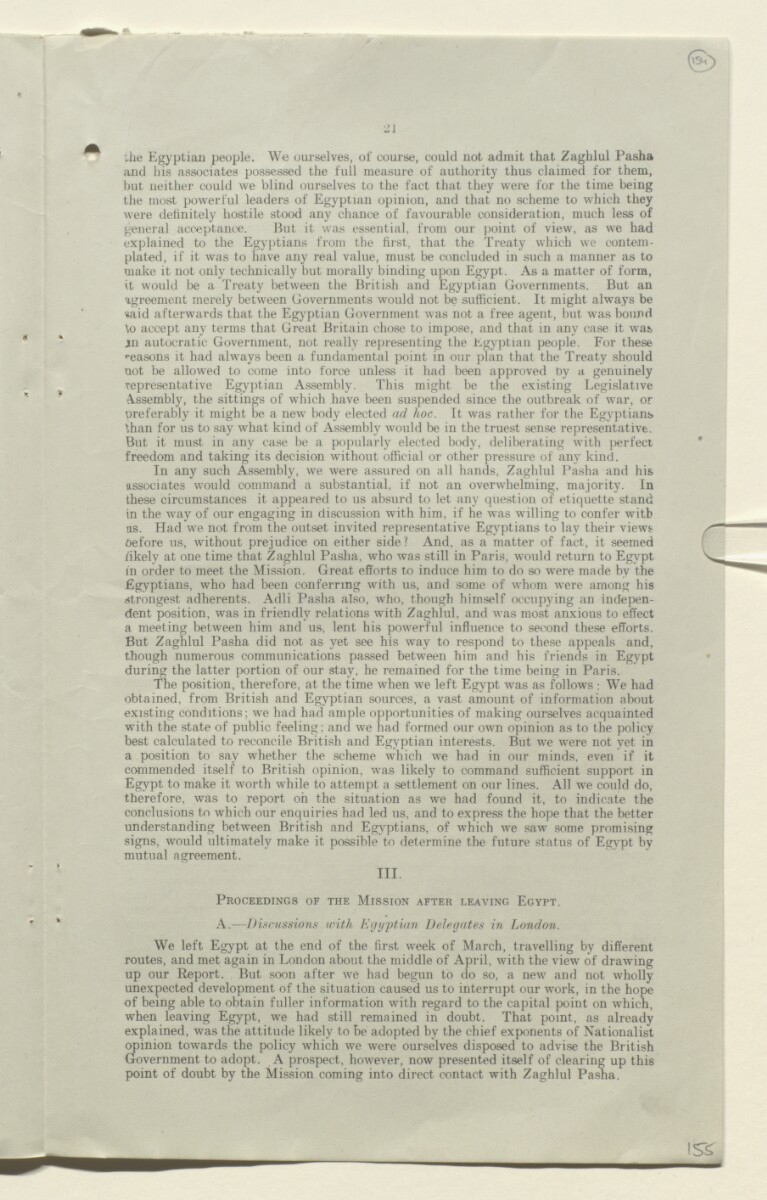
Jie Egyptian people. We ourselves, of course, could not admit that Zaghlul
Pasha
An Ottoman title used after the names of certain provincial governors, high-ranking officials and military commanders.
and his associates possessed the full measure of authority thus claimed for them,
but neither could we blind ourselves to the fact that they were for the time being
the most powerful leaders of Egyptian opinion, and that no scheme to which they
were definitely hostile stood any chance of favourable consideration, much less of
general acceptance. But it was essential, from our point of view, as we had
explained to the Egyptians from the first, that the Treaty which we contem
plated, if it was to have any real value, must be concluded in such a manner as to
make it not only technically but morally binding upon Egypt. As a matter of form,
it would be a Treaty between the British and Egyptian Governments. But an
agreement merely between Governments would not be sufficient. It might always be
said afterwards that the Egyptian Government was not a free agent, but was bound
\o accept any terms that Great Britain chose to impose, and that in any case it was
in autocratic Government, not really representing the Egyptian people. For these
reasons it had always been a fundamental point in our plan that the Treaty should
not be allowed to come into force unless it had been approved Dy a genuinely
representative Egyptian Assembly. This might be the existing Legislative
Assembly, the sittings of which have been suspended since the outbreak of war, or
preferably it might be a new body elected ad hoc. It was rather for the Egyptians
than for us to say what kind of Assembly would be in the truest sense representative.
But it must in any case be a popularly elected body, deliberating with perfect
freedom and taking its decision without official or other pressure of any kind.
In any such Assembly, we were assured on all hands, Zaghlul
Pasha
An Ottoman title used after the names of certain provincial governors, high-ranking officials and military commanders.
and his
associates would command a substantial, if not an overwhelming, majority. In
these circumstances it appeared to us absurd to let any question of etiquette stand
in the way of our engaging in discussion with him, if he was willing to confer with
us. Had we not from the outset invited representative Egyptians to lay their views-
Oefore us, without prejudice on either side? And, as a matter of fact, it seemed
likely at one time that Zaghlul
Pasha
An Ottoman title used after the names of certain provincial governors, high-ranking officials and military commanders.
, who was still in Paris, would return to Egypt
in order to meet the Mission. Great efforts to induce him to do so were made by the
Egyptians, who had been conferring with us, and some of whom were among his
strongest adherents. Adli
Pasha
An Ottoman title used after the names of certain provincial governors, high-ranking officials and military commanders.
also, who, though himself occupying an indepen
dent position, was in friendly relations with Zaghlul, and was most anxious to effect
a meeting between him and us, lent his powerful influence to second these efforts.
But Zaghlul
Pasha
An Ottoman title used after the names of certain provincial governors, high-ranking officials and military commanders.
did not as yet see his way to respond to these appeals and,
though numerous communications passed between him and his friends in Egypt
during the latter portion of our stay, he remained for the time being in Paris.
The position, therefore, at the time when we left Egypt was as follows : We had
obtained, from British and Egyptian sources, a vast amount of information about
existing conditions; we had had ample opportunities of making ourselves acquainted
with the state of public feeling; and we had formed our own opinion as to the policy
best calculated to reconcile British and Egyptian interests. But we were not yet in
a position to say whether the scheme which we had in our minds, even if it
commended itself to British opinion, was likely to command sufficient support in
Egypt to make it worth while to attempt a settlement on our lines. All we could do,
therefore, was to report oh the situation as we had found it, to indicate the
conclusions to which our enquiries had led us, and to express the hope that the better
understanding between British and Egyptians, of which we saw some promising
signs, would ultimately make it possible to determine the future status of Egypt by
mutual agreement.
III.
Proceedings of the Mission after leaving Egypt.
A .—Discussions with Egyptian Delegates in London.
We left Egypt at the end of the first week of March, travelling by different
routes, and met again in London about the middle of April, with the view of drawing
up our Report. But soon after we had begun to do so, a new and not wholly
unexpected development of the situation caused us to interrupt our work, in the hope
of being able to obtain fuller information with regard to the capital point on which,
when leaving Egypt, we had still remained in doubt. That point, as already
explained, was the attitude likely to be adopted by the chief exponents of Nationalist
opinion towards the policy which we were ourselves disposed to advise the British
Government to adopt. A prospect, however, now presented itself of clearing up this
point of doubt by the Mission coming into direct contact with Zaghlul
Pasha
An Ottoman title used after the names of certain provincial governors, high-ranking officials and military commanders.
.
About this item
- Content
The file contains official correspondence, memoranda, and reports relating to political affairs in Egypt. The correspondents and authors are officials at the Foreign Office (Lord Curzon was Secretary of State for Foreign Affairs at the time), War Office, Air Ministry, Admiralty, Colonial Office, Board of Trade, Board of Education, as well as those within the Egyptian civil service.
The file contains copies of reports of the Special Mission to Egypt (folios 1-7, 75-93, and 175-194), led by Lord Alfred Milner, whose purpose was to investigate and advise following the Egyptian Revolution of 1919. Much of the content of the file is in response to the findings and recommendations of the Mission and discusses the possibilities of a political settlement with Egypt.
- Extent and format
- 1 file (237 folios)
- Arrangement
The file is arranged in chronological order, from the front to the rear.
- Physical characteristics
Foliation: the foliation sequence (used for referencing) commences at the front cover with 1, and terminates at the inside back cover with 235; these numbers are written in pencil, are circled, and are located in the top right corner of the recto The front of a sheet of paper or leaf, often abbreviated to 'r'. side of each folio. The file has one foliation anomaly, f 76a.
- Written in
- English in Latin script View the complete information for this record
Use and share this item
- Share this item
Report of the Special Mission to Egypt under Lord Milner, and related papers [154r] (310/473), British Library: India Office Records and Private Papers, Mss Eur F112/260, in Qatar Digital Library <https://www.qdl.qa/archive/81055/vdc_100080131820.0x00006f> [accessed 9 July 2026]
https://www.qdl.qa/en/archive/81055/vdc_100080131820.0x00006f
Copy and paste the code below into your web page where you would like to embed the image.
<meta charset="utf-8"><a href="https://www.qdl.qa/en/archive/81055/vdc_100080131820.0x00006f">Report of the Special Mission to Egypt under Lord Milner, and related papers [‎154r] (310/473)</a> <a href="https://www.qdl.qa/en/archive/81055/vdc_100080131820.0x00006f"> <img src="https://iiif.qdl.qa/iiif/images/81055/vdc_100000001491.0x000295/Mss Eur F112_260_0310.jp2/full/!280,240/0/default.jpg" alt="" /> </a>
This record has a IIIF manifest available as follows. If you have a compatible viewer you can drag the icon to load it.https://www.qdl.qa/en/iiif/81055/vdc_100000001491.0x000295/manifestOpen in Universal viewerOpen in Mirador viewerMore options for embedding images
Copyright: How to use this content
- Reference
- Mss Eur F112/260
- Title
- Report of the Special Mission to Egypt under Lord Milner, and related papers
- Pages
- front, front-i, 2r:39v, 42r:50v, 53r:76v, 76ar:76av, 77r:140v, 143r:143v, 144ar, 144r:235v
- Author
- East India Company, the Board of Control, the India Office, or other British Government Department
- Usage terms
- Open Government Licence