
![Report of the Special Mission to Egypt under Lord Milner, and related papers [‎117r] (235/473)](https://iiif.qdl.qa/iiif/images/81055/vdc_100000001491.0x000295/Mss Eur F112_260_0235.jp2/full/!1200,1200/0/default.jpg "Report of the Special Mission to Egypt under Lord Milner, and related papers [‎117r] (235/473)")
Report of the Special Mission to Egypt under Lord Milner, and related papers [117r] (235/473)
The record is made up of 1 file (237 folios). It was created in 15 May 1920-14 Oct 1921. It was written in English. The original is part of the British Library: India Office The department of the British Government to which the Government of India reported between 1858 and 1947. The successor to the Court of Directors. Records and Private Papers Documents collected in a private capacity. .
Transcription
This transcription is created automatically. It may contain errors.
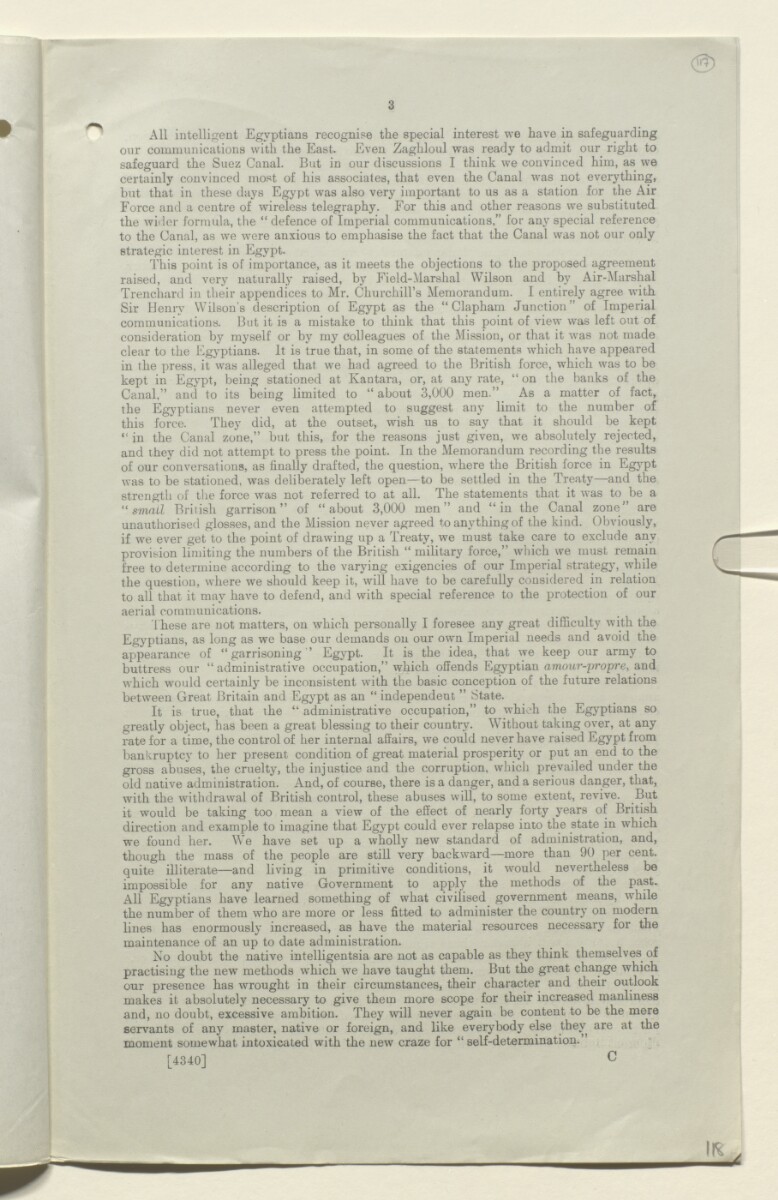
All intelligent Egyptians recognise the special interest we have in safeguarding
our communications with the East. Even Zaghloul was ready to admit our right to
safeguard the Suez Canal. But in our discussions I think we convinced him, as we
certainly convinced most of his associates, that even the Canal was not everything,
but that in these days Egypt was also very important to us as a station for the Air
Force and a centre of wireless telegraphy. For this and other reasons we substituted
the wider formula, the “ defence of Imperial communications,” for any special reference
to the Canal, as we were anxious to emphasise the fact that the Canal was not our only
strategic interest in Egypt.
This point is of importance, as it meets the objections to the proposed agreement
raised, and very naturally raised, by Field-Marshal Wilson and by Air-Marshal
Trenchard in their appendices to Mr. Churchill’s Memorandum. I entirely agree with
Sir Henry Wilson’s description of Egypt as the “ Clapham Junction” of Imperial
communications. But it is a mistake to think that this point of view was left out of
consideration by myself or by my colleagues of the Mission, or that it was not made
clear to the Egyptians. It is true that, in some of the statements which have appeared
in the press, it was alleged that we had agreed to the British force, which was to be
kept in Egypt, being stationed at Kantara, or, at any rate, “ on the banks of the
Canal,” and to its being limited to “ about 3,000 men.” As a matter of fact,
the Egyptians never even attempted to suggest any limit to the number of
this force. They did, at the outset, wish us to say that it should be kept
“ in the Canal zone,” but this, for the reasons just given, we absolutely rejected,
and they did not attempt to press the point. In the Memorandum recording the results
of our conversations, as finally drafted, the question, where the British force in Egypt
was to be stationed, was deliberately left open—to be settled in the Treaty—and the
strength of the force was not referred to at all. The statements that it was to be a
“small British garrison” of “about 3,000 men” and “in the Canal zone” are
unauthorised glosses, and the Mission never agreed to anything of the kind. Obviously,
if we ever get to the point of drawing up a Treaty, we must take care to exclude any
provision limiting the numbers of the British “ military force,” which we must remain
free to determine according to the varying exigencies of our Imperial strategy, while
the question, where we should keep it, will have to be carefully considered in relation
to all that it may have to defend, and with special reference to the protection of our
aerial communications.
'these are not matters, on which personally I foresee any great difficulty with the
Egyptians, as long as we base our demands on our own Imperial needs and avoid the
appearance of “ garrisoning ’ Egypt. It is the idea, that we keep our army to
buttress our “administrative occupation,” which offends Egyptian amour-propre, and
which would certainly be inconsistent with the basic conception of the future relations
between Great Britain and Egypt as an “ independent ” State.
It is true, that the “ administrative occupation,” to which the Egyptians so
greatly object, has been a great blessing to their country. Without taking over, at any
rate for a time, the control of her internal affairs, we could never have raised Egypt from
bankruptcy to her present condition of great material prosperity or put an end to the
gross abuses, the cruelty, the injustice and the corruption, which prevailed under the
old native administration. And, of course, there is a danger, and a serious danger, that,
with the withdrawal of British control, these abuses will, to some extent, revive. But
it would be taking too mean a view of the effect of nearly forty years of British
direction and example to imagine that Egypt could ever relapse into the state in which
we found her. We have set up a wholly new standard of administration, and,
though the mass of the people are still very backward—more than 90 per cent,
quite illiterate—and living in primitive conditions, it would nevertheless be
impossible for any native Government to apply the methods of the past.
All Egyptians have learned something of what civilised government means, while
the number of them who are more or less fitted to administer the country on modern
lines has enormously increased, as have the material resources necessary for the
maintenance of an up to date administration.
No doubt the native intelligentsia are not as capable as they think themselves of
practising the new methods which we have taught them. But the great change which
our presence has wrought in their circumstances, their character and their outlook
makes it absolutely necessary to give them more scope for their increased manliness
and, no doubt, excessive ambition. They will never again be content to be the mere
servants of any master, native or foreign, and like everybody else they are at the
moment somewhat intoxicated wfith the new craze for “ self-determination.
[4340]
C
About this item
- Content
The file contains official correspondence, memoranda, and reports relating to political affairs in Egypt. The correspondents and authors are officials at the Foreign Office (Lord Curzon was Secretary of State for Foreign Affairs at the time), War Office, Air Ministry, Admiralty, Colonial Office, Board of Trade, Board of Education, as well as those within the Egyptian civil service.
The file contains copies of reports of the Special Mission to Egypt (folios 1-7, 75-93, and 175-194), led by Lord Alfred Milner, whose purpose was to investigate and advise following the Egyptian Revolution of 1919. Much of the content of the file is in response to the findings and recommendations of the Mission and discusses the possibilities of a political settlement with Egypt.
- Extent and format
- 1 file (237 folios)
- Arrangement
The file is arranged in chronological order, from the front to the rear.
- Physical characteristics
Foliation: the foliation sequence (used for referencing) commences at the front cover with 1, and terminates at the inside back cover with 235; these numbers are written in pencil, are circled, and are located in the top right corner of the recto The front of a sheet of paper or leaf, often abbreviated to 'r'. side of each folio. The file has one foliation anomaly, f 76a.
- Written in
- English in Latin script View the complete information for this record
Use and share this item
- Share this item
Report of the Special Mission to Egypt under Lord Milner, and related papers [117r] (235/473), British Library: India Office Records and Private Papers, Mss Eur F112/260, in Qatar Digital Library <https://www.qdl.qa/archive/81055/vdc_100080131820.0x000024> [accessed 26 July 2026]
https://www.qdl.qa/en/archive/81055/vdc_100080131820.0x000024
Copy and paste the code below into your web page where you would like to embed the image.
<meta charset="utf-8"><a href="https://www.qdl.qa/en/archive/81055/vdc_100080131820.0x000024">Report of the Special Mission to Egypt under Lord Milner, and related papers [‎117r] (235/473)</a> <a href="https://www.qdl.qa/en/archive/81055/vdc_100080131820.0x000024"> <img src="https://iiif.qdl.qa/iiif/images/81055/vdc_100000001491.0x000295/Mss Eur F112_260_0235.jp2/full/!280,240/0/default.jpg" alt="" /> </a>
This record has a IIIF manifest available as follows. If you have a compatible viewer you can drag the icon to load it.https://www.qdl.qa/en/iiif/81055/vdc_100000001491.0x000295/manifestOpen in Universal viewerOpen in Mirador viewerMore options for embedding images
Copyright: How to use this content
- Reference
- Mss Eur F112/260
- Title
- Report of the Special Mission to Egypt under Lord Milner, and related papers
- Pages
- front, front-i, 2r:39v, 42r:50v, 53r:76v, 76ar:76av, 77r:140v, 143r:143v, 144ar, 144r:235v
- Author
- East India Company, the Board of Control, the India Office, or other British Government Department
- Usage terms
- Open Government Licence