
![Report of the Special Mission to Egypt under Lord Milner, and related papers [‎116v] (234/473)](https://iiif.qdl.qa/iiif/images/81055/vdc_100000001491.0x000295/Mss Eur F112_260_0234.jp2/full/!1200,1200/0/default.jpg "Report of the Special Mission to Egypt under Lord Milner, and related papers [‎116v] (234/473)")
Report of the Special Mission to Egypt under Lord Milner, and related papers [116v] (234/473)
The record is made up of 1 file (237 folios). It was created in 15 May 1920-14 Oct 1921. It was written in English. The original is part of the British Library: India Office The department of the British Government to which the Government of India reported between 1858 and 1947. The successor to the Court of Directors. Records and Private Papers Documents collected in a private capacity. .
Transcription
This transcription is created automatically. It may contain errors.
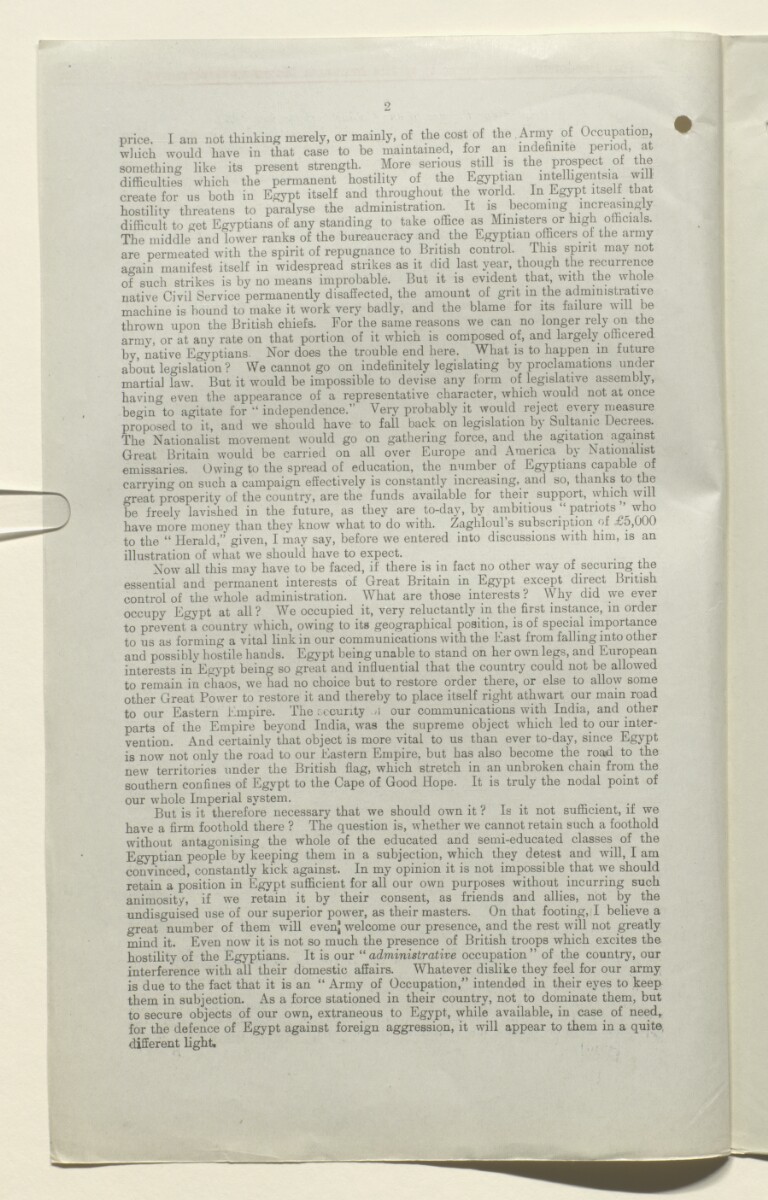
price. I am not thinking merely, or mainly, of the cost of the Army of Occupation,
which would have in that case to be maintained, for an indefinite period, at
something like its present strength. More serious still is the prospect of the
difficulties which the permanent hostility of the Egyptian intelligentsia will
create for us both in Egypt itself and throughout the world In Egypt itself that
hostility threatens to paralyse the administration It is becoming increasingly
difficult to get Egyptians of any standing to take office as Ministers or high oflicials.
The middle and lower ranks of the bureaucracy and the Egyptian officers ot the army
are permeated with the spirit of repugnance to British control. This spirit may not
again manifest itself in widespread strikes as it did last year, though the recurrence
of such strikes is by no means improbable. But it is evident that, with the whole
native Civil Service permanently disaffected, the amount of grit in the administrative
machine is bound to make it work very badly, and the blame for its failure will be
thrown upon the British chiefs. For the same reasons we can no longer rely on the
army, or at any rate on that portion of it which is composed of, and largely oOh ertd
by, native Egyptians. Nor does the trouble end here. What is to happen in future
about legislation? We cannot go on indefinitely legislating by proclamations under
martial law. But it would be impossible to devise any form of legislative assembly,
having even the appearance of a representative character, which would not at once
beo-in to agitate for “ independence. Very probably it would ieject e^eiy measure
proposed to it, and we should have to fall back on legislation by bultanic Deciees.
The Nationalist movement would go on gathering force, and the agitation against
Great Britain would be carried on all over Europe and America by Nationalist
emissaries. Owing to the spread of education, the number of Egyptians capable of
carrying on such a campaign effectively is constantly increasing, and so, thanks to the
great prosperity of the country, are the funds available for their support, \\hich will
be freely lavished in the future, as they are to-day, by ambitious “ patriots ” who
have more money than they know what to do with. Zaghloul’s subscription of £5,000
to the “ Herald,” given, I may say, before we entered into discussions with him, is an
illustration of what we should have to expect.
Now all this may have to be faced, if there is in fact no other way of securing the
essential and permanent interests of Great Britain in Egypt except direct British
control of the whole administration. What are those interests ? Why did we ever
occupy Egypt at all ? We occupied it, very reluctantly in the first instance, in order
to prevent°a country which, owing to its geographical position, is of special importance
to us as forming a vital link in our communications with the East from falling into other
and possibly hostile hands. Egypt being unable to stand on her own legs, and European
interests in Egypt being so great and influential that the country could not be allowed
to remain in cliaos, we had no choice but to restore order there, or else to allow some
other Great Power to restore it and thereby to place itself right athwart our main road
to our Eastern Empire. The r ecunty a our communications with India, and other
parts of the Empire beyond India, was the supreme object which led to our inter
vention. And certainly that object is more vital to us than ever to-day, since Egypt
is now not only the road to our Eastern Empire, but has also become the road to the
new territories under the British flag, which stretch in an unbroken chain from the
southern confines of Egypt to the Cape of Good Hope. It is truly the nodal point of
our whole Imperial system.
But is it therefore necessary that we should own it ? Is it not sufficient, if we
have a firm foothold there ? The question is, whether we cannot retain such a foothold
without antagonising the whole of the educated and semi-educated classes of the
Egyptian people by keeping them in a subjection, which they detest and will, I am
convinced, constantly kick against. In my opinion it is not impossible that we should
retain a position in Egypt sufficient for all our own purposes without incurring such
animosity, if we retain it by their consent, as friends and allies, not by the
undisguised use of our superior power, as their masters. On that footing, I believe a
great number of them will evenj welcome our presence, and the rest will not greatly
mind it. Even now it is not so much the presence of British troops which excites the
hostility of the Egyptians. It is our “administrative occupation” of the country, our
interference with all their domestic affairs. Whatever dislike they feel for our army
is due to the fact that it is an “ Army of Occupation,” intended in their eyes to keep
them in subjection. As a force stationed in their country, not to dominate them, but
to secure objects of our own, extraneous to Egypt, while available, in case of need,
for the defence of Egypt against foreign aggression, it will appear to them in a quite
different light. i
About this item
- Content
The file contains official correspondence, memoranda, and reports relating to political affairs in Egypt. The correspondents and authors are officials at the Foreign Office (Lord Curzon was Secretary of State for Foreign Affairs at the time), War Office, Air Ministry, Admiralty, Colonial Office, Board of Trade, Board of Education, as well as those within the Egyptian civil service.
The file contains copies of reports of the Special Mission to Egypt (folios 1-7, 75-93, and 175-194), led by Lord Alfred Milner, whose purpose was to investigate and advise following the Egyptian Revolution of 1919. Much of the content of the file is in response to the findings and recommendations of the Mission and discusses the possibilities of a political settlement with Egypt.
- Extent and format
- 1 file (237 folios)
- Arrangement
The file is arranged in chronological order, from the front to the rear.
- Physical characteristics
Foliation: the foliation sequence (used for referencing) commences at the front cover with 1, and terminates at the inside back cover with 235; these numbers are written in pencil, are circled, and are located in the top right corner of the recto The front of a sheet of paper or leaf, often abbreviated to 'r'. side of each folio. The file has one foliation anomaly, f 76a.
- Written in
- English in Latin script View the complete information for this record
Use and share this item
- Share this item
Report of the Special Mission to Egypt under Lord Milner, and related papers [116v] (234/473), British Library: India Office Records and Private Papers, Mss Eur F112/260, in Qatar Digital Library <https://www.qdl.qa/archive/81055/vdc_100080131820.0x000023> [accessed 14 July 2026]
https://www.qdl.qa/en/archive/81055/vdc_100080131820.0x000023
Copy and paste the code below into your web page where you would like to embed the image.
<meta charset="utf-8"><a href="https://www.qdl.qa/en/archive/81055/vdc_100080131820.0x000023">Report of the Special Mission to Egypt under Lord Milner, and related papers [‎116v] (234/473)</a> <a href="https://www.qdl.qa/en/archive/81055/vdc_100080131820.0x000023"> <img src="https://iiif.qdl.qa/iiif/images/81055/vdc_100000001491.0x000295/Mss Eur F112_260_0234.jp2/full/!280,240/0/default.jpg" alt="" /> </a>
This record has a IIIF manifest available as follows. If you have a compatible viewer you can drag the icon to load it.https://www.qdl.qa/en/iiif/81055/vdc_100000001491.0x000295/manifestOpen in Universal viewerOpen in Mirador viewerMore options for embedding images
Copyright: How to use this content
- Reference
- Mss Eur F112/260
- Title
- Report of the Special Mission to Egypt under Lord Milner, and related papers
- Pages
- front, front-i, 2r:39v, 42r:50v, 53r:76v, 76ar:76av, 77r:140v, 143r:143v, 144ar, 144r:235v
- Author
- East India Company, the Board of Control, the India Office, or other British Government Department
- Usage terms
- Open Government Licence