
![Report of the Special Mission to Egypt under Lord Milner, and related papers [‎80r] (161/473)](https://iiif.qdl.qa/iiif/images/81055/vdc_100000001491.0x000295/Mss Eur F112_260_0161.jp2/full/!1200,1200/0/default.jpg "Report of the Special Mission to Egypt under Lord Milner, and related papers [‎80r] (161/473)")
Report of the Special Mission to Egypt under Lord Milner, and related papers [80r] (161/473)
The record is made up of 1 file (237 folios). It was created in 15 May 1920-14 Oct 1921. It was written in English. The original is part of the British Library: India Office The department of the British Government to which the Government of India reported between 1858 and 1947. The successor to the Court of Directors. Records and Private Papers Documents collected in a private capacity. .
Transcription
This transcription is created automatically. It may contain errors.
13
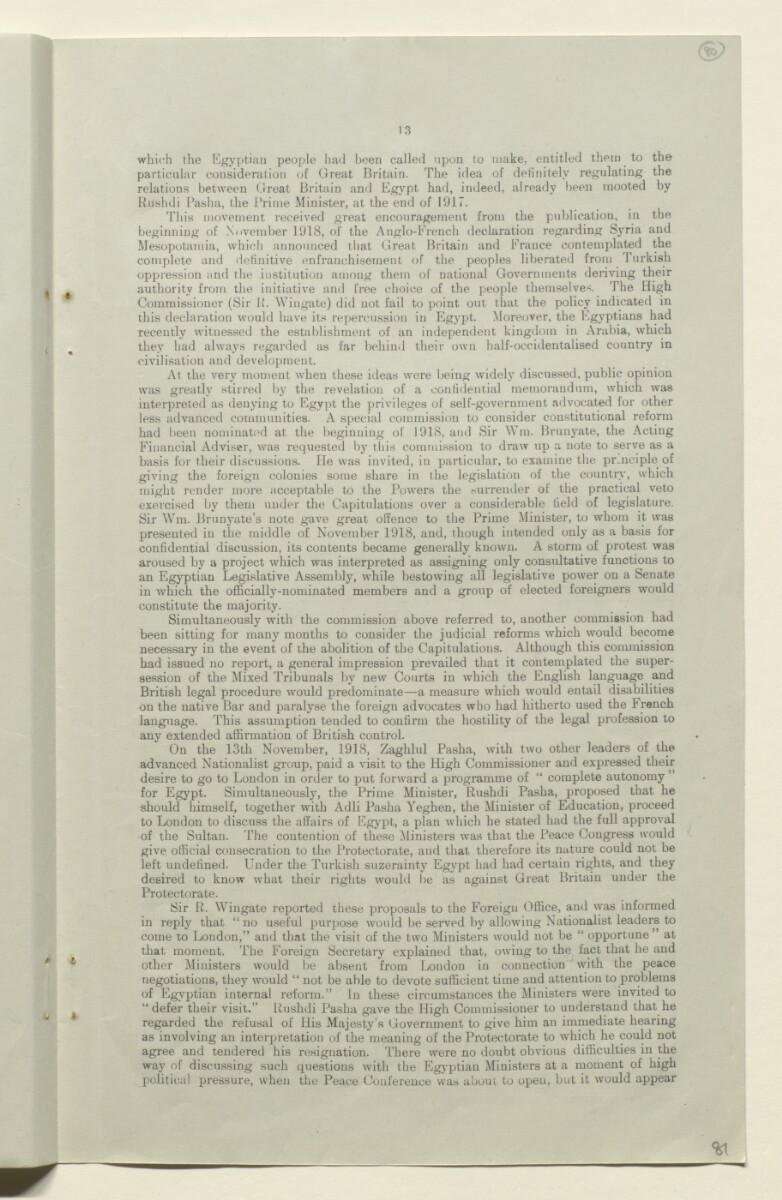
which the Egyptian people had been called upon to make, entitled them to the
particular consideration of Great Britain. The idea of definitely regulating the
relations between Great Britain and Egypt had, indeed, already been mooted by
Rushdi
Pasha
An Ottoman title used after the names of certain provincial governors, high-ranking officials and military commanders.
, the Prime Minister, at the end of 1917.
This movement received great encouragement from the publication, in the
beginning of November 1918, of the Anglo-French declaration regarding Syria and
Mesopotamia, which announced that Great Britain and France contemplated the
complete and definitive enfranchisement of the peoples liberated from Turkish
oppression and the institution among them of national Governments deriving their
authority from the initiative and free choice of the people themselves. The High
Commissioner (Sir P. Wingate) did not fail to point out that the policy indicated in
this declaration would have its repercussion in Egypt. Moreover, the Egyptians had
recently witnessed the establishment of an independent kingdom in Arabia, which
they had always regarded as far behind their own half-occidentalised country in
civilisation and development.
At the very moment when these ideas were being widely discussed, public opinion
was greatly stirred by the revelation of a confidential memorandum, which was
interpreted as denying to Egypt the privileges of self-government advocated for other
less advanced communities. A special commission to consider constitutional reform
had been nominated at the beginning of 1918, and Sir Wm. Brunyate, the Acting
Financial Adviser, was requested by this commission to draw up a note to serve as a
basis for their discussions. He was invited, in particular, to examine the principle of
giving the foreign colonies some share in the legislation of the country, which
might render more acceptable to the Powers the surrender of the practical veto
exercised by them under the Capitulations over a considerable field of legislature.
Sir Wm. Brunyate’s note gave great offence to the Prime Minister, to whom it was
presented in the middle of November 1918, and, though intended only as a basis for
confidential discussion, its contents became generally known. A storm of protest was
aroused by a project which was interpreted as assigning only consultative functions to
an Egyptian Legislative Assembly, while bestowing all legislative power on a Senate
in which the officially-nominated members and a group of elected foreigners would
constitute the majority.
Simultaneously with the commission above referred to, another commission had
been sitting for many months to consider the judicial reforms which would become
necessary in the event of the abolition of the Capitulations. Although this commission
had issued no report, a general impression prevailed that it contemplated the super-
session of the Mixed Tribunals by new Courts in which the English language and
British legal procedure would predominate—a measure which would entail disabilities
on the native Bar and paralyse the foreign advocates who had hitherto used the French
language. This assumption tended to confirm the hostility of the legal profession to
any extended affirmation of British control.
On the 13th November, 1918, Zaghlul
Pasha
An Ottoman title used after the names of certain provincial governors, high-ranking officials and military commanders.
, with two other leaders of the
advanced Nationalist group, paid a visit to the High Commissioner and expressed their
desire to go to London in order to put forward a programme of “ complete autonomy
for Egypt. Simultaneously, the Prime Minister, Rushdi
Pasha
An Ottoman title used after the names of certain provincial governors, high-ranking officials and military commanders.
, proposed that he
should himself, together with Adli
Pasha
An Ottoman title used after the names of certain provincial governors, high-ranking officials and military commanders.
Yeghen, the Minister of Education, proceed
to London to discuss the affairs of Egypt, a plan which he stated had the full approval
of the Sultan. The contention of these Ministers was that the Peace Congress would
give official consecration to the Protectorate, and that therefore its nature could not be
left undefined. Under the Turkish suzerainty Egypt had had certain rights, and they
desired to know what their rights would be as against Great Britain under the
Protectorate.
Sir R. Wingate reported these proposals to the Foreign Office, and was informed
in reply that “ no useful purpose would be served by allowing Nationalist leaders to
come to London,” and that the visit of the two Ministers would not be “ opportune” at
that moment. The Foreign Secretary explained that, owing to the fact that he and
other Ministers would be absent from London in connection with the peace
negotiations, they would “ not be able to devote sufficient time and attention to problems
of Egyptian internal reform.” In these circumstances the Ministers were invited to
“defer their visit.” Rushdi
Pasha
An Ottoman title used after the names of certain provincial governors, high-ranking officials and military commanders.
gave the High Commissioner to understand that he
regarded the refusal of His Majesty's Government to give him an immediate hearing
as involving an interpretation of the meaning of the Protectorate to which he could not
agree and tendered his resignation. 'There were no doubt obvious difficulties in the
way of discussing such questions with the Egyptian Ministers at a moment of high
political pressure, when the Peace Conference was about to open, but it would appear
About this item
- Content
The file contains official correspondence, memoranda, and reports relating to political affairs in Egypt. The correspondents and authors are officials at the Foreign Office (Lord Curzon was Secretary of State for Foreign Affairs at the time), War Office, Air Ministry, Admiralty, Colonial Office, Board of Trade, Board of Education, as well as those within the Egyptian civil service.
The file contains copies of reports of the Special Mission to Egypt (folios 1-7, 75-93, and 175-194), led by Lord Alfred Milner, whose purpose was to investigate and advise following the Egyptian Revolution of 1919. Much of the content of the file is in response to the findings and recommendations of the Mission and discusses the possibilities of a political settlement with Egypt.
- Extent and format
- 1 file (237 folios)
- Arrangement
The file is arranged in chronological order, from the front to the rear.
- Physical characteristics
Foliation: the foliation sequence (used for referencing) commences at the front cover with 1, and terminates at the inside back cover with 235; these numbers are written in pencil, are circled, and are located in the top right corner of the recto The front of a sheet of paper or leaf, often abbreviated to 'r'. side of each folio. The file has one foliation anomaly, f 76a.
- Written in
- English in Latin script View the complete information for this record
Use and share this item
- Share this item
Report of the Special Mission to Egypt under Lord Milner, and related papers [80r] (161/473), British Library: India Office Records and Private Papers, Mss Eur F112/260, in Qatar Digital Library <https://www.qdl.qa/archive/81055/vdc_100080131819.0x0000a2> [accessed 30 August 2026]
https://www.qdl.qa/en/archive/81055/vdc_100080131819.0x0000a2
Copy and paste the code below into your web page where you would like to embed the image.
<meta charset="utf-8"><a href="https://www.qdl.qa/en/archive/81055/vdc_100080131819.0x0000a2">Report of the Special Mission to Egypt under Lord Milner, and related papers [‎80r] (161/473)</a> <a href="https://www.qdl.qa/en/archive/81055/vdc_100080131819.0x0000a2"> <img src="https://iiif.qdl.qa/iiif/images/81055/vdc_100000001491.0x000295/Mss Eur F112_260_0161.jp2/full/!280,240/0/default.jpg" alt="" /> </a>
This record has a IIIF manifest available as follows. If you have a compatible viewer you can drag the icon to load it.https://www.qdl.qa/en/iiif/81055/vdc_100000001491.0x000295/manifestOpen in Universal viewerOpen in Mirador viewerMore options for embedding images
Copyright: How to use this content
- Reference
- Mss Eur F112/260
- Title
- Report of the Special Mission to Egypt under Lord Milner, and related papers
- Pages
- front, front-i, 2r:39v, 42r:50v, 53r:76v, 76ar:76av, 77r:140v, 143r:143v, 144ar, 144r:235v
- Author
- East India Company, the Board of Control, the India Office, or other British Government Department
- Usage terms
- Open Government Licence