
![Report of the Special Mission to Egypt under Lord Milner, and related papers [‎79v] (160/473)](https://iiif.qdl.qa/iiif/images/81055/vdc_100000001491.0x000295/Mss Eur F112_260_0160.jp2/full/!1200,1200/0/default.jpg "Report of the Special Mission to Egypt under Lord Milner, and related papers [‎79v] (160/473)")
Report of the Special Mission to Egypt under Lord Milner, and related papers [79v] (160/473)
The record is made up of 1 file (237 folios). It was created in 15 May 1920-14 Oct 1921. It was written in English. The original is part of the British Library: India Office The department of the British Government to which the Government of India reported between 1858 and 1947. The successor to the Court of Directors. Records and Private Papers Documents collected in a private capacity. .
Transcription
This transcription is created automatically. It may contain errors.
\'2
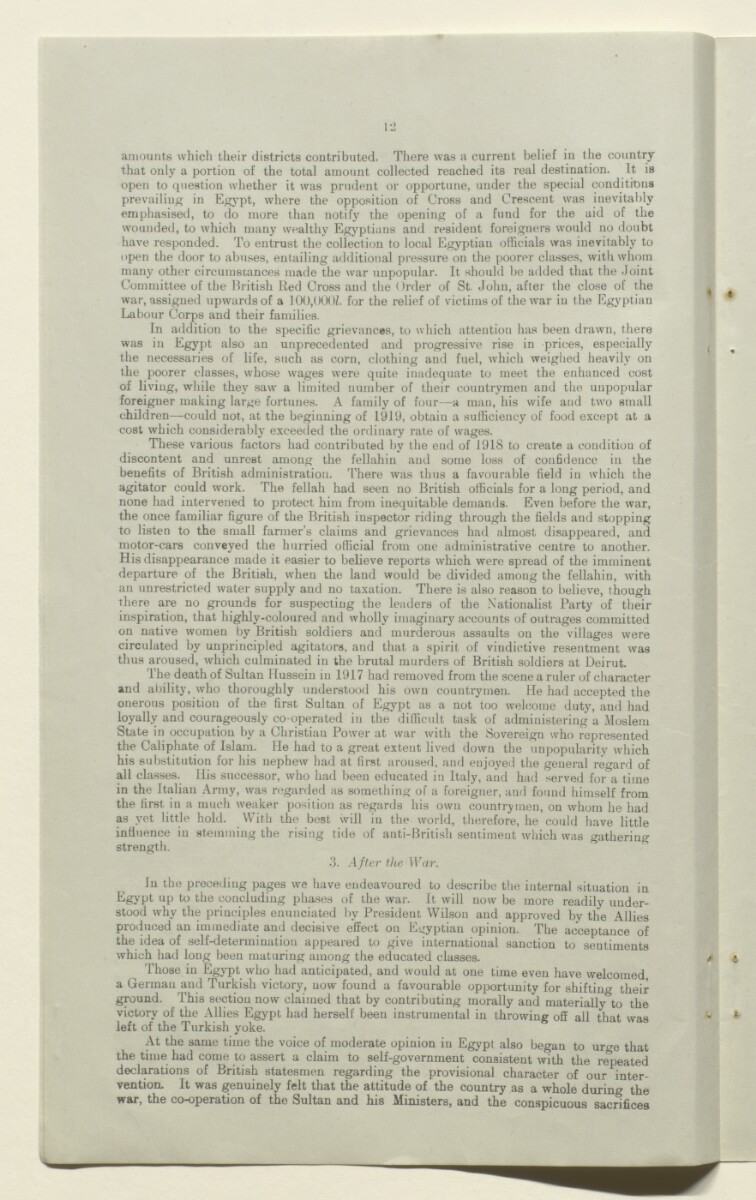
amounts which their districts contributed. There was a current belief in the country
that only a portion of the total amount collected reached its real destination. It is
open to question whether it was prudent or opportune, under the special conditions
prevailing in Egypt, where the opposition of Cross and Crescent was inevitably
emphasised, to do more than notify the opening of a fund for the aid of the
wounded, to which many wealthy Egyptians and resident foreigners would no doubt
have responded. To entrust the collection to local Egyptian officials was inevitably to
open the door to abuses, entailing additional pressure on the poorer classes, with whom
many other circumstances made the war unpopular. It should be added that the Joint
Committee of the British Red Cross and the Order of St. John, after the close of the .
war, assigned upwards of a 100,000Z. for the relief of victims of the war in the Egyptian
Labour Corps and their families.
In addition to the specific grievances, to which attention has been drawn, there
was in Egypt also an unprecedented and progressive rise in prices, especially (
the necessaries of life, such as corn, clothing and fuel, which weighed heavily on
the poorer classes, whose wages were quite inadequate to meet the enhanced cost
of living, while they saw a limited number of their countrymen and the unpopular
foreigner making large fortunes. A family of four—a man, his wife and two small
children—could not, at the beginning of 1919, obtain a sufficiency of food except at a
cost which considerably exceeded the ordinary rate of wages.
These various factors had contributed by the end of 1918 to create a condition of
discontent and unrest among the
fellahin
Arabic for ‘peasant’. It was used by British officials to refer to agricultural workers or to members of a social class employed primarily in agricultural labour.
and some loss of confidence in the
benefits of British administration. 'There was thus a favourable field in which the
agitator could work. The
fellah
Arabic for ‘peasant’. It was used by British officials to refer to agricultural workers or to members of a social class employed primarily in agricultural labour.
had seen no British officials for a long period, and
none had intervened to protect him from inequitable demands. Even before the war,
the once familiar figure of the British inspector riding through the fields and stopping
to listen to the small farmer’s claims and grievances had almost disappeared, and
motor-cars conveyed the hurried official from one administrative centre to another.
His disappearance made it easier to believe reports which were spread of the imminent
departure of the British, when the land would be divided among the
fellahin
Arabic for ‘peasant’. It was used by British officials to refer to agricultural workers or to members of a social class employed primarily in agricultural labour.
, with
an unrestricted water supply and no taxation. There is also reason to believe, though
there are no grounds for suspecting the leaders of the Nationalist Party of their
inspiration, that highly-coloured and wholly imaginary accounts of outrages committed
on native women by British soldiers and murderous assaults on the villages were
circulated by unprincipled agitators, and that a spirit of vindictive resentment was
thus aroused, which culminated in the brutal murders of British soldiers at Dei rut.
The death of Sultan Hussein in 1917 had removed from the scene a ruler of character
and ability, who thoroughly understood his own countrymen. He had accepted the
onerous position of the first Sultan of Egypt as a not too welcome duty, and had
loyally and courageously co-operated in the difficult task of administering a Moslem
State in occupation by a Christian Power at war with the Sovereign who represented
the Caliphate of Islam. He had to a great extent lived down the unpopularity which
his substitution for his nephew had at first aroused, and enjoyed the general regard of
all classes. His successor, who had been educated in Italy, and had served for a time
in the Italian Army, was regarded as something of a foreigner, and found himself from
the first in a much weaker position as regards his own countrymen, on whom he had
as yet little hold. With the best will in the world, therefore, he could have little
influence in stemming the rising tide of anti-British sentiment which was cratherino-
strength.
3. After the War.
In the preceding pages we have endeavoured to describe the internal situation in
Egypt up to the concluding phases of the war. It will now be more readily under
stood why the principles enunciated by President Wilson and approved by the Allies
produced an immediate and decisive effect on Egyptian opinion. The acceptance of
the idea of self-determination appeared to give international sanction to sentiments
which had long been maturing among the educated classes. / t
Those in Egypt who had anticipated, and would at one time even have welcomed,
a German and Turkish victory, now found a favourable opportunity for shifting their
ground. This section now claimed that by contributing morally and materially^to the
victory of the Allies Egypt had herself been instrumental in throwing off all that was v *
left of the Turkish yoke.
At the same time the voice of moderate opinion in Egypt also began to urge that
the time had come to assert a claim to self-government consistent with the repeated
declarations of British statesmen regarding the provisional character of our inter
vention. It was genuinely felt that the attitude of the country as a whole during the
war, the co-operation of the Sultan and his Ministers, and the conspicuous sacrifices
About this item
- Content
The file contains official correspondence, memoranda, and reports relating to political affairs in Egypt. The correspondents and authors are officials at the Foreign Office (Lord Curzon was Secretary of State for Foreign Affairs at the time), War Office, Air Ministry, Admiralty, Colonial Office, Board of Trade, Board of Education, as well as those within the Egyptian civil service.
The file contains copies of reports of the Special Mission to Egypt (folios 1-7, 75-93, and 175-194), led by Lord Alfred Milner, whose purpose was to investigate and advise following the Egyptian Revolution of 1919. Much of the content of the file is in response to the findings and recommendations of the Mission and discusses the possibilities of a political settlement with Egypt.
- Extent and format
- 1 file (237 folios)
- Arrangement
The file is arranged in chronological order, from the front to the rear.
- Physical characteristics
Foliation: the foliation sequence (used for referencing) commences at the front cover with 1, and terminates at the inside back cover with 235; these numbers are written in pencil, are circled, and are located in the top right corner of the recto The front of a sheet of paper or leaf, often abbreviated to 'r'. side of each folio. The file has one foliation anomaly, f 76a.
- Written in
- English in Latin script View the complete information for this record
Use and share this item
- Share this item
Report of the Special Mission to Egypt under Lord Milner, and related papers [79v] (160/473), British Library: India Office Records and Private Papers, Mss Eur F112/260, in Qatar Digital Library <https://www.qdl.qa/archive/81055/vdc_100080131819.0x0000a1> [accessed 29 June 2026]
https://www.qdl.qa/en/archive/81055/vdc_100080131819.0x0000a1
Copy and paste the code below into your web page where you would like to embed the image.
<meta charset="utf-8"><a href="https://www.qdl.qa/en/archive/81055/vdc_100080131819.0x0000a1">Report of the Special Mission to Egypt under Lord Milner, and related papers [‎79v] (160/473)</a> <a href="https://www.qdl.qa/en/archive/81055/vdc_100080131819.0x0000a1"> <img src="https://iiif.qdl.qa/iiif/images/81055/vdc_100000001491.0x000295/Mss Eur F112_260_0160.jp2/full/!280,240/0/default.jpg" alt="" /> </a>
This record has a IIIF manifest available as follows. If you have a compatible viewer you can drag the icon to load it.https://www.qdl.qa/en/iiif/81055/vdc_100000001491.0x000295/manifestOpen in Universal viewerOpen in Mirador viewerMore options for embedding images
Copyright: How to use this content
- Reference
- Mss Eur F112/260
- Title
- Report of the Special Mission to Egypt under Lord Milner, and related papers
- Pages
- front, front-i, 2r:39v, 42r:50v, 53r:76v, 76ar:76av, 77r:140v, 143r:143v, 144ar, 144r:235v
- Author
- East India Company, the Board of Control, the India Office, or other British Government Department
- Usage terms
- Open Government Licence