
![Report of the Special Mission to Egypt under Lord Milner, and related papers [‎2v] (4/473)](https://iiif.qdl.qa/iiif/images/81055/vdc_100000001491.0x000295/Mss Eur F112_260_0004.jp2/full/!1200,1200/0/default.jpg "Report of the Special Mission to Egypt under Lord Milner, and related papers [‎2v] (4/473)")
Report of the Special Mission to Egypt under Lord Milner, and related papers [2v] (4/473)
The record is made up of 1 file (237 folios). It was created in 15 May 1920-14 Oct 1921. It was written in English. The original is part of the British Library: India Office The department of the British Government to which the Government of India reported between 1858 and 1947. The successor to the Court of Directors. Records and Private Papers Documents collected in a private capacity. .
Transcription
This transcription is created automatically. It may contain errors.
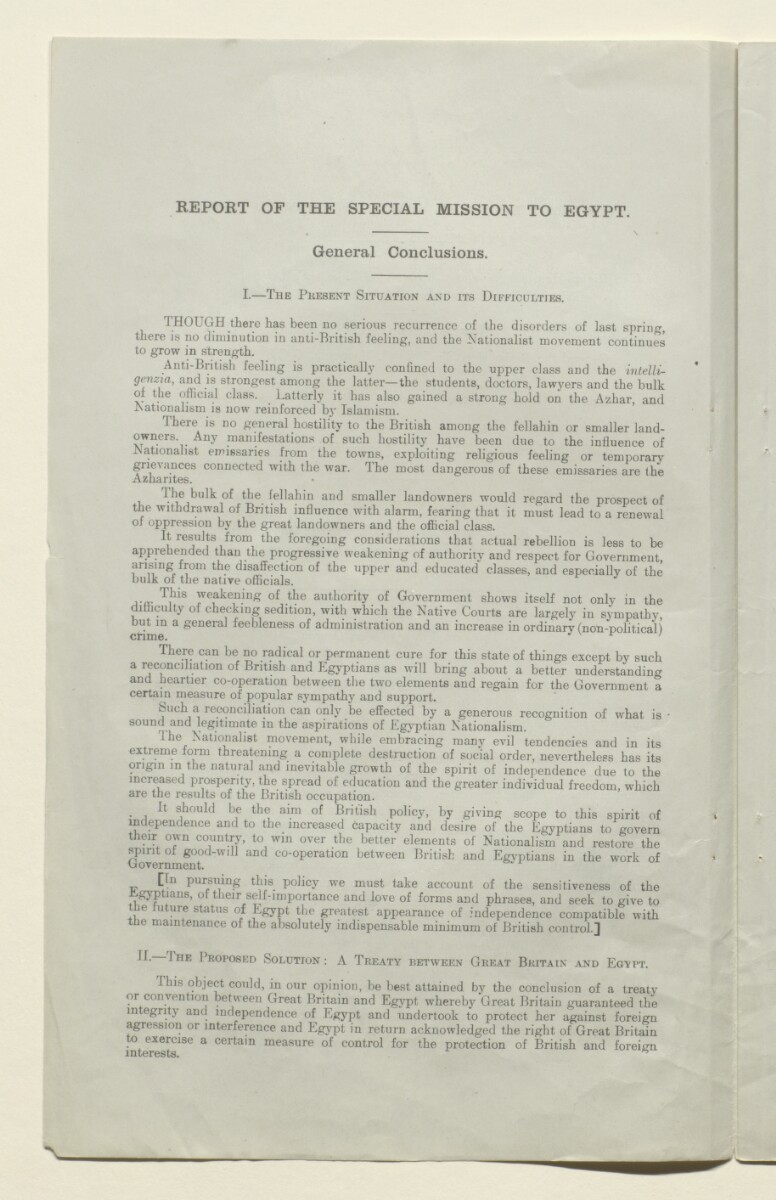
REPORT OF THE SPECIAL MISSION TO EGYPT.
General Conclusions.
I-—The Present Situation and its Difficulties.
THOUGH there has been no serious recurrence of the disorders of last spring,
there is no diminution in anti-British feeling, and the Nationalist movement continues
to grow in strength.
Anti-British feeling is practically confined to the upper class and the intelli-
genzia, and is strongest among the latter—the students, doctors, lawyers and the bulk
of the official class. Latterly it has also gained a strong hold on the Azhar, and
Nationalism is now reinforced by Islamism.
There is no general hostility to the British among the
fellahin
Arabic for ‘peasant’. It was used by British officials to refer to agricultural workers or to members of a social class employed primarily in agricultural labour.
or smaller land-
owners. Any manifestations of such hostility have been due to the influence of
Nationalist emissaries from the towns, exploiting religious feeling or temporary
grievances connected with the war. The most dangerous of these emissaries are the
Azhantes.
T he bulk of the
fellahin
Arabic for ‘peasant’. It was used by British officials to refer to agricultural workers or to members of a social class employed primarily in agricultural labour.
and smaller landowners would regard the prospect of
the withdrawal of British influence with alarm, fearing that it must lead to a renewal
of oppression by the great landowners and the oflicial class.
It results from the foregoing considerations that actual rebellion is less to be
apprehended than the progressive weakening of authority and respect for Government,
arising from the disaffection of the upper and educated classes, and especially of the
bulk of the native officials.
j’-u- ^ vea k en i D & of the authority of Government shows itself not only in the
difficulty of checking sedition, with which the Native Courts are largely in sympathy,
but m a genera] feebleness of administration and an increase in ordinary (non-political)
There can be no radical or permanent cure for this state of things except by such
a reconciliation of British and Egyptians as will bring about a better understanding
and heartier co-operation between the tw^o elements and regain for the Government a
certain measure of popular sympathy and support.
Such a reconciliation can only be effected by a generous recognition of what is
sound and legitimate in the aspirations of Egyptian Nationalism.
I he Nationalist movement, while embracing many evil tendencies and in its
extreme form threatening a complete destruction of social order, nevertheless has its
origin in the natural and inevitable growth of the spirit of independence due to the
increased prosperity, the spread of education and the greater individual freedom, which
are the results of the British occupation.
. , 11 8houl(1 ai . m of British policy, by giving scope to this spirit of
independence and to the increased capacity and desire of the Egyptians to govern
their own country, to win over the better elements of Nationalism and restore the
Governme t ^ C0 ' 0peratl011 between British and Egyptians in the work of
[In pursuing this policy we must take account of the sensitiveness of the
Egyptians, of their self-importance and love of forms and phrases, and seek to give to
the nature status of Egypt the greatest appearance of independence compatible with
le maintenance of the absolutely indispensable minimum of British control.]
H. 1 he Proposed Solution: A Treaty between Great Britain and Egypt.
I his object could, in our opinion, be best attained by the conclusion of a treaty
or convention between Great Britain and Egypt whereby Great Britain guaranteed the
m egnt} am mcependence of Egypt and undertook to protect her against foreign
agression or interference and Egypt in return acknowledged the right of Great Britain
o exercise a certain measure of control for the protection of British and foreign
J.JLI Lv3T0SLS«
About this item
- Content
The file contains official correspondence, memoranda, and reports relating to political affairs in Egypt. The correspondents and authors are officials at the Foreign Office (Lord Curzon was Secretary of State for Foreign Affairs at the time), War Office, Air Ministry, Admiralty, Colonial Office, Board of Trade, Board of Education, as well as those within the Egyptian civil service.
The file contains copies of reports of the Special Mission to Egypt (folios 1-7, 75-93, and 175-194), led by Lord Alfred Milner, whose purpose was to investigate and advise following the Egyptian Revolution of 1919. Much of the content of the file is in response to the findings and recommendations of the Mission and discusses the possibilities of a political settlement with Egypt.
- Extent and format
- 1 file (237 folios)
- Arrangement
The file is arranged in chronological order, from the front to the rear.
- Physical characteristics
Foliation: the foliation sequence (used for referencing) commences at the front cover with 1, and terminates at the inside back cover with 235; these numbers are written in pencil, are circled, and are located in the top right corner of the recto The front of a sheet of paper or leaf, often abbreviated to 'r'. side of each folio. The file has one foliation anomaly, f 76a.
- Written in
- English in Latin script View the complete information for this record
Use and share this item
- Share this item
Report of the Special Mission to Egypt under Lord Milner, and related papers [2v] (4/473), British Library: India Office Records and Private Papers, Mss Eur F112/260, in Qatar Digital Library <https://www.qdl.qa/archive/81055/vdc_100080131819.0x000005> [accessed 4 June 2026]
https://www.qdl.qa/en/archive/81055/vdc_100080131819.0x000005
Copy and paste the code below into your web page where you would like to embed the image.
<meta charset="utf-8"><a href="https://www.qdl.qa/en/archive/81055/vdc_100080131819.0x000005">Report of the Special Mission to Egypt under Lord Milner, and related papers [‎2v] (4/473)</a> <a href="https://www.qdl.qa/en/archive/81055/vdc_100080131819.0x000005"> <img src="https://iiif.qdl.qa/iiif/images/81055/vdc_100000001491.0x000295/Mss Eur F112_260_0004.jp2/full/!280,240/0/default.jpg" alt="" /> </a>
This record has a IIIF manifest available as follows. If you have a compatible viewer you can drag the icon to load it.https://www.qdl.qa/en/iiif/81055/vdc_100000001491.0x000295/manifestOpen in Universal viewerOpen in Mirador viewerMore options for embedding images
Copyright: How to use this content
- Reference
- Mss Eur F112/260
- Title
- Report of the Special Mission to Egypt under Lord Milner, and related papers
- Pages
- front, front-i, 2r:39v, 42r:50v, 53r:76v, 76ar:76av, 77r:140v, 143r:143v, 144ar, 144r:235v
- Author
- East India Company, the Board of Control, the India Office, or other British Government Department
- Usage terms
- Open Government Licence