
![Typescript and printed cabinet papers and parliamentary papers on events in Egypt [‎99r] (197/520)](https://iiif.qdl.qa/iiif/images/81055/vdc_100000001491.0x000297/Mss Eur F112_262_0197.jp2/full/!1200,1200/0/default.jpg "Typescript and printed cabinet papers and parliamentary papers on events in Egypt [‎99r] (197/520)")
Typescript and printed cabinet papers and parliamentary papers on events in Egypt [99r] (197/520)
The record is made up of 1 file (260 folios). It was created in 10 Jul 1921-27 Feb 1922. It was written in English and French. The original is part of the British Library: India Office The department of the British Government to which the Government of India reported between 1858 and 1947. The successor to the Court of Directors. Records and Private Papers Documents collected in a private capacity. .
Transcription
This transcription is created automatically. It may contain errors.
9
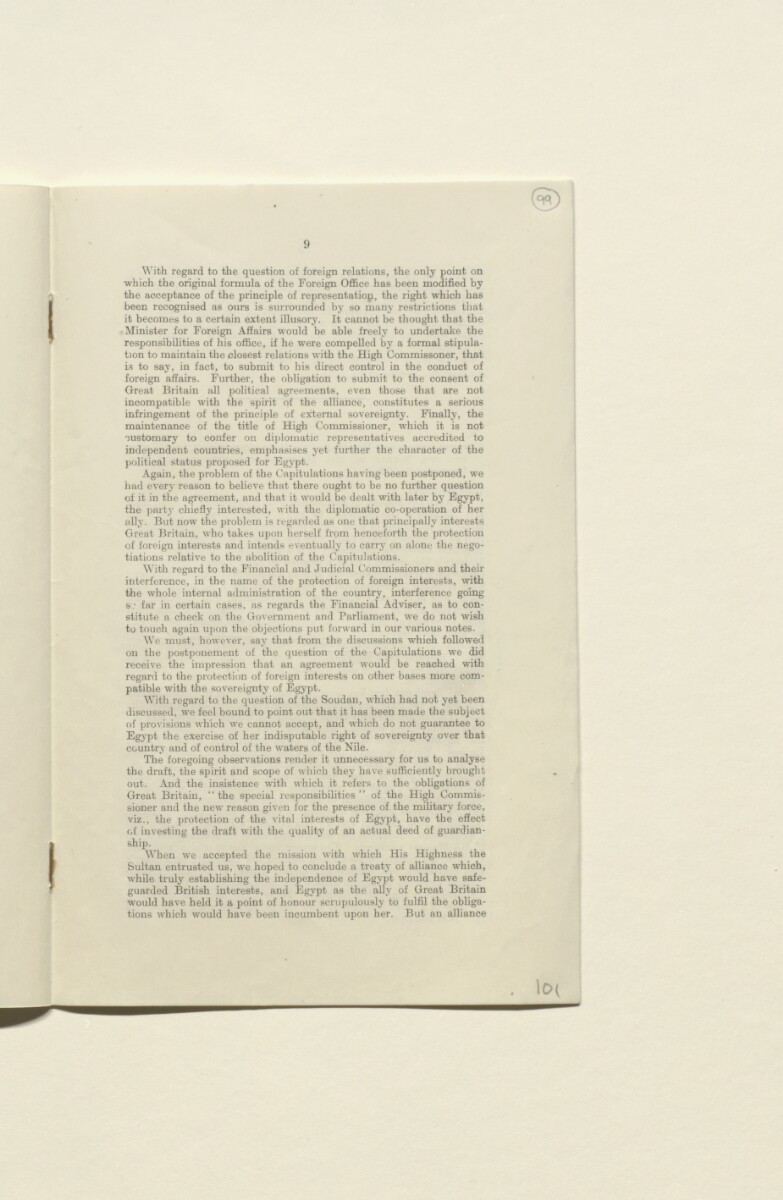
With regard to the question of foreign relations, the only point on
which the original formula of the Foreign Office has been modified by
the acceptance of the principle of representatiop, the right which has
been recognised as ours is surrounded by so many restrictions that
it becomes to a certain extent illusory. It cannot be thought that the
Minister for Foreign Affairs would be able freely to undertake the
responsibilities of his office, if he were compelled by a formal stipula
tion to maintain the closest relations with the High Commissoner, that
is to say, in fact, to submit to his direct control in the conduct of
foreign affairs. Further, the obligation to submit to the consent of
Great Britain all political agreements, even those that are not
incompatible with the spirit of the alliance, constitutes a serious
infringement of the principle of external sovereignty. Finally, the
maintenance of the title of High Commissioner, which it is not
customary to confer on diplomatic representatives accredited to
independent countries, emphasises yet further the character of the
political status proposed for Egypt.
Again, the problem of the Capitulations having been postponed, we
had every reason to believe that there ought to be no further question
of it in the agreement, and that it would be dealt with later by Egypt,
the party chiefly interested, with the diplomatic co-operation of her
ally. But now the problem is regarded as one that principally interests
Great Britain, who takes upon herself from henceforth the protection
of foreign interests and intends eventually to carry on alone the nego
tiations relative to the abolition of the Capitulations.
With regard to the Financial and Judicial Commissioners and their
interference, in the name of the protection of foreign interests, with
the whole internal administration of the country, interference going
s: far in certain cases, as regards the Financial Adviser, as to con
stitute a check on the Government and Parliament, we do not wish
to touch again upon the objections put forward in our various notes.
We must, however, say that from the discussions which followed
on the postponement of the question of the Capitulations we did
receive the impression that an agreement would be reached with
regard to the protection of foreign interests on other bases more com
patible with the sovereignty of Egypt.
With regard to the question of the Soudan, which had not yet been
discussed, we feel bound to point out that it has been made the subject
of provisions which we cannot accept, and which do not guarantee to
Egypt the exercise of her indisputable right of sovereignty over that
country and of control of the waters of the Nile.
The foregoing observations render it unnecessary for us to analyse
the draft, the spirit and scope of which they have sufficiently brought
out. And the insistence with which it refers to the obligations of
Great Britain, “ the special responsibilities ” of the High Commis
sioner and the new reason given for the presence of the military force,
viz., the protection of the vital interests of Egypt, have the effect
of investing the draft with the quality of an actual deed of guardian
ship.
When we accepted the mission with which His Highness the
Sultan entrusted us, we hoped to conclude a treaty of alliance which,
while truly establishing the independence of Egypt would have safe
guarded British interests, and Egypt as the ally of Great Britain
would have held it a point of honour scrupulously to fulfil the obliga
tions which would have been incumbent upon her. But an alliance
About this item
- Content
The file contains correspondence, memoranda, minutes, and other papers concerning the political situation in Egypt and negotiations between the British Government and an Egyptian delegation for the end of the British Protectorate in Egypt. The papers cover the effort to come to an agreement on future relations between the two parties following negotiations in the summer of 1921 and up until Britain's unilateral declaration of the end of the protectorate in February 1922.
The majority of the memoranda is written by Foreign Office officials, including the Secretary of State for Foreign Affairs, Lord Curzon. Records of meetings of the Cabinet and a sub-committee on the Egyptian situation, and of a few high-level gatherings at 10 Downing Street, make up a substantial part of the file. There is also a large amount of correspondence between Curzon and Field Marshal Edmund Henry Hynman Allenby, High Commissioner of Egypt, on the question of Egyptian independence and events in Egypt. Other papers include printed collections relating to the Egyptian situation that were presented to Parliament.
At the back of the file is a chronological summary and a résumé of events in Egypt since the publication of the report of the Milner Mission to Egypt (folios 238-260).
- Extent and format
- 1 file (260 folios)
- Arrangement
The file is arranged in chronological order, from the front to the rear.
- Physical characteristics
Foliation: the main foliation sequence (used for referencing) commences at the first folio with 1, and terminates at the last folio with 260; these numbers are written in pencil, are circled, and are located in the top right corner of the recto The front of a sheet of paper or leaf, often abbreviated to 'r'. side of each folio. An additional foliation sequence is present in parallel between ff 1-260; these numbers are also written in pencil, but are not circled.
Pagination: the file also contains an original printed pagination sequence.
- Written in
- English and French in Latin script View the complete information for this record
Use and share this item
- Share this item
Typescript and printed cabinet papers and parliamentary papers on events in Egypt [99r] (197/520), British Library: India Office Records and Private Papers, Mss Eur F112/262, in Qatar Digital Library <https://www.qdl.qa/archive/81055/vdc_100077517244.0x0000c6> [accessed 4 August 2026]
https://www.qdl.qa/en/archive/81055/vdc_100077517244.0x0000c6
Copy and paste the code below into your web page where you would like to embed the image.
<meta charset="utf-8"><a href="https://www.qdl.qa/en/archive/81055/vdc_100077517244.0x0000c6">Typescript and printed cabinet papers and parliamentary papers on events in Egypt [‎99r] (197/520)</a> <a href="https://www.qdl.qa/en/archive/81055/vdc_100077517244.0x0000c6"> <img src="https://iiif.qdl.qa/iiif/images/81055/vdc_100000001491.0x000297/Mss Eur F112_262_0197.jp2/full/!280,240/0/default.jpg" alt="" /> </a>
This record has a IIIF manifest available as follows. If you have a compatible viewer you can drag the icon to load it.https://www.qdl.qa/en/iiif/81055/vdc_100000001491.0x000297/manifestOpen in Universal viewerOpen in Mirador viewerMore options for embedding images
Copyright: How to use this content
- Reference
- Mss Eur F112/262
- Title
- Typescript and printed cabinet papers and parliamentary papers on events in Egypt
- Pages
- 1r:1v, 4r:5v, 8r:9v, 11r:19v, 23r:44v, 49r:260v
- Author
- East India Company, the Board of Control, the India Office, or other British Government Department
- Usage terms
- Open Government Licence