
![File of printed papers marked 'Egyptian negotiation' between Curzon and Adly Pasha and the Egyptian delegation [‎18v] (36/178)](https://iiif.qdl.qa/iiif/images/81055/vdc_100000001491.0x000296/Mss Eur F112_261_0036.jp2/full/!1200,1200/0/default.jpg "File of printed papers marked 'Egyptian negotiation' between Curzon and Adly Pasha and the Egyptian delegation [‎18v] (36/178)")
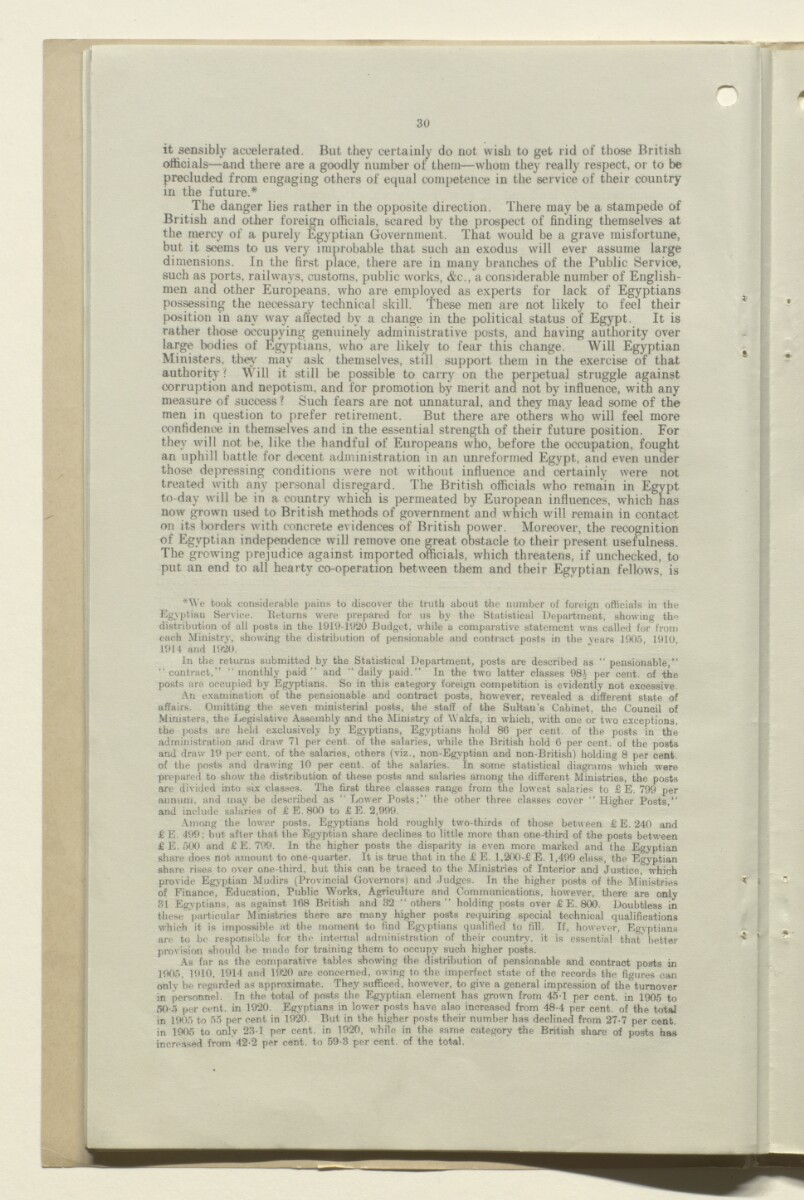
File of printed papers marked 'Egyptian negotiation' between Curzon and Adly Pasha and the Egyptian delegation [18v] (36/178)
The record is made up of 1 file (87 folios). It was created in 13 Jul 1921-4 Jan 1923. It was written in English. The original is part of the British Library: India Office The department of the British Government to which the Government of India reported between 1858 and 1947. The successor to the Court of Directors. Records and Private Papers Documents collected in a private capacity. .
Transcription
This transcription is created automatically. It may contain errors.
30
it sensibly accelerated. But they certainly do not wish to get rid of those British
officials—and there are a goodly number of them—whom they really respect, or to be
precluded from engaging others of equal competence in the service of their country
in the future.*
The danger lies rather in the opposite direction. There may be a stampede of
British and other foreign officials, scared by the prospect of finding themselves at
the mercy of a purely Egyptian Government. That would be a grave misfortune,
but it seems to us very improbable that such an exodus will ever assume large
dimensions. In the first place, there are in many branches of the Public Service,
such as ports, railways, customs, public works, &c., a considerable number of English
men and other Europeans, who are employed as experts for lack of Egyptians
possessing the necessary technical skill. These men are not likely to feel their
position in any way affected by a change in the political status of Egypt. It is
rather those occupying genuinely administrative posts, and having authority over
large bodies of Egyptians, who are likely to fear this change. Will Egyptian
Ministers, they may ask themselves, still support them in the exercise of that
authority ? Will it still be possible to carry on the perpetual struggle against
corruption and nepotism, and for promotion by merit and not by influence, with any
measure of success ? Such fears are not unnatural, and they may lead some of the
men in question to prefer retirement. But there are others who will feel more
confidence in themselves and in the essential strength of their future position. For
they will not be, like the handful of Europeans who, before the occupation, fought
an uphill battle for decent administration in an unreformed Egypt, and even under
those depressing conditions were not without influence and certainly were not
treated with any personal disregard. The British officials who remain in Egypt
to-day will be in a country which is permeated by European influences, which has
now grown used to British methods of government and which will remain in contact
on its borders with concrete evidences of British power. Moreover, the recognition
of Egyptian independence will remove one great obstacle to their present usefulness.
The growing prejudice against imported officials, which threatens, if unchecked, to
put an end to all hearty co-operation between them and their Egyptian fellows, is
*\Ye took considerable pains to discover the truth about the number of foreign officials in the
Egyptian Service. Iteturns were prepared for us by the Statistical Department, showing the
distribution of all posts in the 1919-1920 Budget, while a comparative statement was called for from
each Ministry, showing the distribution of pensionable and contract posts in the years 1905 1910
1914 and 1920.
In the returns submitted by the Statistical Department, posts are described as “ pensionable,”
“contract,” “monthly paid” and “daily paid.” In the two latter classes 981 per cent, of the
posts are occupied by Egyptians. So in this category foreign competition is evidently not excessive.
An examination of the pensionable and contract posts, however, revealed a different state of
affairs. Omitting the seven ministerial posts, the staff of the Sultan’s Cabinet, the Council of
Ministers, the Legislative Assembly and the Ministry of Wakfs, in which, with one or two exceptions,
the posts are held exclusively by Egyptians, Egyptians hold 86 per cent, of the posts in the
administration and draw 71 per cent, of the salaries, while the British hold 6 per cent, of the posts
and draw 19 per cent, of the salaries, others (viz., non-Egyptian and non-British) holding 8 per cent,
of the posts and drawing 10 per cent, of the salaries. In some statistical diagrams which were
prepared to show the distribution of these posts and salaries among the different Ministries, the posts
are divided into six classes. The first three classes range from the lowest salaries to £ E. 799 per
annum, and may be described as “ Lower Posts;” the other three classes cover “ Higher Posts,”
and include salaries of £ E. 800 to £ E. 2,999.
Among the lower posts, Egyptians hold roughly two-thirds of those between £E.240 and
£ E. 499; but after that the Egyptian share declines to little more than one-third of the posts between
£ E. 500 and £ E. 799. In the higher posts the disparity is even more marked and the Egyptian
share does not amount to one-quarter. It is true that in the £ E. l,200-£ E. 1,499 class, the Egyptian
share rises to over one-third, but this can be traced to the Ministries of Interior and Justice, "which
provide Egyptian Mudirs (Provincial Governors) and Judges. In the higher posts of the Ministries
of Finance, Education, Public Works, Agriculture and Communications, however, there are only
31 Egyptians, as against 168 British and 32 “ others ” holding posts over £ E. 800. Doubtless in
these particular Ministries there are many higher posts requiring special technical qualifications
which it is impossible at the moment to find Egyptians qualified to fill. If, however, Egyptians
are to be responsible for the internal administration of their country, it is essential that better
provision should be made for training them to occupy such higher posts.
As far as the comparative tables showing the distribution of pensionable and contract posts in
1905, 1910, 1914 and 1920 are concerned, owing to the impertect state of the records the figures can
only be regarded as approximate. They sufficed, however, to give a general impression of the^turnover
in personnel. In the total of posts the Egyptian element has grown from 45-1 per cent, in 1905 to
50-5 per cent, in 1920. Egyptians in lower posts have also increased from 48-4 per cent, of the total
in 1905 to 55 per cent in 1920. But in the higher posts their number has declined from 27-7 per cent,
in 1905 to only 23-1 per cent, in 1920, while in the same category the British share of posts haa
increased from 42-2 per cent, to 59-3 per cent, of the total.
About this item
- Content
The file contains correspondence, minutes, and memoranda relating to negotiations between the British and Egyptian governments over Egyptian independence. Most of the file consists of minutes of conferences that took place at the Foreign Office during July and August 1921. These conferences involved an Egyptian delegation, led by Sir Adly Yeghen [Yakan] Pasha An Ottoman title used after the names of certain provincial governors, high-ranking officials and military commanders. , and the British, led by the Secretary of State for Foreign Affairs, Lord George Nathaniel Curzon. Matters covered in these meetings included: the termination of the British Protectorate, Britain's military presence, foreign relations, legislation, employment of foreign officials, financial and judicial control, Soudan [Sudan], the Suez Canal, communication rights, protection of minorities, retirement and compensation of British officials, and diplomatic relations between the two countries.
Also contained within the file are minutes by Ronald Charles Lindsay and John Murray, both Foreign Office officials, and correspondence between Curzon, Lindsay, Adly Pasha An Ottoman title used after the names of certain provincial governors, high-ranking officials and military commanders. , and Field Marshal Edmund Henry Hynman Allenby, High Commissioner for Egypt and Sudan. These papers all concern matters covered by the negotiations.
Documents of note include a copy of the Report of the Special Mission to Egypt, dated 9 December 1920 (folios 4-23), and a memorandum on the political situation in Egypt by John Murray, dated 4 January 1923 (folios 74-87).
- Extent and format
- 1 file (87 folios)
- Arrangement
The file is arranged in rough chronological order, from the front to the rear. On the inside front cover is a manuscript index with a numbered list of the file's contents.
- Physical characteristics
Foliation: the main foliation sequence (used for referencing) commences at the front cover with 1, and terminates at the inside back cover with 89; these numbers are written in pencil, are circled, and are located in the top right corner of the recto The front of a sheet of paper or leaf, often abbreviated to 'r'. side of each folio. An additional foliation sequence is present in parallel between ff 2-87; these numbers are also written in pencil, but are not circled.
Pagination: the file also contains an original printed pagination sequence.
- Written in
- English in Latin script View the complete information for this record
Use and share this item
- Share this item
File of printed papers marked 'Egyptian negotiation' between Curzon and Adly Pasha and the Egyptian delegation [18v] (36/178), British Library: India Office Records and Private Papers, Mss Eur F112/261, in Qatar Digital Library <https://www.qdl.qa/archive/81055/vdc_100077019155.0x000025> [accessed 23 July 2026]
https://www.qdl.qa/en/archive/81055/vdc_100077019155.0x000025
Copy and paste the code below into your web page where you would like to embed the image.
<meta charset="utf-8"><a href="https://www.qdl.qa/en/archive/81055/vdc_100077019155.0x000025">File of printed papers marked 'Egyptian negotiation' between Curzon and Adly Pasha and the Egyptian delegation [‎18v] (36/178)</a> <a href="https://www.qdl.qa/en/archive/81055/vdc_100077019155.0x000025"> <img src="https://iiif.qdl.qa/iiif/images/81055/vdc_100000001491.0x000296/Mss Eur F112_261_0036.jp2/full/!280,240/0/default.jpg" alt="" /> </a>
This record has a IIIF manifest available as follows. If you have a compatible viewer you can drag the icon to load it.https://www.qdl.qa/en/iiif/81055/vdc_100000001491.0x000296/manifestOpen in Universal viewerOpen in Mirador viewerMore options for embedding images
Copyright: How to use this content
- Reference
- Mss Eur F112/261
- Title
- File of printed papers marked 'Egyptian negotiation' between Curzon and Adly Pasha and the Egyptian delegation
- Pages
- front, front-i, 2r:24v, 27r:40v, 46r:53v, 55r:59v, 62r:62v, 64r, 65r, 66r:67v, 71r:85v, 88r:88v, back-i, back
- Author
- East India Company, the Board of Control, the India Office, or other British Government Department
- Usage terms
- Open Government Licence