
![Papers written by Curzon on the Near and Middle East [‎136v] (272/348)](https://iiif.qdl.qa/iiif/images/81055/vdc_100000001491.0x00028c/Mss Eur F112_278_0280.jp2/full/!1200,1200/0/default.jpg "Papers written by Curzon on the Near and Middle East [‎136v] (272/348)")
Papers written by Curzon on the Near and Middle East [136v] (272/348)
The record is made up of 1 file (174 folios). It was created in 16 Nov 1917-17 Jan 1924. It was written in English and French. The original is part of the British Library: India Office The department of the British Government to which the Government of India reported between 1858 and 1947. The successor to the Court of Directors. Records and Private Papers Documents collected in a private capacity. .
Transcription
This transcription is created automatically. It may contain errors.
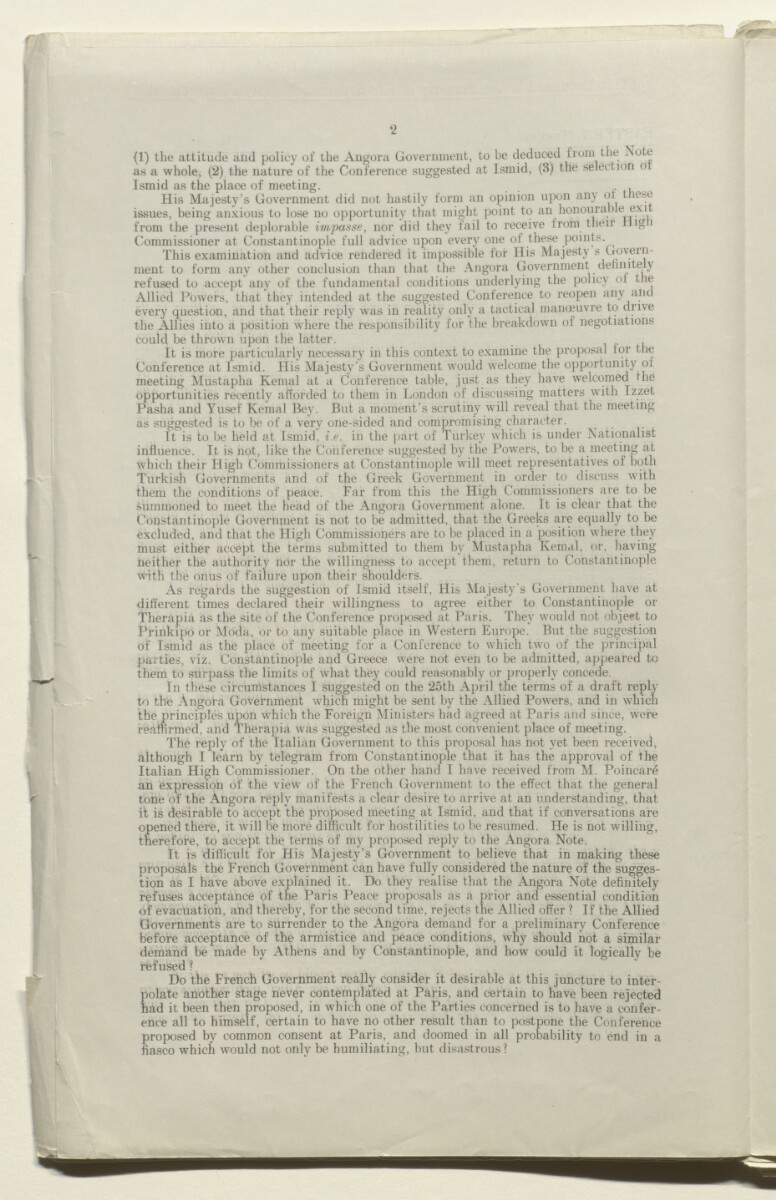
‘2
(1) the attitude and policy of the Angora Government, to be deduced from the ^ o e
as a whole, (2) the nature of the Conference suggested at Ismid, (3) the selection o
Ismid as the place of meeting. ,
His Majesty’s Government did not hastily form an opinion upon an} oi these
issues, being anxious to lose no opportunity that might point to an honourable exi
from the present deplorable impasse, nor did they fail to receive trom their lligi
Commissioner at Constantinople full advice upon every one of these points.
This examination and advice rendered it impossible tor His Majesty s Go vein-
ment to form any other conclusion than that the Angora Government definitely
refused to accept any of the fundamental conditions underlying the policy ot the
Allied Powers, that they intended at the suggested Conference to reopen any and
every question, and that their reply was in reality only a tactical manoeuvre to drive
the Allies into a position where the responsibility for the breakdown of negotiations
could be thrown upon the latter.
It is more particularly necessary in this context to examine the proposal tor the
Conference at Ismid. His Majesty's Government would welcome the opportunity of
meeting Mustapha Kemal at a Conference table, just as they have welcomed the
opportunities recently afforded to them in London of discussing matters with Tzzet
Pasha
An Ottoman title used after the names of certain provincial governors, high-ranking officials and military commanders.
and Yusef Kemal Bey. But a moment’s scrutiny will reveal that the meeting
as suggested is to be of a very one-sided and compromising character.
It is to be held at Ismid, i.e. in the part of Turkey which is under Nationalist
influence. It is not, like the Conference suggested by the Powers, to be a meeting at
which their High Commissioners at Constantinople will meet representatives of both
Turkish Governments and of the Greek Government in order to discuss with
them the conditions of peace. Far from this the High Commissioners are to be
summoned to meet the head of the Angora Government alone. It is clear that the
Constantinople Government is not to be admitted, that the Greeks are equally to be
excluded, and that the High Commissioners are to be placed in a position where they
must either accept the terms submitted to them by Mustapha Kemal, or. having
neither the authority nor the willingness to accept them, return to Constantinople
with the onus of failure upon their shoulders.
As regards the suggestion of Ismid itself, His Majesty's Government have at
different times declared their willingness to agree either to Constantinople or
Therapia as the site of the Conference proposed at Paris. They would not object to
Prinkipo or Moda, or to any suitable place in Western Europe. But the suggestion
of Ismid as the place of meeting for a Conference to which two of the principal
parties, viz. Constantinople and Greece were not even to be admitted, appeared to
them to surpass the limits of what they could reasonably or properly concede.
In these circumstances I suggested on the 25th April the terms of a draft reply
to the Angora Government which might be sent by the Allied Powers, and in which
the principles upon which the Foreign Ministers had agreed at Paris and since, were
reaffirmed, and Therapia was suggested as the most convenient place of meeting.
The reply of the Italian Government to this proposal has not yet been received,
although I learn by telegram from Constantinople that it has the approval of the
Italian High Commissioner. On the other hand I have received from M. Poincare
an expression of the view of the French Government to the effect that the general
tone of the Angora reply manifests a clear desire to arrive at an understanding, that
it is desirable to accept the proposed meeting at Ismid, and that if conversations are
opened there, it will be more difficult for hostilities to be resumed. He is not willing,
therefore, to accept the terms of my proposed reply to the Angora Note.
It is difficult for His Majesty’s Government to believe that in making these
proposals the French Government can have fully considered the nature of the sugges
tion as I have above explained it. Do they realise that the Angora Note definitely
refuses acceptance of the Paris Peace proposals as a prior and essential condition
of evacuation, and thereby, for the second time, rejects the Allied offer ? If the Allied
Governments are to surrender to the Angora demand for a preliminary Conference
before acceptance of the armistice and peace conditions, why should not a similar
demand be made by Athens and by Constantinople, and how could it logically be
refused ?
Do the French Government really consider it desirable at this juncture to inter
polate another stage never contemplated at Paris, and certain to have been rejected
had it been then proposed, in which one of the Parties concerned is to have a confer
ence all to himself, certain to have no other result than to postpone the Conference
proposed by common consent at Paris, and doomed in all probability to end in a
fiasco whicli would not only be humiliating, but disastrous?
About this item
- Content
The file contains correspondence, memoranda, maps, and notes on various subjects connected to the Near and Middle East. The majority of the papers are written by George Curzon himself and concern the settlement of former territories of the Ottoman Empire following its break up after the First World War. Matters such as the Greek occupation of Smyrna, the division of Thrace, the Greco-Turkish War, Georgian independence, and the Treaties of Sèvres and Lausanne are all discussed.
Other matters covered by the file include those concerning the Arab territories of the former Ottoman Empire, American advisers in Persia, and the future of Palestine, including a report by the Committee on Palestine (Colonial Office) dated 27 July 1923 (folios 168-171).
Correspondence within the file is mostly between Curzon and representatives of the other Allied Powers, as well as officials from other governmental departments and diplomatic offices.
- Extent and format
- 1 file (174 folios)
- Arrangement
The file is arranged in chronological order from the front to the back.
- Physical characteristics
Foliation: the foliation sequence (used for referencing) commences at the first folio with 1, and terminates at the last folio with 174; these numbers are written in pencil, are circled, and are located in the top right corner of the recto The front of a sheet of paper or leaf, often abbreviated to 'r'. side of each folio.
- Written in
- English and French in Latin script View the complete information for this record
Use and share this item
- Share this item
Papers written by Curzon on the Near and Middle East [136v] (272/348), British Library: India Office Records and Private Papers, Mss Eur F112/278, in Qatar Digital Library <https://www.qdl.qa/archive/81055/vdc_100076917036.0x000049> [accessed 1 August 2026]
https://www.qdl.qa/en/archive/81055/vdc_100076917036.0x000049
Copy and paste the code below into your web page where you would like to embed the image.
<meta charset="utf-8"><a href="https://www.qdl.qa/en/archive/81055/vdc_100076917036.0x000049">Papers written by Curzon on the Near and Middle East [‎136v] (272/348)</a> <a href="https://www.qdl.qa/en/archive/81055/vdc_100076917036.0x000049"> <img src="https://iiif.qdl.qa/iiif/images/81055/vdc_100000001491.0x00028c/Mss Eur F112_278_0280.jp2/full/!280,240/0/default.jpg" alt="" /> </a>
This record has a IIIF manifest available as follows. If you have a compatible viewer you can drag the icon to load it.https://www.qdl.qa/en/iiif/81055/vdc_100000001491.0x00028c/manifestOpen in Universal viewerOpen in Mirador viewerMore options for embedding images
Copyright: How to use this content
- Reference
- Mss Eur F112/278
- Title
- Papers written by Curzon on the Near and Middle East
- Pages
- 2r:12v, 15r:48v, 54r:93v, 95r:105v, 118r:145r, 147v:153r, 154v, 156r:161v, 163r:173v, back, back-i
- Author
- East India Company, the Board of Control, the India Office, or other British Government Department
- Usage terms
- Open Government Licence