
![Papers written by Curzon on the Near and Middle East [‎103v] (206/348)](https://iiif.qdl.qa/iiif/images/81055/vdc_100000001491.0x00028c/Mss Eur F112_278_0206.jp2/full/!1200,1200/0/default.jpg "Papers written by Curzon on the Near and Middle East [‎103v] (206/348)")
Papers written by Curzon on the Near and Middle East [103v] (206/348)
The record is made up of 1 file (174 folios). It was created in 16 Nov 1917-17 Jan 1924. It was written in English and French. The original is part of the British Library: India Office The department of the British Government to which the Government of India reported between 1858 and 1947. The successor to the Court of Directors. Records and Private Papers Documents collected in a private capacity. .
Transcription
This transcription is created automatically. It may contain errors.
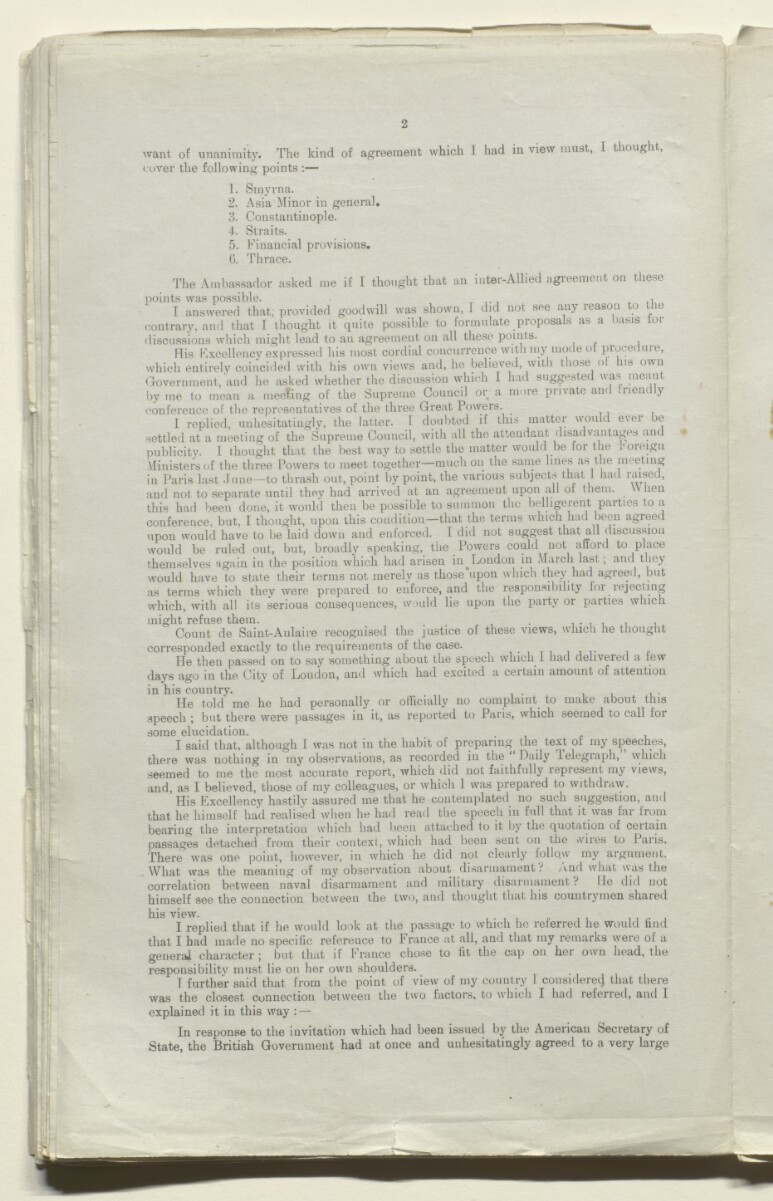
2
want of unanimity. The kind of agreement which J had in view must, I thought,
cover the following points :—
1 . Smyrna.
2. Asia Minor in general.
3. Constantinople.
4. Straits.
5. Financial provisions.
(j. Thrace.
The Ambassador asked me if I thought that an inter-Allied agreement on these
points was possible. u
I answered that, provided goodwill was shown, I did not see any reason to the
contrary, and that I thought it quite possible to formulate proposals as a basis ioi
discussions which might lead to an agreement on all these points.
His Fxcellency expressed his most cordial concurrence with my mode ot procedure,
which entirely coincided with his own views and, he believed, with those ol Ins own
Government, and he asked whether the discussion which I had suggested was meant
by me to mean a meeting of the Supreme Council or a more private and friendly
conference of the representatives of the three Great Powers.
I replied, unhesitatingly, the latter. 1 doubted if this matter would ever be
settled at a meeting of the Supreme Council, with all the attendant disadvantages an
publicity. 1 thought that the best way to settle the matter would be for the foreign
Ministers of the three Powers to meet together—much on the same ^ llle ^ as the meeting
in Paris last June—to thrash out, point by point, the various subjects that 1 had raised,
and not to separate until they had arrived at an agreement upon all of them. When
this had been done, it would then be possible to summon the belligerent parties to a
conference, but, I thought, upon this condition—that the terms which had been agreed
upon would have to be laid down and enforced. I did not suggest that all discussion
would be ruled out, but, broadly speaking, the Powers could not afford to place
themselves again in the position which had arisen in^London in March last; and they
would have to state their terms not merely as those upon which they had agreed, but
as terms which they were prepared to enforce, and the responsibility loi rejecting
which, with all its serious consequences, would lie upon the party or parties which
might refuse them. _ . . .
Count de Saint-Aulaire recognised the justice of these views, winch he thought
corresponded exactly to the requirements of the case.
He then passed on to say something about the speech which 1 had delivered a few
days ago in the Citv of London, and which had excited a ceitain amount of attention
in his country.
He told me he had personally or officially no complaint to make about this
speech ; but there were passages in it, as reported to Paris, which seemed to call loi
some elucidation. .
I said that, although I was not in the habit of preparing the text of my speeches,
there was nothing in my observations, as recorded in the Daily lelegiaph, which
seemed to me the most accurate report, which did not faithfully represent my views,
and, as I believed, those of my colleagues, or which 1 was prepared to withdraw.
His Excellency hastily assured me that he contemplated no such suggestion, ami
that he himself had realised when he had read the speech in full that it was far Ironi
bearing the interpretation which had been attached to it by the quotation of certain
passages detached from their context, which had been sent on the vires to Paris.
There was one point, however, in which he did not clearly follow my argument.
What was the meaning of my observation about disarmament ? .wnd what was the
correlation betw r een naval disarmament and military disarmament ? He did not
himself see the connection between the two, and thought that his countrymen shared
his view.
I replied that if he would look at the passage to which he referred he would hud
that I had made no specific reference to France at all, and that my remarks were of a
general character ; but that if France chose to fit the cap on her own head, the
responsibilitv must lie on her own shoulders.
T further said that from the point of view of my country I considerec) that there
was the closest connection between the two factors, to wdiich I had referred, and I
explained it in this way : —
In response to the invitation which had been issued by the American Secretary of
State, the British Government had at once and unhesitatingly agreed to a very large
About this item
- Content
The file contains correspondence, memoranda, maps, and notes on various subjects connected to the Near and Middle East. The majority of the papers are written by George Curzon himself and concern the settlement of former territories of the Ottoman Empire following its break up after the First World War. Matters such as the Greek occupation of Smyrna, the division of Thrace, the Greco-Turkish War, Georgian independence, and the Treaties of Sèvres and Lausanne are all discussed.
Other matters covered by the file include those concerning the Arab territories of the former Ottoman Empire, American advisers in Persia, and the future of Palestine, including a report by the Committee on Palestine (Colonial Office) dated 27 July 1923 (folios 168-171).
Correspondence within the file is mostly between Curzon and representatives of the other Allied Powers, as well as officials from other governmental departments and diplomatic offices.
- Extent and format
- 1 file (174 folios)
- Arrangement
The file is arranged in chronological order from the front to the back.
- Physical characteristics
Foliation: the foliation sequence (used for referencing) commences at the first folio with 1, and terminates at the last folio with 174; these numbers are written in pencil, are circled, and are located in the top right corner of the recto The front of a sheet of paper or leaf, often abbreviated to 'r'. side of each folio.
- Written in
- English and French in Latin script View the complete information for this record
Use and share this item
- Share this item
Papers written by Curzon on the Near and Middle East [103v] (206/348), British Library: India Office Records and Private Papers, Mss Eur F112/278, in Qatar Digital Library <https://www.qdl.qa/archive/81055/vdc_100076917036.0x000007> [accessed 19 June 2026]
https://www.qdl.qa/en/archive/81055/vdc_100076917036.0x000007
Copy and paste the code below into your web page where you would like to embed the image.
<meta charset="utf-8"><a href="https://www.qdl.qa/en/archive/81055/vdc_100076917036.0x000007">Papers written by Curzon on the Near and Middle East [‎103v] (206/348)</a> <a href="https://www.qdl.qa/en/archive/81055/vdc_100076917036.0x000007"> <img src="https://iiif.qdl.qa/iiif/images/81055/vdc_100000001491.0x00028c/Mss Eur F112_278_0206.jp2/full/!280,240/0/default.jpg" alt="" /> </a>
This record has a IIIF manifest available as follows. If you have a compatible viewer you can drag the icon to load it.https://www.qdl.qa/en/iiif/81055/vdc_100000001491.0x00028c/manifestOpen in Universal viewerOpen in Mirador viewerMore options for embedding images
Copyright: How to use this content
- Reference
- Mss Eur F112/278
- Title
- Papers written by Curzon on the Near and Middle East
- Pages
- 2r:12v, 15r:48v, 54r:93v, 95r:105v, 118r:145r, 147v:153r, 154v, 156r:161v, 163r:173v, back, back-i
- Author
- East India Company, the Board of Control, the India Office, or other British Government Department
- Usage terms
- Open Government Licence