
![Papers written by Curzon on the Near and Middle East [‎21r] (41/348)](https://iiif.qdl.qa/iiif/images/81055/vdc_100000001491.0x00028c/Mss Eur F112_278_0041.jp2/full/!1200,1200/0/default.jpg "Papers written by Curzon on the Near and Middle East [‎21r] (41/348)")
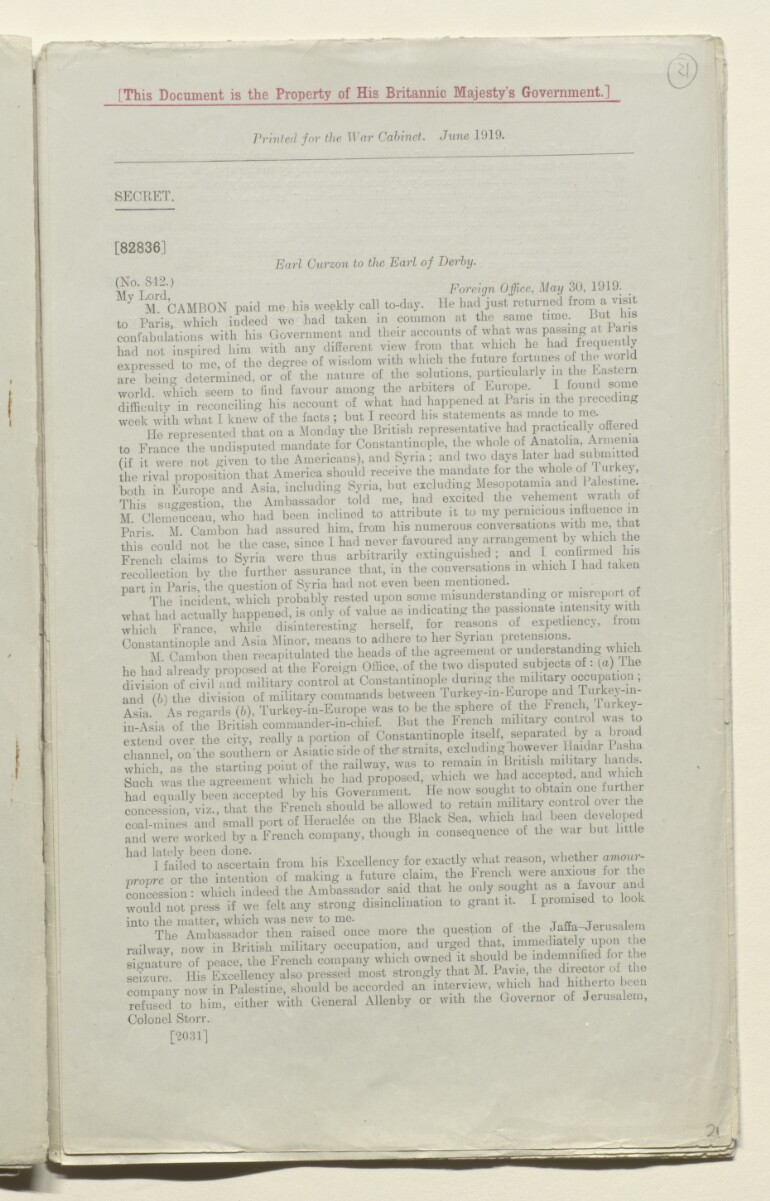
Papers written by Curzon on the Near and Middle East [21r] (41/348)
The record is made up of 1 file (174 folios). It was created in 16 Nov 1917-17 Jan 1924. It was written in English and French. The original is part of the British Library: India Office The department of the British Government to which the Government of India reported between 1858 and 1947. The successor to the Court of Directors. Records and Private Papers Documents collected in a private capacity. .
Transcription
This transcription is created automatically. It may contain errors.
[This Document is the Property of His Britannic Majesty’s Government. 1
Printed for the ^Vcir Cabinet. June 11)19.
SECRET.
[82836]
Earl Curzon to the Earl of Derby.
IMv Vord^ Foreign Office, May 30, 1919.
M GAMBON paid me hie weekly call to-day. He had just returned from a visit
to Paris which indeed we had taken in common at the same time. But Ins
confabulations with his Government and their accounts of what was passing at Pans
had not inspired him with any different view from that which he had frequently
expressed to me, of the degree of wisdom with which the future fortunes of the wor
are being determined, or of the nature of the solutions particularly in the pastern
world which seem to find favour among the arbiters of Emope. 1 found some
difficulty in reconciling his account of what had happened at Pans in the preceding
week with what I knew of the facts ; but I record his statements as made to me.
He represented that on a Monday the British representative had practically offered
to France the undisputed mandate for Constantinople, the whole of
Anatolia
Peninsula that forms most of modern-day Turkey.
, Aimenia
if It were not given to the Americans), and Syria ; and two days later had subnntted
the rival proposition that America should receive the mandate for the whole of I urkej,
both in Europe and Asia, including Syria, but excluding Mesopotamia and ah s in .
This suggestion, the Ambassador told me, had excited the vehement wrath of
M Olemenceau who had been inclined to attribute it to my pernicious influence in
Paris M. Canibon had assured him, from his numerous conversations with me that
tliis could not be the case, since I had never favoured any arrangement by which the
French claims to Syria were thus arbitrarily extinguished; and conhimed Ins
recollection bv the further assurance that, in the conversations m which 1 had taken
oart in Paris, the question of Syria had not even been mentioned. .
The incident, which probably rested upon some misunderstanding or misreport of
what had actually happened, is only of value as indicating the passionate intensity wit
which France, while dismteresting herself, for reasons of expediency,
rrmstnntinoole and Asia Minor, means to adhere to her Syrian pretensions.
M. Gambon then recapitulated the heads of the agreement or understanding whic
he had already proposed at the Foreign Office,.of the two disputed subjects of : (a) 1 he
division of civiUnd military control at Constantinople during the military occupation ,
and (b) the division of military commands between Turkey-in-Europe and Turke\-in-
Asia Vs regards (6), Turkey-in-Europe was to be the sphere of the French, lurkey-
Asia of die British commander-in-chief. But the French military control was to
extend over the city, really a portion of Constantinople itself, separated by a broad
channel, on the southern or Asiatic side of the straits, excludingffiow^
which as the starting point of the railway, was to remain m British military liand
Such was the agreement which he had proposed, which we had accepted, and wine
had eauallv been accepted by his Government. He now sought to obtain one iuither
concession viz., that the French should be allowed to retain military control over the
coal-mines' and small port of HeracWe on the Black Sea, wh ‘ C p h 'riLe'war butHtde
and were worked by a French company, though in consequence ot the ^ar but little
lia<l ^fade^to ascertain from his Excellency for exactly what reason, whether amour-
propre or the intention of making a future claim, the French were anxious for the
concession: which indeed the Ambassador said that he only sought as a favour ai ■
would not press if we felt any strong disinclination to grant rt. I promised to look
into the matter, which was new to me. Tnffa Tpnmalem
The Ambassador then raised once more the question of the Jaffa Jerusafe
railway now in British military occupation, and urged that, immediately upon the
signature of peace, the French company which owned it should be indemnilied for the
seizure. His^xcellency also pressed most strongly that M. Pavie, the director of the
company now in Palestine, should be accorded an interview, which had hitherto xc
refused" to him, either with General Allenby or with the Governor of Jerusalei ,
Colonel Storr.
[2031]
About this item
- Content
The file contains correspondence, memoranda, maps, and notes on various subjects connected to the Near and Middle East. The majority of the papers are written by George Curzon himself and concern the settlement of former territories of the Ottoman Empire following its break up after the First World War. Matters such as the Greek occupation of Smyrna, the division of Thrace, the Greco-Turkish War, Georgian independence, and the Treaties of Sèvres and Lausanne are all discussed.
Other matters covered by the file include those concerning the Arab territories of the former Ottoman Empire, American advisers in Persia, and the future of Palestine, including a report by the Committee on Palestine (Colonial Office) dated 27 July 1923 (folios 168-171).
Correspondence within the file is mostly between Curzon and representatives of the other Allied Powers, as well as officials from other governmental departments and diplomatic offices.
- Extent and format
- 1 file (174 folios)
- Arrangement
The file is arranged in chronological order from the front to the back.
- Physical characteristics
Foliation: the foliation sequence (used for referencing) commences at the first folio with 1, and terminates at the last folio with 174; these numbers are written in pencil, are circled, and are located in the top right corner of the recto The front of a sheet of paper or leaf, often abbreviated to 'r'. side of each folio.
- Written in
- English and French in Latin script View the complete information for this record
Use and share this item
- Share this item
Papers written by Curzon on the Near and Middle East [21r] (41/348), British Library: India Office Records and Private Papers, Mss Eur F112/278, in Qatar Digital Library <https://www.qdl.qa/archive/81055/vdc_100076917035.0x00002a> [accessed 18 August 2026]
https://www.qdl.qa/en/archive/81055/vdc_100076917035.0x00002a
Copy and paste the code below into your web page where you would like to embed the image.
<meta charset="utf-8"><a href="https://www.qdl.qa/en/archive/81055/vdc_100076917035.0x00002a">Papers written by Curzon on the Near and Middle East [‎21r] (41/348)</a> <a href="https://www.qdl.qa/en/archive/81055/vdc_100076917035.0x00002a"> <img src="https://iiif.qdl.qa/iiif/images/81055/vdc_100000001491.0x00028c/Mss Eur F112_278_0041.jp2/full/!280,240/0/default.jpg" alt="" /> </a>
This record has a IIIF manifest available as follows. If you have a compatible viewer you can drag the icon to load it.https://www.qdl.qa/en/iiif/81055/vdc_100000001491.0x00028c/manifestOpen in Universal viewerOpen in Mirador viewerMore options for embedding images
Copyright: How to use this content
- Reference
- Mss Eur F112/278
- Title
- Papers written by Curzon on the Near and Middle East
- Pages
- 2r:12v, 15r:48v, 54r:93v, 95r:105v, 118r:145r, 147v:153r, 154v, 156r:161v, 163r:173v, back, back-i
- Author
- East India Company, the Board of Control, the India Office, or other British Government Department
- Usage terms
- Open Government Licence