
!['General information on Persia for any future edition, 1895' [‎51r] (92/211)](https://iiif.qdl.qa/iiif/images/81055/vdc_100000001491.0x00033d/Mss Eur F111_67_0098.jp2/full/!1200,1200/0/default.jpg "'General information on Persia for any future edition, 1895' [‎51r] (92/211)")
'General information on Persia for any future edition, 1895' [51r] (92/211)
The record is made up of 1 volume (109 folios). It was created in c 1892-1895. It was written in English. The original is part of the British Library: India Office The department of the British Government to which the Government of India reported between 1858 and 1947. The successor to the Court of Directors. Records and Private Papers Documents collected in a private capacity. .
Transcription
This transcription is created automatically. It may contain errors.
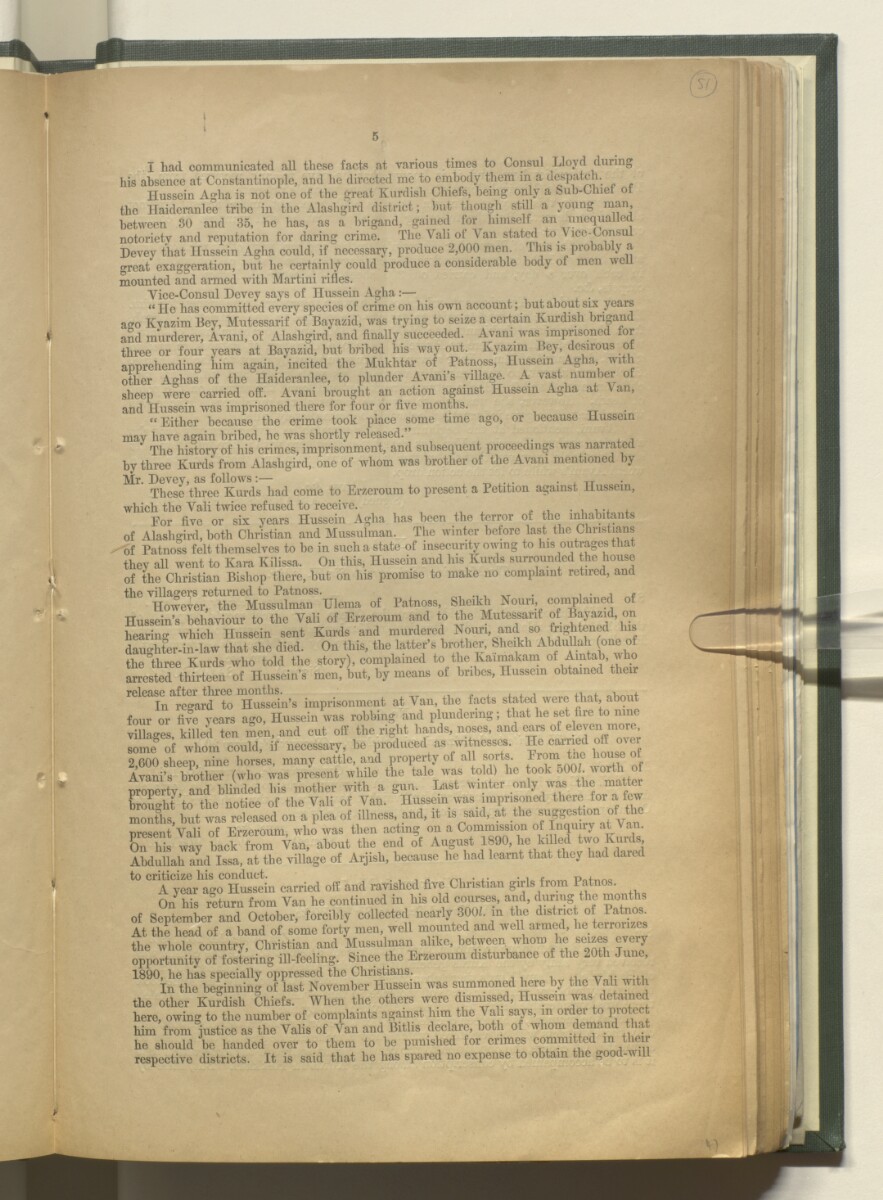
I had communicated all these facts at various times to Consul Llo\ d during
his absence at Constantinople, and he directed me to embody them in a despatch.^
Hussein Agha is not one of the great Kurdish Chiefs, being only a Sub-Chiet o
the Haideranlee tribe in the Alashgird district; but though still a young man,
between 30 and 35 , he has, as a brigand, gained for himself an unequalled
notoriety and reputation for daring crime. The Vali of A an stated to Yice-Consu
Devey that Hussein Agha could, if necessary, produce 2,000 men. This is probably a
great exaggeration, but he certainly could produce a considerable body of men ue
mounted and armed with Martini rifles.
Vice-Consul Devey says of Hussein Agha :—
“ He has committed every species of crime on his own account; but about six years
a "0 Kyazim Bey, Mutessarif of Bayazid, was trying to seize a certain Kurdish brigand
and murderer, Avani, of Alashgird, and finally succeeded. Ayani was imprisoned for
three or four years at Bayazid, but bribed his way out. Kyazim Bey, desirous or
apprehending him again, incited the Mukhtar of Patnoss, Hussein Agha, with
other Aghas of the Haideranlee, to plunder Avani’s village. A vast number oi
sheep were carried off. Avani brought an action against Hussein Agha at Van,
and Hussein was imprisoned there for four or five months.
“ Either because the crime took place some time ago, or because Hussein
may have again bribed, he was shortly released.”
The history of his crimes, imprisonment, and subsequent proceedings was narrated
by three Kurds from Alashgird, one of whom was brother of the Avani mentioned by
Mr. Devey, as follows:— _ • i tt
These three Kurds had come to Erzeroum to present a Petition against Hussein,
which the Vali twice refused to receive.
For five or six years Hussein Agha has been the terror of the inhabitants
of Alashgird, both Christian and Mussulman. The winter before last the Christians
^of Patnoss felt themselves to be in such a state of insecurity owing to his outrages that
they all went to Kara Kilissa. On this, Hussein and his Kurds surrounded the house
of the Christian Bishop there, but on his promise to make no complaint retired, and
the villagers returned to Patnoss. _ « ^. T • i •
However, the Mussulman Ulema of Patnoss, Sheikh Noun, complained of
Hussein’s behaviour to the Vali of Erzeroum and to the Mutessarif of Bayazid, on
hearing which Hussein sent Kurds and murdered Noun, and so frightened his
daughter-in-law that she died. On this, the latter s brother, Sheikh Abdullah (one of
the three Kurds who told the story), complained to the Kaimakam of Amtab
arrested thirteen of Hussein’s men, but, by means of bribes, Hussein obtained their
reiease^after three months.^ at V an, the facts stated were that about
four or five years ago, Hussein was robbing and plundering; that he set fuc to nine
villages, killed ten men, and cut off the right hands, noses, and ears of eleven more,
some of whom could, if necessary, be produced as witnesses. He carried off o\ er
2,600 sheep, nine horses, many cattle, and property of all sorts. From the house of
Avani’s brother (who was present while the tale was told) he took 500/. " orl1 '
property and blinded bis mother with a gun. Last winter only was the matter
brought ’to the notice of the Vali of Van. Hussein was imprisoned there for a few
months, but was released on a plea of illness, and, it is said, at ,* e ° y
present Vali of Erzeroum, who was then acting on a Commission ^ a )- J 1 , '
On his way back from Van, about the end of August 1890, he killed ti o Kurds
Abdullah and Issa, at the village of Arjish, because he had learnt that they had dated
A year ago Hussein carried off and ravished five Christian girls from Pat nos.
On his return from Van he continued in his old courses, and, during the months
of September and October, forcibly collected nearly 300/. m the district of Patnos
At the head of a band of some forty men, well mounted and well armed, he terronzes
the whole country, Christian and Mussulman alike, between whom he seizes every
opportunity of fostering ill-feeling. Since the Erzeroum disturbance of the 20th June,
1890, be has specially oppressed the Christians.
In the beginning of last November Hussein was summoned here by the Vah wi
the other Kurdish Chiefs. When the others were dismissed, Hussein was detained
here, owing to the number of complaints against him the Vali says, m order to protect
him from iustice as the Valis of Van and Bitlis declare, both of whom demand that
he should be handed over to them to be punished for crimes committed m their
respective districts. It is said that he has spared no expense to obtain the good-will
About this item
- Content
This volume consists of an envelope of notes and printed papers that make up some ancillary materials collected by George Curzon at the time of the publication of his book, Persia and the Persian Question . The notes consist of official correspondence on Persia from the British Government, archaeological surveys, and more recent published material on the trade and regional affairs of Persia, particularly the ports of the Persian Gulf The historical term used to describe the body of water between the Arabian Peninsula and Iran. and its trade with India. The papers were originally kept in a large envelope, which is found at the back of the volume.
- Extent and format
- 1 volume (109 folios)
- Arrangement
The papers appear in no discernible order.
- Physical characteristics
Foliation: the foliation sequence (used for referencing) commences at the inside front cover with 1, and terminates at the inside back cover with 111; these numbers are written in pencil, are circled, and are located in the top right corner of the recto The front of a sheet of paper or leaf, often abbreviated to 'r'. side of each folio.
- Written in
- English in Latin script View the complete information for this record
Use and share this item
- Share this item
'General information on Persia for any future edition, 1895' [51r] (92/211), British Library: India Office Records and Private Papers, Mss Eur F111/67, in Qatar Digital Library <https://www.qdl.qa/archive/81055/vdc_100076639076.0x00005d> [accessed 10 August 2026]
https://www.qdl.qa/en/archive/81055/vdc_100076639076.0x00005d
Copy and paste the code below into your web page where you would like to embed the image.
<meta charset="utf-8"><a href="https://www.qdl.qa/en/archive/81055/vdc_100076639076.0x00005d">'General information on Persia for any future edition, 1895' [‎51r] (92/211)</a> <a href="https://www.qdl.qa/en/archive/81055/vdc_100076639076.0x00005d"> <img src="https://iiif.qdl.qa/iiif/images/81055/vdc_100000001491.0x00033d/Mss Eur F111_67_0098.jp2/full/!280,240/0/default.jpg" alt="" /> </a>
This record has a IIIF manifest available as follows. If you have a compatible viewer you can drag the icon to load it.https://www.qdl.qa/en/iiif/81055/vdc_100000001491.0x00033d/manifestOpen in Universal viewerOpen in Mirador viewerMore options for embedding images
Copyright: How to use this content
- Reference
- Mss Eur F111/67
- Title
- 'General information on Persia for any future edition, 1895'
- Pages
- front, back, spine, edge, head, tail, front-i, 2r:3v, 10r, 11r:11v, 36r:36v, 47r:59v, 60v:93r, 94r:98v, 100r:110v, back-i
- Author
- East India Company, the Board of Control, the India Office, or other British Government Department
- Usage terms
- Open Government Licence