
!['Memoirs and Recollections of An Officer of the Indian Political Service' [‎14r] (27/156)](https://iiif.qdl.qa/iiif/images/81055/vdc_100000000880.0x0002d8/Mss Eur F226_7_0027.jp2/full/!1200,1200/0/default.jpg "'Memoirs and Recollections of An Officer of the Indian Political Service' [‎14r] (27/156)")
'Memoirs and Recollections of An Officer of the Indian Political Service' [14r] (27/156)
The record is made up of 1 file (78 folios). It was created in 1983?. It was written in English. The original is part of the British Library: India Office The department of the British Government to which the Government of India reported between 1858 and 1947. The successor to the Court of Directors. Records and Private Papers Documents collected in a private capacity. .
Transcription
This transcription is created automatically. It may contain errors.
14
/4
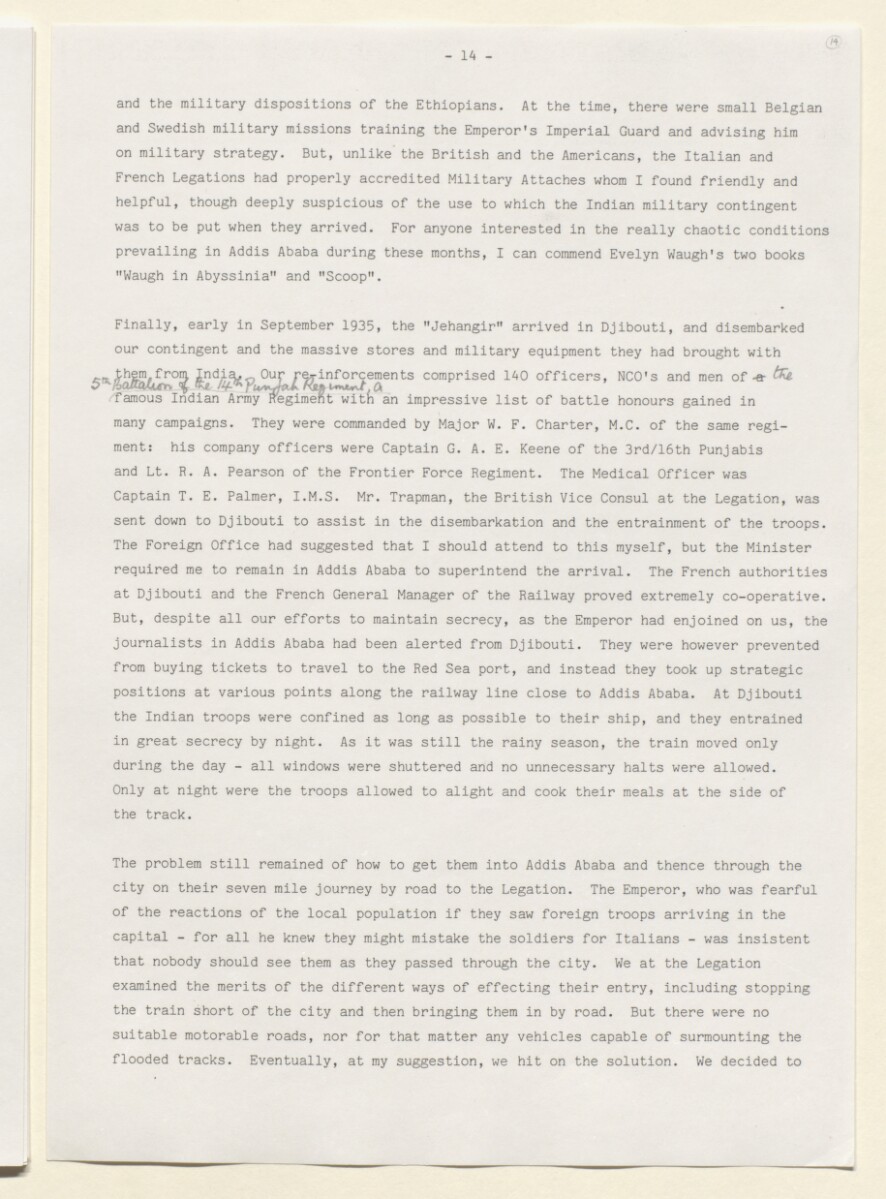
and the military dispositions of the Ethiopians. At the time, there were small Belgian
and Swedish military missions training the Emperor's Imperial Guard and advising him
on military strategy. But, unlike the British and the Americans, the Italian and
French Legations had properly accredited Military Attaches whom I found friendly and
helpful, though deeply suspicious of the use to which the Indian military contingent
was to be put when they arrived. For anyone interested in the really chaotic conditions
prevailing in Addis Ababa during these months, I can commend Evelyn Waugh's two books
"Waugh in Abyssinia" and "Scoop".
Finally, early in September 1935, the "Jehangir" arrived in Djibouti, and disembarked
our contingent and the massive stores and military equipment they had brought with
OU ^/’1ji r i£2i5 e S entS cornprised 140 officers, NCO's and men of-a-
famous Indian Army Regiment witfi an impressive list of battle honours gained in
many campaigns. They were commanded by Major W. F. Charter, M.C. of the same regi
ment: his company officers were Captain G. A. E. Keene of the 3rd/16th Punjabis
and Lt. R. A. Pearson of the Frontier Force Regiment. The Medical Officer was
Captain T. E. Palmer, I.M.S. Mr. Trapman, the British Vice Consul at the Legation, was
sent down to Djibouti to assist in the disembarkation and the entrainment of the troops.
The Foreign Office had suggested that I should attend to this myself, but the Minister
required me to remain in Addis Ababa to superintend the arrival. The French authorities
at Djibouti and the French General Manager of the Railway proved extremely co-operative.
But, despite all our efforts to maintain secrecy, as the Emperor had enjoined on us, the
journalists in Addis Ababa had been alerted from Djibouti. They were however prevented
from buying tickets to travel to the Red Sea port, and instead they took up strategic
positions at various points along the railway line close to Addis Ababa. At Djibouti
the Indian troops were confined as long as possible to their ship, and they entrained
in great secrecy by night. As it was still the rainy season, the train moved only
during the day - all windows were shuttered and no unnecessary halts were allowed.
Only at night were the troops allowed to alight and cook their meals at the side of
the track.
The problem still remained of how to get them into Addis Ababa and thence through the
city on their seven mile journey by road to the Legation. The Emperor, who was fearful
of the reactions of the local population if they saw foreign troops arriving in the
capital - for all he knew they might mistake the soldiers for Italians - was insistent
that nobody should see them as they passed through the city. We at the Legation
examined the merits of the different ways of effecting their entry, including stopping
the train short of the city and then bringing them in by road. But there were no
suitable motorable roads, nor for that matter any vehicles capable of surmounting the
flooded tracks. Eventually, at my suggestion, we hit on the solution. We decided to
About this item
- Content
This file contains a photocopy of a typewritten draft of Sir John Richard Cotton's (b 1909) memoirs of his time in the Indian military and civil service. The memoirs, which were written when the author was 'in his seventy-fourth year', cover his time in the Indian Army, at Aden, Ethiopia, Attock, the Persian Gulf The historical term used to describe the body of water between the Arabian Peninsula and Iran. , Mount Abu, Hyderabad, Rajkot (Kathiawar), the Political Department in New Delhi, and finally the UK High Commission in Pakistan.
- Extent and format
- 1 file (78 folios)
- Physical characteristics
Foliation: the foliation sequence (used for referencing) commences at the first folio with 1, and terminates at the last folio with 78; these numbers are written in pencil and are located in the top right corner of the recto The front of a sheet of paper or leaf, often abbreviated to 'r'. side of each folio. The file also contains an original printed foliation sequence.
- Written in
- English in Latin script View the complete information for this record
Use and share this item
- Share this item
'Memoirs and Recollections of An Officer of the Indian Political Service' [14r] (27/156), British Library: India Office Records and Private Papers, Mss Eur F226/7, in Qatar Digital Library <https://www.qdl.qa/archive/81055/vdc_100076278456.0x00001c> [accessed 15 June 2026]
https://www.qdl.qa/en/archive/81055/vdc_100076278456.0x00001c
Copy and paste the code below into your web page where you would like to embed the image.
<meta charset="utf-8"><a href="https://www.qdl.qa/en/archive/81055/vdc_100076278456.0x00001c">'Memoirs and Recollections of An Officer of the Indian Political Service' [‎14r] (27/156)</a> <a href="https://www.qdl.qa/en/archive/81055/vdc_100076278456.0x00001c"> <img src="https://iiif.qdl.qa/iiif/images/81055/vdc_100000000880.0x0002d8/Mss Eur F226_7_0027.jp2/full/!280,240/0/default.jpg" alt="" /> </a>
This record has a IIIF manifest available as follows. If you have a compatible viewer you can drag the icon to load it.https://www.qdl.qa/en/iiif/81055/vdc_100000000880.0x0002d8/manifestOpen in Universal viewerOpen in Mirador viewerMore options for embedding images
Copyright: How to use this content
- Reference
- Mss Eur F226/7
- Title
- 'Memoirs and Recollections of An Officer of the Indian Political Service'
- Pages
- 1r:78v
- Author
- Cotton, Sir John Richard
- Copyright
- ©From Sir John Cotton's "Memoirs & Recollections of an Officer of the Indian Political Service"
- Usage terms
- Creative Commons Non-Commercial Licence