
![Letters and Papers Concerning the Trans-Persian Railway and Other Railways in Persia [‎149v] (298/442)](https://iiif.qdl.qa/iiif/images/81055/vdc_100000001491.0x0001bd/Mss Eur F112_252_0302.jp2/full/!1200,1200/0/default.jpg "Letters and Papers Concerning the Trans-Persian Railway and Other Railways in Persia [‎149v] (298/442)")
Letters and Papers Concerning the Trans-Persian Railway and Other Railways in Persia [149v] (298/442)
The record is made up of 1 file (221 folios). It was created in Nov 1911-Mar 1917. It was written in English. The original is part of the British Library: India Office The department of the British Government to which the Government of India reported between 1858 and 1947. The successor to the Court of Directors. Records and Private Papers Documents collected in a private capacity. .
Transcription
This transcription is created automatically. It may contain errors.
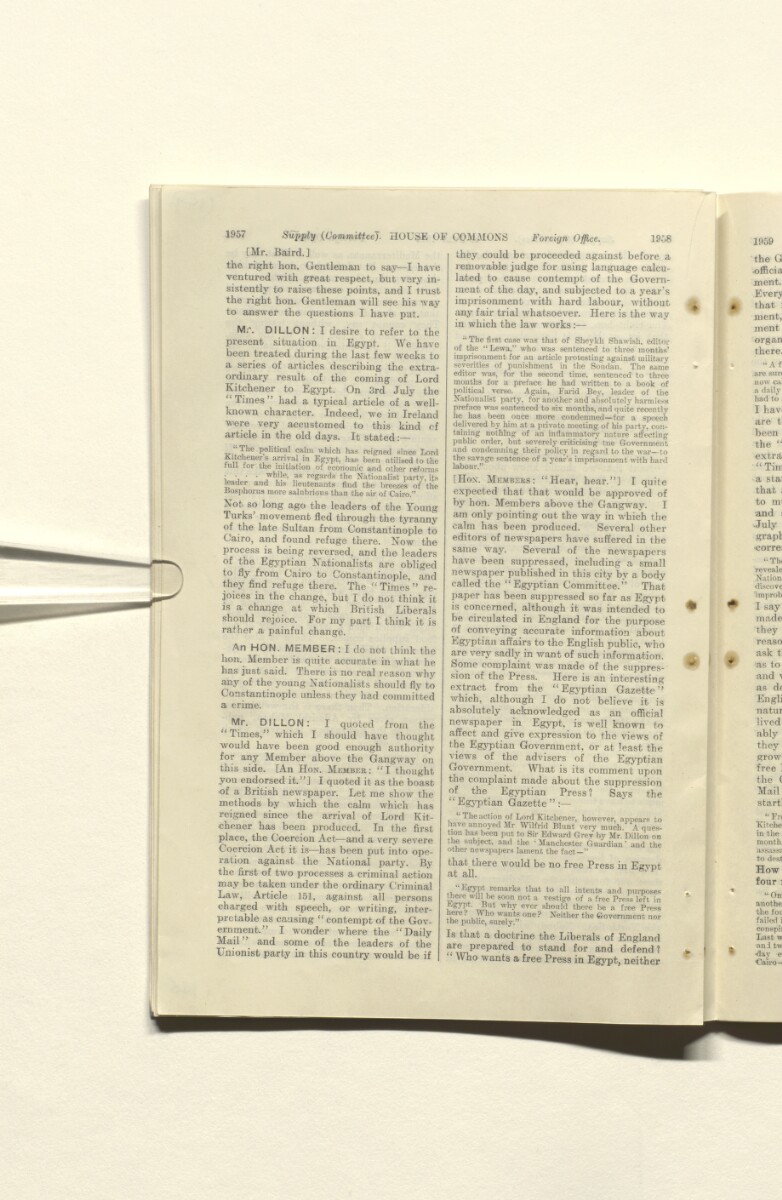
1957
Supply {Committee). HOUSE OF COMMONS Foreign Office.
1958
[Mr. Baird.]
the right hon. Gentleman to say—I have
ventured with great respect, but vary in
sistently to raise these points, and I trust
the right hon. Gentleman will see his way
to answer the questions I have put.
Mr. DILLON : I desire to refer to the
present situation in Egypt. We have
been treated during the last few weeks to
a series of articles describing the extra
ordinary result of the coming of Lord
Kitchener to Egypt. On 3rd July the
Times had a typical article of a well-
known character. Indeed, we in Ireland
were very accustomed to this kind of
article in the old days. It stated
r p ie political calm which has reigned since Lord
Kitcheners arrival in Egypt, has been utilised to the
lull tor the initiation of economic and other reforms
• . . . while, as regards the Nationalist party, its
leader and his lieutenants find the breezes of the
-Bosphorus more salubrious than the air of Cairo.”
Not so long ago the leaders of the Young
Turks movement fled through the tyranny
of the late Sultan from Constantinople to
Cairo, and found refuge there. Now the
process is being reversed, and the leaders
of the Egyptian Nationalists are obliged
to fly from Cairo to Constantinople, and
they find refuge there. The “ Times ” re
joices in the change, but I do not think it
is a change at which British Liberals
should rejoice. For my part I think it is
rather a painful change.
An HON. MEMBER : I do not think the
hon. Member is quite accurate in what he
has just said. There is no real reason why
any of the young Nationalists should fly to
Constantinople unless they had committed
a crime.
Mr. DILLON: I quoted from the
“Times,” which I should have thought
would have been good enough authority
for any Member above the Gangway on
this side. [An Hon. Member: “I thought
you endorsed it.”] I quoted it as the boast
of a British newspaper. Let me show the
methods by which the calm which has
reigned since the arrival of Lord Kit
chener has been produced. In the first
place, the Coercion Act—and a very severe
Coercion Act it is—has been put into ope
ration against the National party. By
the first of two processes a criminal action
may be taken under the ordinary Criminal
Law, Article 151, against ail persons
charged with speech, or writing, inter
pretable as causing “ contempt of the Gov
ernment.” I wonder where the “Daily
Mail” and some of the leaders of the
Unionist party in this country would be if
they could be proceeded against before a
removable judge for using language calcu
lated to cause contempt of the Govern
ment of the day, and subjected to a year's
imprisonment with hard labour, without
any fair trial whatsoever. Here is the way
in which the law works:—
The first case was that of Sheykh Shawish, editor
of the “Lewa,” who was sentenced to three months’
imprisonment for an article protesting against military
severities of punishment in the Soudan. The same
editor was, for the second time, sentenced to three
months for a preface he had written to a book of
political verse. Again, Farid Bey, leader of the
Nationalist party, for another and absolutely harmless
preface was sentenced to six months, and quite recently
he has been once more condemned—for a speech
delivered by him at a private meeting of his party, con
taining nothing of an inflammatory nature affecting
public order, but severely criticising tne Government
and condemning their policy in regard to the war—to
the savage sentence of a year’s imprisonment with hard
labour.”
[Hon. Members: “Hear, hear.”] I quite
expected that that would be approved of
by hon. Members above the Gangway. I
am only pointing out the way in which the
calm has been produced. Several other
editors of newspapers have suffered in the
same way. Several of the newspapers
have been suppressed, including a small
newspaper published in this city by a body
called the “Egyptian Committee.” That
paper has been suppressed so far as Egypt
is concerned, although it was intended" to
be circulated in England for the purpose
of conveying accurate information about
Egyptian affairs to the English public, who
are very sadly in want of such information.
Some complaint was made of the suppres
sion of the Press. Here is an interesting
extract from the “Egyptian Gazette”
which, although I do not believe it is
absolutely acknowledged as an official
newspaper in Egypt, is well known to
affect and give expression to the views of
the Egyptian Government, or at least the
views of the advisers of the Egyptian
Government. What is its comment upon
the complaint made about the suppression
of the Egyptian Press? Savs the
“Egyptian Gazette”:—
have annoyed Mr Wilfrid Blunt very much. A ques
tion has been put to Sir Edward Grey by Mr. Dillon on
the subject, and the ‘Manchester Guardian" and the
other newspapers lament the fact—”
that there would be no free Press in Egypt
at all.
Fg.VPt remarks that to all intents and purposes
there will be soon not a vestige of a free Press left in
V" wh y ever should there be a free Press
: 1 , ere • 110 wants one ? Neither the Government nor
the public, surely.
Is that a doctrine the Liberals of England
are prepared to stand for and defend?
“ Wh° wants a free Press in Egypt, neither
About this item
- Content
The file contains correspondence, memoranda, and other papers relating to railway projects in Persia [Iran] and the surrounding region. The papers deal with the proposals for, planning, and progress of, several railway lines, including one from the Mediterranean to India, the Trans-Persian Railway, the Baghdad Railway, and the Nushki and Dalbandin extension from Quetta. The documents discuss the merits and flaws of the proposals, technical issues such as gauge sizes, and the impact of such projects on Britain's relations with Russia, Germany, France, and Turkey.
At the back of the file are a number of official reports on Parliamentary debates within the House of Commons, dating from 10 July 1912 to 25 May 1914, all of which feature railways (folios 128-218). Also at the rear of the file are three maps:
- General Map of Asia with proposed British, German, and Russian rail lines added by hand
- War Office map of the Middle East, showing railways and railway projects
- As above with further rail lines added and details of gauges given.
Correspondents include: Arthur Campbell Yate, army Officer; Henry McNiel; Francis Richard Maunsell, army officer; George Lloyd, politician; Lieutenant-Colonel Charles à Court Repington, army officer and war correspondent; Lord Robert Offley Ashburton Crewe-Milnes, Leader of the House of Lords; Henry Charles Keith Petty-Fitzmaurice (Lord Lansdowne), statesman; Lucien Wolf, journalist and historian; Charles Staniforth, businessman and railway investor; Charles Prestwich Scott, Editor of the Manchester Guardian; Hugh Shakespear Barnes, Director, Imperial Bank of Persia; and Colonel Frank Cooke Webb Ware, former Political Agent A mid-ranking political representative (equivalent to a Consul) from the diplomatic corps of the Government of India or one of its subordinate provincial governments, in charge of a Political Agency. , Chagai.
- Extent and format
- 1 file (221 folios)
- Arrangement
The file is arranged in chronological order from the front to the rear.
- Physical characteristics
Foliation: the foliation sequence (used for referencing) commences at the first folio with 1, and terminates at the last folio with 221; these numbers are written in pencil, are circled, and are located in the top right corner of the recto The front of a sheet of paper or leaf, often abbreviated to 'r'. side of each folio.
- Written in
- English in Latin script View the complete information for this record
Use and share this item
- Share this item
Letters and Papers Concerning the Trans-Persian Railway and Other Railways in Persia [149v] (298/442), British Library: India Office Records and Private Papers, Mss Eur F112/252, in Qatar Digital Library <https://www.qdl.qa/archive/81055/vdc_100075113116.0x000063> [accessed 22 July 2026]
https://www.qdl.qa/en/archive/81055/vdc_100075113116.0x000063
Copy and paste the code below into your web page where you would like to embed the image.
<meta charset="utf-8"><a href="https://www.qdl.qa/en/archive/81055/vdc_100075113116.0x000063">Letters and Papers Concerning the Trans-Persian Railway and Other Railways in Persia [‎149v] (298/442)</a> <a href="https://www.qdl.qa/en/archive/81055/vdc_100075113116.0x000063"> <img src="https://iiif.qdl.qa/iiif/images/81055/vdc_100000001491.0x0001bd/Mss Eur F112_252_0302.jp2/full/!280,240/0/default.jpg" alt="" /> </a>
This record has a IIIF manifest available as follows. If you have a compatible viewer you can drag the icon to load it.https://www.qdl.qa/en/iiif/81055/vdc_100000001491.0x0001bd/manifestOpen in Universal viewerOpen in Mirador viewerMore options for embedding images
Copyright: How to use this content
- Reference
- Mss Eur F112/252
- Title
- Letters and Papers Concerning the Trans-Persian Railway and Other Railways in Persia
- Pages
- 87r:90v, 95r:221v
- Author
- East India Company, the Board of Control, the India Office, or other British Government Department
- Usage terms
- Open Government Licence