
![Papers of the Interdepartmental Conference on Middle Eastern Affairs [‎129v] (258/290)](https://iiif.qdl.qa/iiif/images/81055/vdc_100000001491.0x0002a9/Mss Eur F112_275_0258.jp2/full/!1200,1200/0/default.jpg "Papers of the Interdepartmental Conference on Middle Eastern Affairs [‎129v] (258/290)")
Papers of the Interdepartmental Conference on Middle Eastern Affairs [129v] (258/290)
The record is made up of 1 file (145 folios). It was created in 7 Jan 1919-7 Dec 1920. It was written in English. The original is part of the British Library: India Office The department of the British Government to which the Government of India reported between 1858 and 1947. The successor to the Court of Directors. Records and Private Papers Documents collected in a private capacity. .
Transcription
This transcription is created automatically. It may contain errors.
4
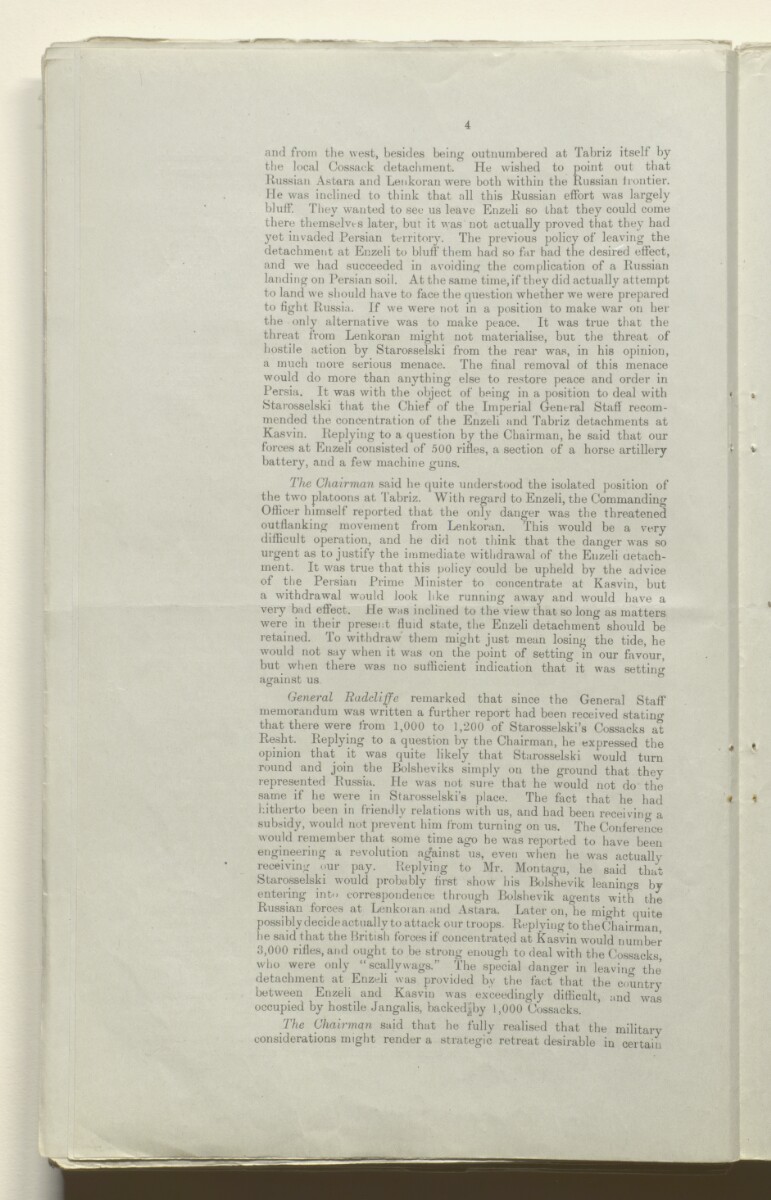
and from the west, besides being outnumbered at Tabriz itself by
the local Cossack detachment. He wished to point out that
Russian Astara and Lenkoran were both within the Russian frontier.
He was inclined to think that all this Russian effort was largely
bluff*. They wanted to see us leave Enzeli so that they could come
there themselves later, bur it was not actually proved that they had
yet invaded Persian territory. The previous policy of leaving the
detachment at Enzeli to bluff them had so far had the desired effect,
and we had succeeded in avoiding the complication of a Russian
landing on Persian soil. At the same time, if they did actually attempt
to land we should have to face the question whether we were prepared
to fight Russia. If we were not in a position to make war on her
the only alternative was to make peace. It was true that the
threat from Lenkoran might not materialise, but the threat of
hostile action by Starosselski from the rear was, in his opinion,
a much more serious menace. The final removal of this menace
would do more than anything else to restore peace and order in
Persia. It was with the object of being in a position to deal with » *
Starosselski that the Chief of the Imperial General Staff recom
mended the concentration of the Enzeli and Tabriz detachments at
Kasvin. Replying to a question by the Chairman, he said that our
forces at Enzeli consisted of 500 rifles, a section of a horse artillery ‘ *
battery, and a few machine guns.
The Chairman said he quite understood the isolated position of
the two platoons at labriz. With regard to Enzeli, the Commanding
Officer himself reported that the only danger was the threatened
outflanking movement from Lenkoran. This would be a very
difficult operation, and he did not think that the danger was so
urgent as to justify the immediate withdrawal of the Enzeli detach
ment. It was true that this policy could be upheld by the advice
of the Persian Prime Minister to concentrate at Kasvin, but
a withdrawal would look like running away and would have a
very bad effect. He was inclined to the view that so long as matters
were in their present fluid state, the Enzeli detachment should be
retained. To withdraw them might just mean losing the tide, he
would not say when it was on the point of setting in our favour,
but when there was no sufficient indication that it was setting
against us
General Radcliffe remarked that since the General Staff
memorandum was written a further report had been received statins
that there were from 1,000 to 1,200 of Starosselski’s Cossacks at
Resht. Replying to a question by the Chairman, he expressed the 4 «
opinion that it was quite likely that Starosselski would turn
round and join the Bolsheviks simply on the ground that they
represented Russia. He was not sure that he would not do the
same if he were in Starosselski’s place. The fact that he had *
hitherto been in friendly relations with us, and had been receiving a
subsidy, would not prevent him from turning on us. The Conference
would remember that some time ago he was reported to have been
engineering a revolution against us, even when he was actually
receiving our pay. Replying to Mr. Montagu, he said that
Starosselski would probably first show his Bolshevik leanings by
entering into correspondence through Bolshevik agents with the
Russian forces at Lenkoian and Astara. Later on, he might quite
possibly decide actually to attack our troops. Replying to the Chairman,
he said that the British forces if concentrated at Kasvin would number
3,000 rifles, and ought to be strong enough to deal with the Cossacks
who were only “scallywags.” The special danger in leavino- the
detachment at Enzeli was provided by the fact that the country
between Enzeli and Kasvin was exceedingly difficult, and was
occupied by hostile Jangalis, backed^by 1,000 Cossacks.
The Chairman said that he fully realised that the military
considerations might render a strategic retreat desirable in certain
About this item
- Content
This file is composed of papers produced by the Foreign Office's Interdepartmental Conference on Middle Eastern Affairs. It consists entirely of printed minutes of meetings of the conference, most of which are chaired by George Curzon.
Those attending include senior representatives of the Foreign Office, the India Office The department of the British Government to which the Government of India reported between 1858 and 1947. The successor to the Court of Directors. (most notably the Secretary of State for India), the War Office, the Admiralty, the Air Ministry, and the Treasury (including the Chancellor of the Exchequer). Other notable figures attending include Harry St John Bridger Philby and Gertrude Margaret Lowthian Bell.
The meetings concern British policy in the Middle East, and mainly cover the following geographical areas: Mesopotamia, Kurdistan, Trans-Caspia, Trans-Caucasia, the Caspian Sea, Palestine, Persia, Hejaz, and Afghanistan. Some of the meetings also touch on matters beyond the Middle East (e.g. wireless telegraphy in Tibet, ff 79-80).
Recurring topics of discussion include railways (chiefly in relation to Mesopotamia), Bolshevik influence in the Middle East (particularly in Persia and Trans-Caspia), and relations between King Hussein [Ḥusayn bin ‘Alī al-Hāshimī] and Ibn Saud [‘Abd al-‘Azīz bin ‘Abd al-Raḥmān bin Fayṣal Āl Sa‘ūd].
Several sets of minutes also contain related memoranda as appendices.
- Extent and format
- 1 file (145 folios)
- Arrangement
The papers are arranged in approximate chronological order from the front to the rear of the file.
- Physical characteristics
Foliation: the foliation sequence (used for referencing) commences at the first folio with 1, and terminates at the last folio with 145, these numbers are written in pencil, are circled, and are located in the top right corner of the recto The front of a sheet of paper or leaf, often abbreviated to 'r'. side of each folio.
- Written in
- English in Latin script View the complete information for this record
Use and share this item
- Share this item
Papers of the Interdepartmental Conference on Middle Eastern Affairs [129v] (258/290), British Library: India Office Records and Private Papers, Mss Eur F112/275, in Qatar Digital Library <https://www.qdl.qa/archive/81055/vdc_100070539236.0x00003b> [accessed 6 June 2026]
https://www.qdl.qa/en/archive/81055/vdc_100070539236.0x00003b
Copy and paste the code below into your web page where you would like to embed the image.
<meta charset="utf-8"><a href="https://www.qdl.qa/en/archive/81055/vdc_100070539236.0x00003b">Papers of the Interdepartmental Conference on Middle Eastern Affairs [‎129v] (258/290)</a> <a href="https://www.qdl.qa/en/archive/81055/vdc_100070539236.0x00003b"> <img src="https://iiif.qdl.qa/iiif/images/81055/vdc_100000001491.0x0002a9/Mss Eur F112_275_0258.jp2/full/!280,240/0/default.jpg" alt="" /> </a>
This record has a IIIF manifest available as follows. If you have a compatible viewer you can drag the icon to load it.https://www.qdl.qa/en/iiif/81055/vdc_100000001491.0x0002a9/manifestOpen in Universal viewerOpen in Mirador viewerMore options for embedding images
Copyright: How to use this content
- Reference
- Mss Eur F112/275
- Title
- Papers of the Interdepartmental Conference on Middle Eastern Affairs
- Pages
- front, front-i, 2r:144v, back-i, back
- Author
- East India Company, the Board of Control, the India Office, or other British Government Department
- Usage terms
- Open Government Licence