
![Papers of the Interdepartmental Conference on Middle Eastern Affairs [‎110v] (220/290)](https://iiif.qdl.qa/iiif/images/81055/vdc_100000001491.0x0002a9/Mss Eur F112_275_0220.jp2/full/!1200,1200/0/default.jpg "Papers of the Interdepartmental Conference on Middle Eastern Affairs [‎110v] (220/290)")
Papers of the Interdepartmental Conference on Middle Eastern Affairs [110v] (220/290)
The record is made up of 1 file (145 folios). It was created in 7 Jan 1919-7 Dec 1920. It was written in English. The original is part of the British Library: India Office The department of the British Government to which the Government of India reported between 1858 and 1947. The successor to the Court of Directors. Records and Private Papers Documents collected in a private capacity. .
Transcription
This transcription is created automatically. It may contain errors.
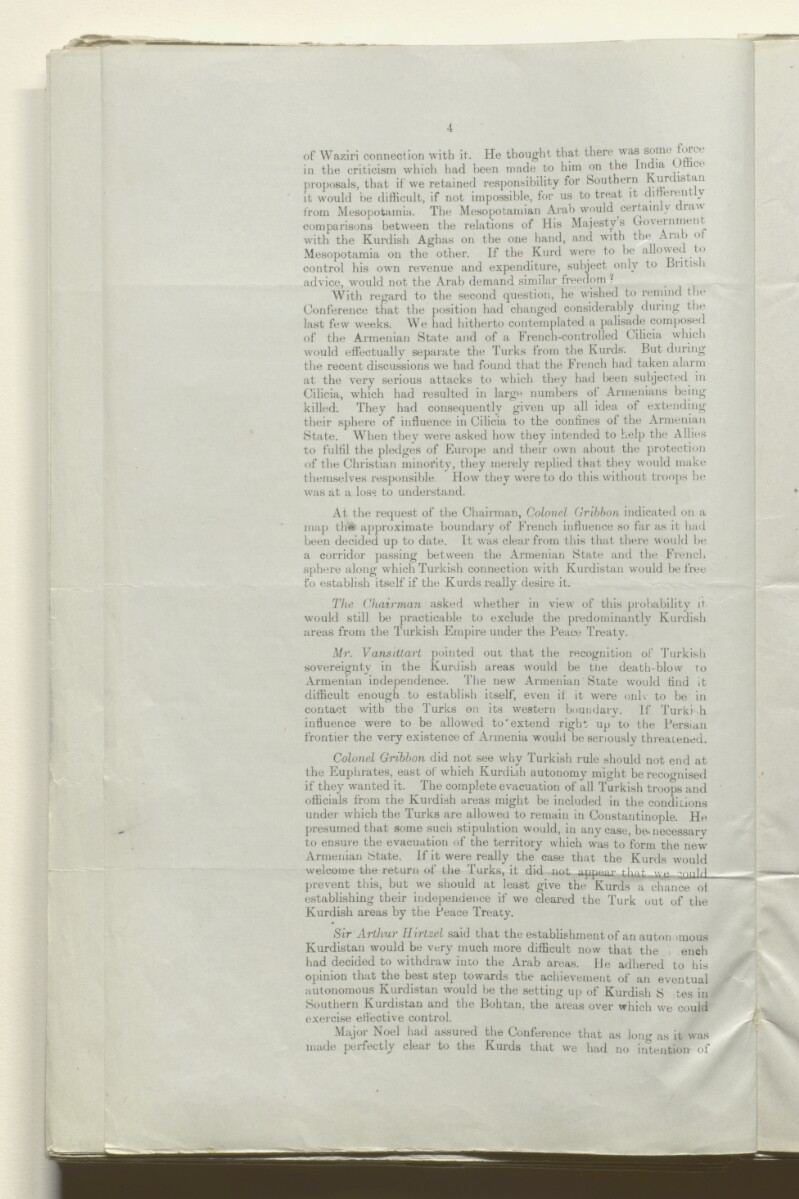
4
of Waziri connection with it. He thought that there was somt inu
in the criticism which had been made to him on the tn ,a Ct
proposals, that if we retained responsibility for Southern *yur ( istan
it would be difficult, if not impossible, for us to treat it di t rt _ 11 ^ y
from Mesopotamia. The Mesopotamian Arab would certainIv draw
comparisons between the relations of His Majesty s (to\ ei nnu nl
with the Kurdish Aghas on the one hand, and with the Arab of
Mesopotamia on the other. If the Kurd were to he allowed to
control his own revenue and expenditure, subject only to Bntish
advice, would not the Arab demand similar freedom ?
With regard to the second question, he wished to remind the
Conference that the position had changed considerably during tin*
last few weeks. We had hitherto contemplated a palisade composed
of the Armenian State and of a French-controlled ( ilicia which
would effectually separate the Turks from the Kurds. But during
the recent discussions we had found that the French had taken alarm
at the very serious attacks to which they had been subjected in
Cilicia, which had resulted in large numbers of Armenians being
killed. They had consequently given up all idea of extending
their sphere of influence in Cilicia to the confines of the Armenian
State. When they were asked how they intended to help the Allies
to fulfil the pledges of Europe and their own about the protection
of the Christian minority, they merely replied that they would make
themselves responsible. How they were to do this without troops he
was at a loss to understand.
At the request of the Chairman, Colonel Gribbon indicated on a
map the approximate boundary of French influence so far as it had
been decided up to date. It was clear from this that there would be
a corridor passing between the Armenian State and the French
sphere along which Turkish connection with Kurdistan would he free
to establish itself if the Kurds really desire it.
The Chairman asked whether in view of this probability it
would still be practicable to exclude the predominantly Kurdish
areas from the Turkish Empire under the Peace Treaty.
Mr. Vansittart pointed out that the recognition of Turkish
sovereignty in the Kurdish areas would be the death-blow to
Armenian independence. The new Armenian State would find it
difficult enough to establish itself, even if it were onlv to he in
contact with the Turks on its western boundary. If Turkish
influence were to be allowed to'extend right up to the Persian
frontier the very existence of Armenia would be seriously threatened.
Colonel Gribbon did not see why Turkish rule should not end at
the Euphrates, east of which Kurdish autonomy might be recognised
if they wanted it. The complete evacuation of all Turkish troops and
officials from the Kurdish areas might be included in the conditions
under which the Turks are allowed to remain in Constantinople. He
presumed that some such stipulation would, in any case, be*necessarv
to ensure the evacuation of the territory which was to form the new
Armenian estate. If it were really the case that the Kurds would
welcome the return of the Turks, it did not upp^r
prevent this, but we should at least give the Kurds a chance of
establishing their independence if we cleared the Turk out of the
Kurdish areas by the Peace Treaty.
Sir Arthur Ilirtzel said that the establishment of an auton 'inous
Kurdistan would be very much more difficult now that the ench
had decided to withdraw into the Arab areas. He adhered to his
opinion that the best step towards the achievement of an eventual
autonomous Kurdistan would be the setting up of Kurdish S tes in
Southern Kurdistan and the Bohtan. the areas over which we could
exercise effective control.
Major Noel had assured the Conference that as long as it was
made perfectly clear to the Kurds that we had no intention of
About this item
- Content
This file is composed of papers produced by the Foreign Office's Interdepartmental Conference on Middle Eastern Affairs. It consists entirely of printed minutes of meetings of the conference, most of which are chaired by George Curzon.
Those attending include senior representatives of the Foreign Office, the India Office The department of the British Government to which the Government of India reported between 1858 and 1947. The successor to the Court of Directors. (most notably the Secretary of State for India), the War Office, the Admiralty, the Air Ministry, and the Treasury (including the Chancellor of the Exchequer). Other notable figures attending include Harry St John Bridger Philby and Gertrude Margaret Lowthian Bell.
The meetings concern British policy in the Middle East, and mainly cover the following geographical areas: Mesopotamia, Kurdistan, Trans-Caspia, Trans-Caucasia, the Caspian Sea, Palestine, Persia, Hejaz, and Afghanistan. Some of the meetings also touch on matters beyond the Middle East (e.g. wireless telegraphy in Tibet, ff 79-80).
Recurring topics of discussion include railways (chiefly in relation to Mesopotamia), Bolshevik influence in the Middle East (particularly in Persia and Trans-Caspia), and relations between King Hussein [Ḥusayn bin ‘Alī al-Hāshimī] and Ibn Saud [‘Abd al-‘Azīz bin ‘Abd al-Raḥmān bin Fayṣal Āl Sa‘ūd].
Several sets of minutes also contain related memoranda as appendices.
- Extent and format
- 1 file (145 folios)
- Arrangement
The papers are arranged in approximate chronological order from the front to the rear of the file.
- Physical characteristics
Foliation: the foliation sequence (used for referencing) commences at the first folio with 1, and terminates at the last folio with 145, these numbers are written in pencil, are circled, and are located in the top right corner of the recto The front of a sheet of paper or leaf, often abbreviated to 'r'. side of each folio.
- Written in
- English in Latin script View the complete information for this record
Use and share this item
- Share this item
Papers of the Interdepartmental Conference on Middle Eastern Affairs [110v] (220/290), British Library: India Office Records and Private Papers, Mss Eur F112/275, in Qatar Digital Library <https://www.qdl.qa/archive/81055/vdc_100070539236.0x000015> [accessed 6 July 2026]
https://www.qdl.qa/en/archive/81055/vdc_100070539236.0x000015
Copy and paste the code below into your web page where you would like to embed the image.
<meta charset="utf-8"><a href="https://www.qdl.qa/en/archive/81055/vdc_100070539236.0x000015">Papers of the Interdepartmental Conference on Middle Eastern Affairs [‎110v] (220/290)</a> <a href="https://www.qdl.qa/en/archive/81055/vdc_100070539236.0x000015"> <img src="https://iiif.qdl.qa/iiif/images/81055/vdc_100000001491.0x0002a9/Mss Eur F112_275_0220.jp2/full/!280,240/0/default.jpg" alt="" /> </a>
This record has a IIIF manifest available as follows. If you have a compatible viewer you can drag the icon to load it.https://www.qdl.qa/en/iiif/81055/vdc_100000001491.0x0002a9/manifestOpen in Universal viewerOpen in Mirador viewerMore options for embedding images
Copyright: How to use this content
- Reference
- Mss Eur F112/275
- Title
- Papers of the Interdepartmental Conference on Middle Eastern Affairs
- Pages
- front, front-i, 2r:144v, back-i, back
- Author
- East India Company, the Board of Control, the India Office, or other British Government Department
- Usage terms
- Open Government Licence