
![Papers of the Interdepartmental Conference on Middle Eastern Affairs [‎51r] (101/290)](https://iiif.qdl.qa/iiif/images/81055/vdc_100000001491.0x0002a9/Mss Eur F112_275_0101.jp2/full/!1200,1200/0/default.jpg "Papers of the Interdepartmental Conference on Middle Eastern Affairs [‎51r] (101/290)")
Papers of the Interdepartmental Conference on Middle Eastern Affairs [51r] (101/290)
The record is made up of 1 file (145 folios). It was created in 7 Jan 1919-7 Dec 1920. It was written in English. The original is part of the British Library: India Office The department of the British Government to which the Government of India reported between 1858 and 1947. The successor to the Court of Directors. Records and Private Papers Documents collected in a private capacity. .
Transcription
This transcription is created automatically. It may contain errors.
3
4
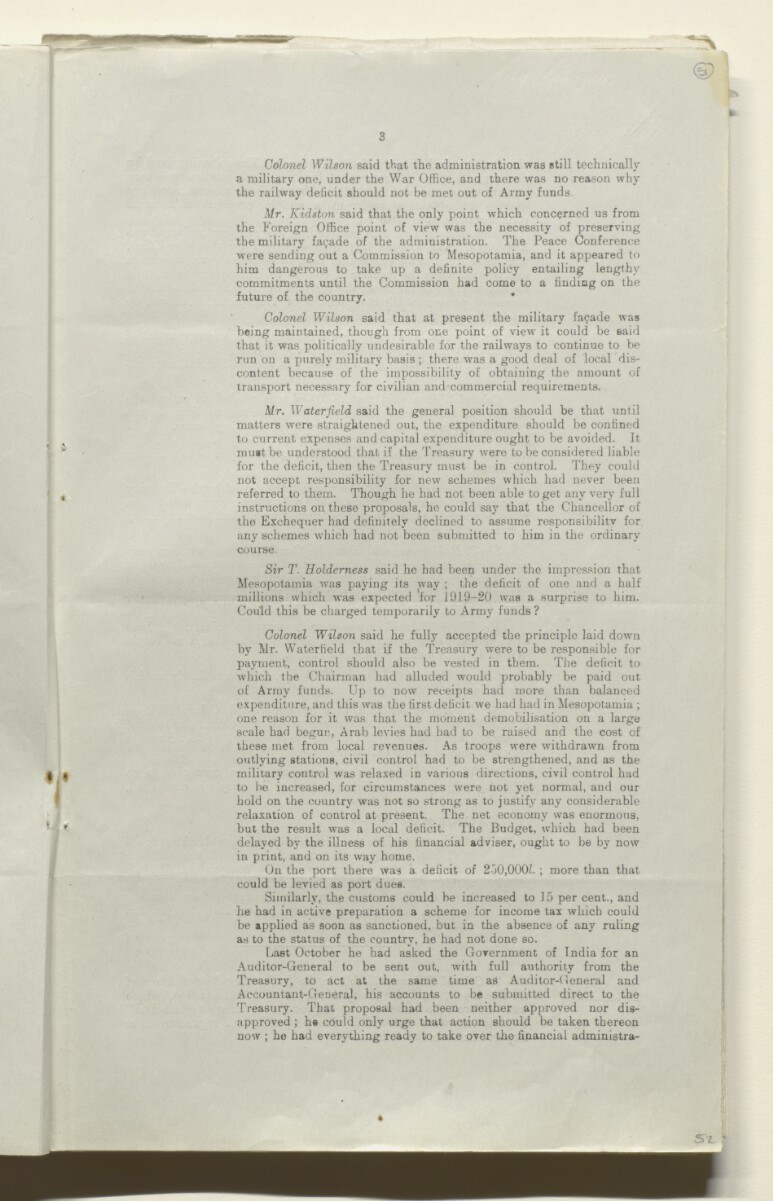
Colonel Wilson said that the administration was still technically
a military one, under the War Office, and there was no reason why
the railway deficit should not be met out of Army funds.
Mr. Kidston said that the only point which concerned us from
the Foreign Office point of view was the necessity of preserving
the military facade of the administration. The Peace Conference
were sending out a Commission to Mesopotamia, and it appeared to
him dangerous to take up a definite policy entailing lengthy
commitments until the Commission had come to a finding on the
future of the country. *
Colonel Wilson said that at present the military facade was
being maintained, though from one point of view it could be said
that it was politically undesirable for the railways to continue to be
run on a purely military basis ; there was a good deal of local dis
content because of the impossibility of obtaining the amount of
transport necessary for civilian and commercial requirements.
Mr. Waterfield said the general position should be that until
matters were straightened out, the expenditure should be confined
to current expenses and capital expenditure ought to be avoided. It
must be understood that if the Treasury were to be considered liable
for the deficit, then the Treasury must be in control. They could
not accept responsibility for new schemes which had never been
referred to them. Though he had not been able to get any very full
instructions on these proposals, he could say that the Chancellor of
the Exchequer had definitely declined to assume responsibilitv for
any schemes which had not been submitted to him in the ordinary
course.
Sir T. Holderness said he had been under the impression that
Mesopotamia was paying its way ; the deficit of one and a half
millions which was expected for 1919-20 was a surprise to him.
Could this be charged temporarily to Army funds ?
Colonel Wilson said he fully accepted the principle laid down
by Mr. Waterfield that if the Treasury were to be responsible for
payment, control should also be vested in them. The deficit to
which the Chairman had alluded would probably be paid out
of Army funds. Up to now receipts had more than balanced
expenditure, and this was the first deficit we had had in Mesopotamia ;
one reason for it was that the moment demobilisation on a large
scale had begun, Arab levies had had to be raised and the cost of
these met from local revenues. As troops were withdrawn from
outlying stations, civil control had to be strengthened, and as the
military control was relaxed in various directions, civil control had
to be increased, for circumstances were not yet normal, and our
hold on the country was not so strong as to justify any considerable
relaxation of control at present. The net economy was enormous,
but the result was a local deficit. The Budget, which had been
delayed by the illness of his financial adviser, ought to be by now
in print, and on its way home.
On the port there was a deficit of 2 jO,OOOL ; more than that
could be levied as port dues.
Similarly, the customs could be increased to 15 per cent., and
he had in active preparation a scheme for income tax which could
be applied as soon as sanctioned, but in the absence of any ruling
as to the status of the country, he had not done so.
Last October he had asked the Government of India for an
Auditor-General to be sent out, with full authority from the
Treasury, to act at the same time as Auditor-General and
Accountant-General, his accounts to be submitted direct to the
Treasury. That proposal had been neither approved nor dis
approved ; he could only urge that action should be taken thereon
now ; he had everything ready to take over the financial administra
About this item
- Content
This file is composed of papers produced by the Foreign Office's Interdepartmental Conference on Middle Eastern Affairs. It consists entirely of printed minutes of meetings of the conference, most of which are chaired by George Curzon.
Those attending include senior representatives of the Foreign Office, the India Office The department of the British Government to which the Government of India reported between 1858 and 1947. The successor to the Court of Directors. (most notably the Secretary of State for India), the War Office, the Admiralty, the Air Ministry, and the Treasury (including the Chancellor of the Exchequer). Other notable figures attending include Harry St John Bridger Philby and Gertrude Margaret Lowthian Bell.
The meetings concern British policy in the Middle East, and mainly cover the following geographical areas: Mesopotamia, Kurdistan, Trans-Caspia, Trans-Caucasia, the Caspian Sea, Palestine, Persia, Hejaz, and Afghanistan. Some of the meetings also touch on matters beyond the Middle East (e.g. wireless telegraphy in Tibet, ff 79-80).
Recurring topics of discussion include railways (chiefly in relation to Mesopotamia), Bolshevik influence in the Middle East (particularly in Persia and Trans-Caspia), and relations between King Hussein [Ḥusayn bin ‘Alī al-Hāshimī] and Ibn Saud [‘Abd al-‘Azīz bin ‘Abd al-Raḥmān bin Fayṣal Āl Sa‘ūd].
Several sets of minutes also contain related memoranda as appendices.
- Extent and format
- 1 file (145 folios)
- Arrangement
The papers are arranged in approximate chronological order from the front to the rear of the file.
- Physical characteristics
Foliation: the foliation sequence (used for referencing) commences at the first folio with 1, and terminates at the last folio with 145, these numbers are written in pencil, are circled, and are located in the top right corner of the recto The front of a sheet of paper or leaf, often abbreviated to 'r'. side of each folio.
- Written in
- English in Latin script View the complete information for this record
Use and share this item
- Share this item
Papers of the Interdepartmental Conference on Middle Eastern Affairs [51r] (101/290), British Library: India Office Records and Private Papers, Mss Eur F112/275, in Qatar Digital Library <https://www.qdl.qa/archive/81055/vdc_100070539234.0x000066> [accessed 28 July 2026]
https://www.qdl.qa/en/archive/81055/vdc_100070539234.0x000066
Copy and paste the code below into your web page where you would like to embed the image.
<meta charset="utf-8"><a href="https://www.qdl.qa/en/archive/81055/vdc_100070539234.0x000066">Papers of the Interdepartmental Conference on Middle Eastern Affairs [‎51r] (101/290)</a> <a href="https://www.qdl.qa/en/archive/81055/vdc_100070539234.0x000066"> <img src="https://iiif.qdl.qa/iiif/images/81055/vdc_100000001491.0x0002a9/Mss Eur F112_275_0101.jp2/full/!280,240/0/default.jpg" alt="" /> </a>
This record has a IIIF manifest available as follows. If you have a compatible viewer you can drag the icon to load it.https://www.qdl.qa/en/iiif/81055/vdc_100000001491.0x0002a9/manifestOpen in Universal viewerOpen in Mirador viewerMore options for embedding images
Copyright: How to use this content
- Reference
- Mss Eur F112/275
- Title
- Papers of the Interdepartmental Conference on Middle Eastern Affairs
- Pages
- front, front-i, 2r:144v, back-i, back
- Author
- East India Company, the Board of Control, the India Office, or other British Government Department
- Usage terms
- Open Government Licence