
![Papers of the Interdepartmental Conference on Middle Eastern Affairs [‎34r] (67/290)](https://iiif.qdl.qa/iiif/images/81055/vdc_100000001491.0x0002a9/Mss Eur F112_275_0067.jp2/full/!1200,1200/0/default.jpg "Papers of the Interdepartmental Conference on Middle Eastern Affairs [‎34r] (67/290)")
Papers of the Interdepartmental Conference on Middle Eastern Affairs [34r] (67/290)
The record is made up of 1 file (145 folios). It was created in 7 Jan 1919-7 Dec 1920. It was written in English. The original is part of the British Library: India Office The department of the British Government to which the Government of India reported between 1858 and 1947. The successor to the Court of Directors. Records and Private Papers Documents collected in a private capacity. .
Transcription
This transcription is created automatically. It may contain errors.
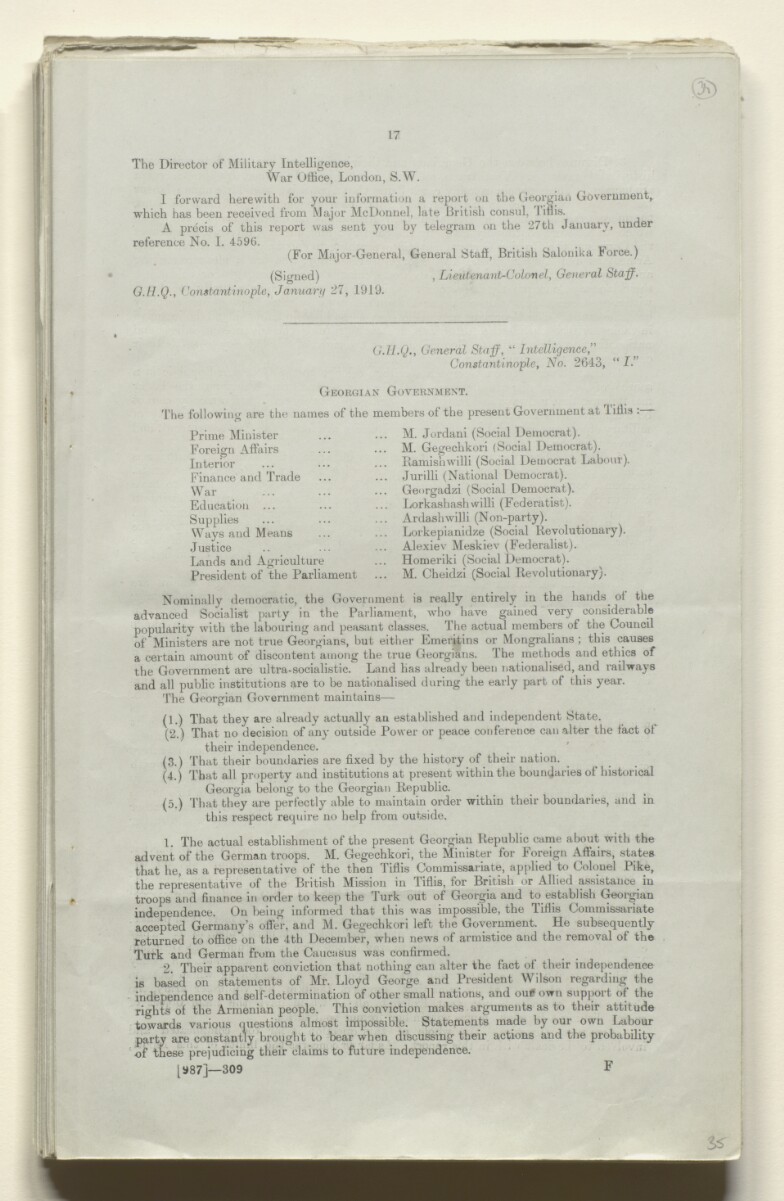
17
The Director of Military Intelligence,
War Office, London, S.W.
I forward herewith for your information a report on the Georgian Government,
which has been received from Major McDonnel, late British consul, 1 iffis.
A precis of this report was sent you by telegram on the 27th January, under
reference -No X. 4590.
(For Major-General, General Staff, British Salonika Force.)
(Signed) , Lieutenant-Colonel, General Staff.
G.U.Q., Constantinople, January 27, 1919.
*
G.U.Q., General Staff, “ Intelligence,’'
Constantinople, No. 2643, “ I.”
Georgian Government.
The following are the names of the members of the present Government at Tiflis :—
Prime Minister
Foreign Affairs
Interior
Finance and Trade
War
Education ...
Supplies
Ways and Means
Justice
Lands and Agriculture
President of the Parliament
M. Jordani (Social Democrat).
M. Gegechkori (Social Democrat).
Ramishwilli (Social Democrat Labour).
Jurilli (National Democrat).
Georgadzi (Social Democrat).
Lorkashash willi (Federatist).
Ardashwilli (Non-party).
Lorkepianidze (Social Revolutionary).
Alexiev Meskiev (Federalist).
Homeriki (Social Democrat).
M. Cheidzi (Social Revolutionary).
Nominally democratic, the Government is really entirely in the hands, ot the
advanced Socialist party in the Parliament, who have gained very considerable
popularity with the labouring and peasant classes. The actual members of the Council
of Ministers are not true Georgians, but either Emeritins or Mongolians ; this causes
a certain amount of discontent among the true Georgians. The methods and ethics of
the Government are ultra-socialistic. Land has already been nationalised, and railways
and all public institutions are to be nationalised during the early part of this year.
The Georgian Government maintains—
( 1 .) That they are already actually an established and independent State.
( 2 .) That no decision of any outside Power or peace conference can alter the fact ot
their independence.
( 3 .) That their boundaries are fixed by the history of their nation.
( 4 .) That all property and institutions at present within the boundaries of historical
Georgia belong to the Georgian Republic.
( 5 .) That they are perfectly able to maintain order within their boundaries, and in
this respect require no help from outside.
1 . The actual establishment of the present Georgian Republic came about with the
advent of the German troops. M. Gegechkori, the Minister for Foreign Affairs, states
that he, as a representative of the then Tiflis Commissariate, applied to Colonel Pike,
the representative of the British Mission in 1 itiis, for British or Allied assistance in
troops and finance in order to keep the lurk out of Georgia and to establish Georgian
independence. On being informed that this was impossible, the lifiis Commissariate
accepted Germany’s offer, and M. Gegechkori left the Government. He subsequently
returned to office on the 4 th December, when news of armistice and the removal of the
Turk and German from the Caucasus was confirmed.
2. Their apparent conviction that nothing can alter the fact of their independence
is based on statements of Mr. Lloyd George and President Wilson regarding the
independence and self-determination of other small nations, and our own support of the
rights of the Armenian people. This conviction makes arguments as to their attitude
towards various questions almost impossible. Statements made by our own Labour
party are constantly brought to bear when discussing their actions and the probability
of these prejudicing their claims to future independence.
[»87]—309 F
About this item
- Content
This file is composed of papers produced by the Foreign Office's Interdepartmental Conference on Middle Eastern Affairs. It consists entirely of printed minutes of meetings of the conference, most of which are chaired by George Curzon.
Those attending include senior representatives of the Foreign Office, the India Office The department of the British Government to which the Government of India reported between 1858 and 1947. The successor to the Court of Directors. (most notably the Secretary of State for India), the War Office, the Admiralty, the Air Ministry, and the Treasury (including the Chancellor of the Exchequer). Other notable figures attending include Harry St John Bridger Philby and Gertrude Margaret Lowthian Bell.
The meetings concern British policy in the Middle East, and mainly cover the following geographical areas: Mesopotamia, Kurdistan, Trans-Caspia, Trans-Caucasia, the Caspian Sea, Palestine, Persia, Hejaz, and Afghanistan. Some of the meetings also touch on matters beyond the Middle East (e.g. wireless telegraphy in Tibet, ff 79-80).
Recurring topics of discussion include railways (chiefly in relation to Mesopotamia), Bolshevik influence in the Middle East (particularly in Persia and Trans-Caspia), and relations between King Hussein [Ḥusayn bin ‘Alī al-Hāshimī] and Ibn Saud [‘Abd al-‘Azīz bin ‘Abd al-Raḥmān bin Fayṣal Āl Sa‘ūd].
Several sets of minutes also contain related memoranda as appendices.
- Extent and format
- 1 file (145 folios)
- Arrangement
The papers are arranged in approximate chronological order from the front to the rear of the file.
- Physical characteristics
Foliation: the foliation sequence (used for referencing) commences at the first folio with 1, and terminates at the last folio with 145, these numbers are written in pencil, are circled, and are located in the top right corner of the recto The front of a sheet of paper or leaf, often abbreviated to 'r'. side of each folio.
- Written in
- English in Latin script View the complete information for this record
Use and share this item
- Share this item
Papers of the Interdepartmental Conference on Middle Eastern Affairs [34r] (67/290), British Library: India Office Records and Private Papers, Mss Eur F112/275, in Qatar Digital Library <https://www.qdl.qa/archive/81055/vdc_100070539234.0x000044> [accessed 14 August 2026]
https://www.qdl.qa/en/archive/81055/vdc_100070539234.0x000044
Copy and paste the code below into your web page where you would like to embed the image.
<meta charset="utf-8"><a href="https://www.qdl.qa/en/archive/81055/vdc_100070539234.0x000044">Papers of the Interdepartmental Conference on Middle Eastern Affairs [‎34r] (67/290)</a> <a href="https://www.qdl.qa/en/archive/81055/vdc_100070539234.0x000044"> <img src="https://iiif.qdl.qa/iiif/images/81055/vdc_100000001491.0x0002a9/Mss Eur F112_275_0067.jp2/full/!280,240/0/default.jpg" alt="" /> </a>
This record has a IIIF manifest available as follows. If you have a compatible viewer you can drag the icon to load it.https://www.qdl.qa/en/iiif/81055/vdc_100000001491.0x0002a9/manifestOpen in Universal viewerOpen in Mirador viewerMore options for embedding images
Copyright: How to use this content
- Reference
- Mss Eur F112/275
- Title
- Papers of the Interdepartmental Conference on Middle Eastern Affairs
- Pages
- front, front-i, 2r:144v, back-i, back
- Author
- East India Company, the Board of Control, the India Office, or other British Government Department
- Usage terms
- Open Government Licence