
![Papers of the Interdepartmental Conference on Middle Eastern Affairs [‎28v] (56/290)](https://iiif.qdl.qa/iiif/images/81055/vdc_100000001491.0x0002a9/Mss Eur F112_275_0056.jp2/full/!1200,1200/0/default.jpg "Papers of the Interdepartmental Conference on Middle Eastern Affairs [‎28v] (56/290)")
Papers of the Interdepartmental Conference on Middle Eastern Affairs [28v] (56/290)
The record is made up of 1 file (145 folios). It was created in 7 Jan 1919-7 Dec 1920. It was written in English. The original is part of the British Library: India Office The department of the British Government to which the Government of India reported between 1858 and 1947. The successor to the Court of Directors. Records and Private Papers Documents collected in a private capacity. .
Transcription
This transcription is created automatically. It may contain errors.
6
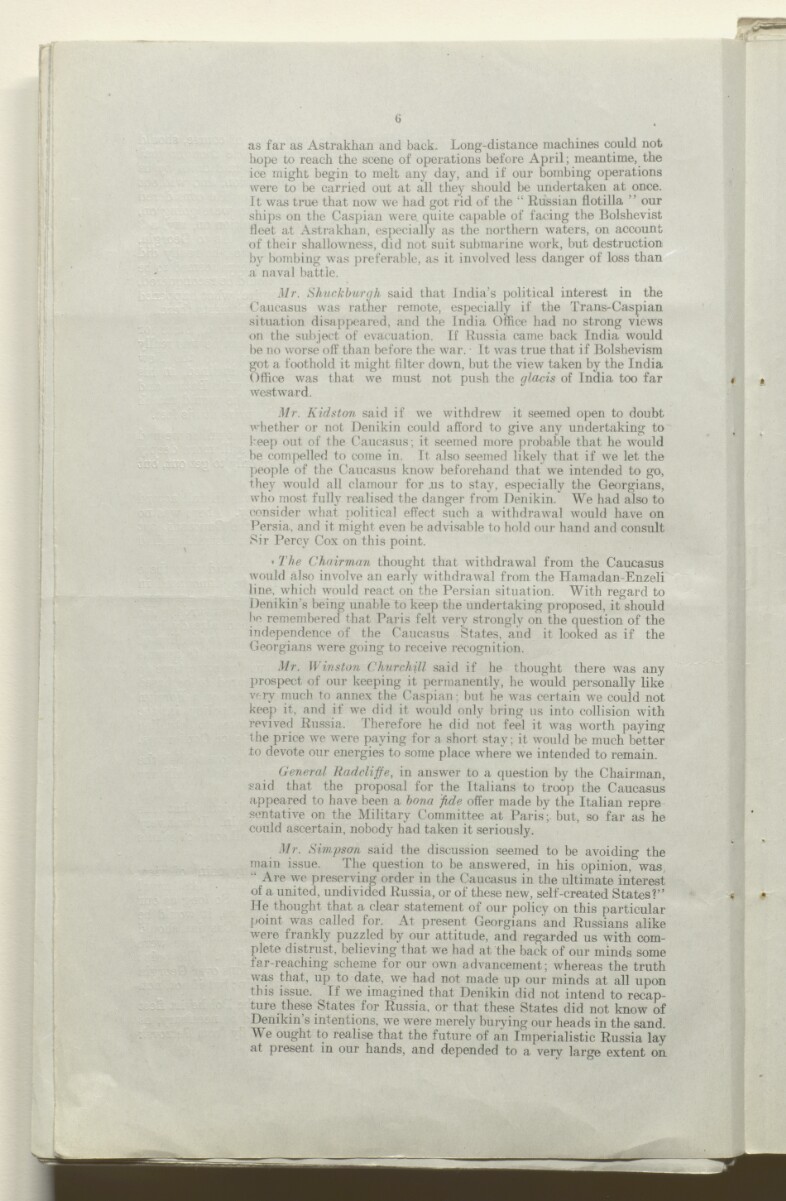
as far as Astrakhan and back. Long-distance machines could not
hope to reach the scene of operations before April; meantime, the
ice might begin to melt any day, and if our bombing operations
were to be carried out at all they should be undertaken at once.
It was true that now we had got rid of the “ Russian flotilla ” our
ships on the Caspian were quite capable of facing the Bolshevist
fleet at Astrakhan, especially as the northern waters, on account
of their shallowness, did not suit submarine work, but destruction
by bombing was preferable, as it involved less danger of loss than
a naval battle.
Mr. Shuckburgh said that India's political interest in the
Caucasus was rather remote, especially if the Trans-Caspian
situation disappeared, and the
India Office
The department of the British Government to which the Government of India reported between 1858 and 1947. The successor to the Court of Directors.
had no strong views
on the subject of evacuation. If Russia came back India would
be no worse off than before the war. • It was true that if Bolshevism
got a foothold it might filter down, but the view taken by the India
Office was that we must not push the glacis of India too far
westward.
Mr. Kidston said if we withdrew it seemed open to doubt
whether or not Denikin could afford to give any undertaking to
keep out of the Caucasus; it seemed more probable that he would
be compelled to come in. It also seemed likely that if we let the
people of the Caucasus know beforehand that we intended to go,
they would all clamour for us to stay, especially the Georgians,
who most fully realised the danger from Denikin. We had also to
consider what political effect such a withdrawal would have on
Persia, and it might even be advisable to hold our hand and consult
Sir Percy Cox on this point.
» The Chairman thought that withdrawal from the Caucasus
would also involve an early withdrawal from the Hamadan-Enzeli
line, which would react on the Persian situation. With regard to
Denikin's being unable to keep the undertaking proposed, it should
be remembered that Paris felt very strongly on the question of the
independence of the Caucasus States, and it looked as if the
Georgians were going to receive recognition.
Mr. Winston Churchill said if he thought there was any
prospect of our keeping it permanently, he would personally like
very much to annex the Caspian; but he was certain we could not
keep it, and if we did it would only bring us into collision with
revived Russia. I herefore he did not feel it was worth paying
the price we were paying for a short stay; it would be much better
to devote our energies to some place where we intended to remain.
General Radcliffe, in answer to a question by the Chairman,
■said that the proposal for the Italians to troop the Caucasus
appeared to have been a bona fide offer made by the Italian repre
sentative on the Military Committee at Paris; but, so far as he
could ascertain, nobody had taken it seriously.
Mr. Simpson said the discussion seemed to be avoiding the
main issue. The question to be answered, in his opinion, was
“ Are we preserving order in the Caucasus in the ultimate interest
of a united, undivided Russia, or of these new, self-created States?”
He thought that a clear statement of our policy on this particular
point was called for. At present Georgians and Russians alike
were frankly puzzled by our attitude, and regarded us with com
plete distrust, believing that we had at the back of our minds some
far-reaching scheme for our own advancement; whereas the truth
was that, up to date, we had not made up our minds at all upon
this issue. If we imagined that Denikin did not intend to recap
ture these States for Russia, or that these States did not know of
Denikin's intentions, we were merely burying our heads in the sand.
Me ought to realise that the future of an Imperialistic Russia lay
at present in our hands, and depended to a very large extent on
About this item
- Content
This file is composed of papers produced by the Foreign Office's Interdepartmental Conference on Middle Eastern Affairs. It consists entirely of printed minutes of meetings of the conference, most of which are chaired by George Curzon.
Those attending include senior representatives of the Foreign Office, the India Office The department of the British Government to which the Government of India reported between 1858 and 1947. The successor to the Court of Directors. (most notably the Secretary of State for India), the War Office, the Admiralty, the Air Ministry, and the Treasury (including the Chancellor of the Exchequer). Other notable figures attending include Harry St John Bridger Philby and Gertrude Margaret Lowthian Bell.
The meetings concern British policy in the Middle East, and mainly cover the following geographical areas: Mesopotamia, Kurdistan, Trans-Caspia, Trans-Caucasia, the Caspian Sea, Palestine, Persia, Hejaz, and Afghanistan. Some of the meetings also touch on matters beyond the Middle East (e.g. wireless telegraphy in Tibet, ff 79-80).
Recurring topics of discussion include railways (chiefly in relation to Mesopotamia), Bolshevik influence in the Middle East (particularly in Persia and Trans-Caspia), and relations between King Hussein [Ḥusayn bin ‘Alī al-Hāshimī] and Ibn Saud [‘Abd al-‘Azīz bin ‘Abd al-Raḥmān bin Fayṣal Āl Sa‘ūd].
Several sets of minutes also contain related memoranda as appendices.
- Extent and format
- 1 file (145 folios)
- Arrangement
The papers are arranged in approximate chronological order from the front to the rear of the file.
- Physical characteristics
Foliation: the foliation sequence (used for referencing) commences at the first folio with 1, and terminates at the last folio with 145, these numbers are written in pencil, are circled, and are located in the top right corner of the recto The front of a sheet of paper or leaf, often abbreviated to 'r'. side of each folio.
- Written in
- English in Latin script View the complete information for this record
Use and share this item
- Share this item
Papers of the Interdepartmental Conference on Middle Eastern Affairs [28v] (56/290), British Library: India Office Records and Private Papers, Mss Eur F112/275, in Qatar Digital Library <https://www.qdl.qa/archive/81055/vdc_100070539234.0x000039> [accessed 12 June 2026]
https://www.qdl.qa/en/archive/81055/vdc_100070539234.0x000039
Copy and paste the code below into your web page where you would like to embed the image.
<meta charset="utf-8"><a href="https://www.qdl.qa/en/archive/81055/vdc_100070539234.0x000039">Papers of the Interdepartmental Conference on Middle Eastern Affairs [‎28v] (56/290)</a> <a href="https://www.qdl.qa/en/archive/81055/vdc_100070539234.0x000039"> <img src="https://iiif.qdl.qa/iiif/images/81055/vdc_100000001491.0x0002a9/Mss Eur F112_275_0056.jp2/full/!280,240/0/default.jpg" alt="" /> </a>
This record has a IIIF manifest available as follows. If you have a compatible viewer you can drag the icon to load it.https://www.qdl.qa/en/iiif/81055/vdc_100000001491.0x0002a9/manifestOpen in Universal viewerOpen in Mirador viewerMore options for embedding images
Copyright: How to use this content
- Reference
- Mss Eur F112/275
- Title
- Papers of the Interdepartmental Conference on Middle Eastern Affairs
- Pages
- front, front-i, 2r:144v, back-i, back
- Author
- East India Company, the Board of Control, the India Office, or other British Government Department
- Usage terms
- Open Government Licence