
![Papers of the Interdepartmental Conference on Middle Eastern Affairs [‎25r] (49/290)](https://iiif.qdl.qa/iiif/images/81055/vdc_100000001491.0x0002a9/Mss Eur F112_275_0049.jp2/full/!1200,1200/0/default.jpg "Papers of the Interdepartmental Conference on Middle Eastern Affairs [‎25r] (49/290)")
Papers of the Interdepartmental Conference on Middle Eastern Affairs [25r] (49/290)
The record is made up of 1 file (145 folios). It was created in 7 Jan 1919-7 Dec 1920. It was written in English. The original is part of the British Library: India Office The department of the British Government to which the Government of India reported between 1858 and 1947. The successor to the Court of Directors. Records and Private Papers Documents collected in a private capacity. .
Transcription
This transcription is created automatically. It may contain errors.
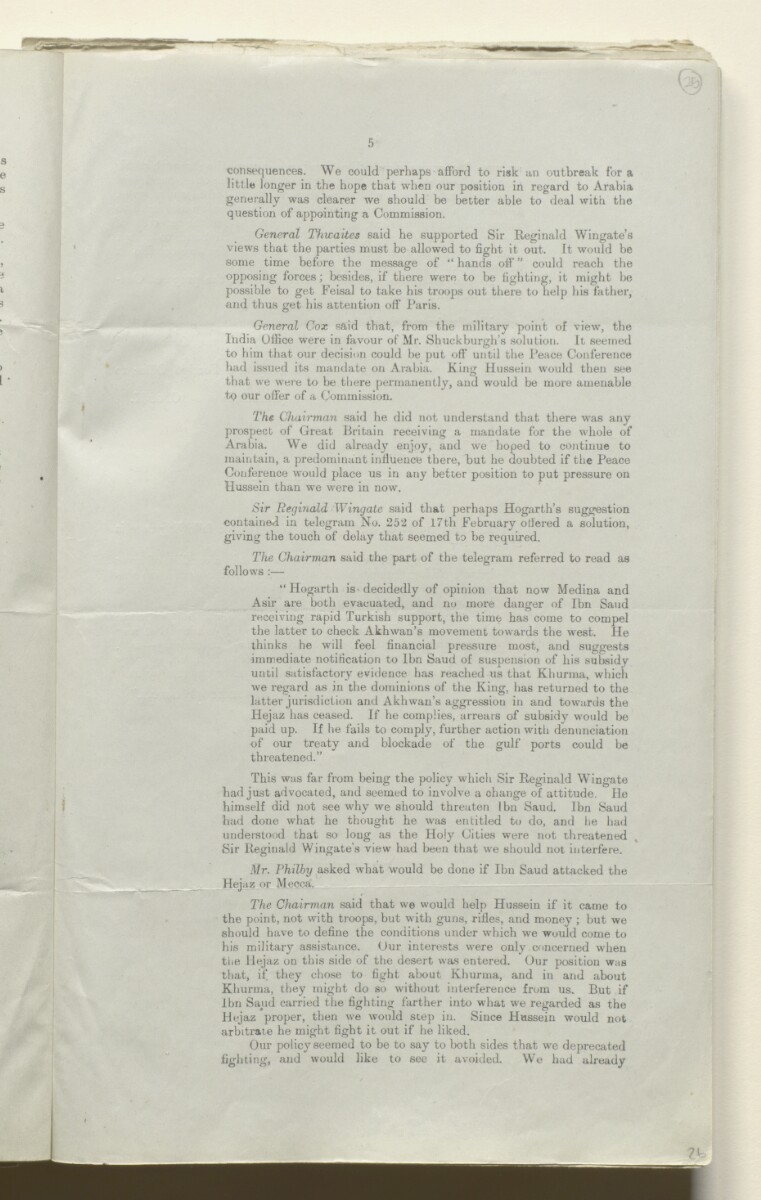
5
consequences. We could perhaps afford to risk an outbreak For a
little longer in the hope that when our position in regard to Arabia
generally was clearer we should be better able to deal with the
question of appointing a Commission.
General Thwaites said he supported Sir Reginald Wingate’s
views that the parties must be allowed to fight it out. It would be
some time before the message of “ hands off ” could reach the
opposing forces; besides, if there were to be fighting, it might be
possible to get Feisal to take his troops out there to help his father,
and thus get his attention off Paris.
General Cox said that, from the military point of view, the
India Office
The department of the British Government to which the Government of India reported between 1858 and 1947. The successor to the Court of Directors.
were in favour of Mr. Shuckburgh’s solution. It seemed
to him that our decision could be put off until the Peace Conference
had issued its mandate on Arabia. King Hussein would then see
that we were to be there permanently, and would be more amenable
tq our offer of a Commission.
The Chairman said he did not understand that there was any
prospect of Great Britain receiving a mandate for the whole of
Arabia. We did already enjoy, and we hoped to continue to
maintain, a predominant influence there, but he doubted if the Peace
Conference would place us in any better position to put pressure on
Hussein than we were in now.
Sir Reginald Wingate said that perhaps Hogarth’s suggestion
contained in telegram No. 252 of 17th February otlered a solution,
giving the touch of delay that seemed to be required.
The Chairman said the part of the telegram referred to read as
follows :—
“Hogarth is-decidedly of opinion that now Medina and
Asir are both evacuated, and no more danger of Ibn Sand
receiving rapid Turkish support, the time has come to compel
the latter to check Akhwan’s movement towards the west. He
thinks he will feel financial pressure most, and suggests
immediate notification to Ibn Saud of suspension of his subsidy
until satisfactory evidence has reached us that Khurma, which
we regard as in the dominions of the King, has returned to the
latter jurisdiction and Akhwan’s aggression in and towards the
Hejaz has ceased. If he complies, arrears of subsidy would be
paid up. If he fails to comply, further action with denunciation
of our treaty and blockade of the gulf ports could be
threatened.”
This was far from being the policy which Sir Reginald Wingate
had just advocated, and seemed to involve a change of attitude. He
himself did not see why we should threaten Ibn Saud. Ibn Saud
had done what he thought he was entitled to do, and he had
understood that so long as the Holy Cities were not threatened
Sir Reginald Wingate’s view had been that we should not interfere.
Mr. Philby asked what would be done if Ibn Saud attacked the
Hejaz or Mecca.
The Chairman said that we would help Hussein if it came to
the point, not with troops, but with guns, rifles, and money ; but we
should have to define the conditions under which we would come to
his military assistance. Our interests were only concerned when
the Hejaz on this side of the desert was entered. Our position was
that, if they chose to fight about Khurma, and in and about
Khurma, they might do so without interference from us. But if
Ibn Saud carried the fighting farther into what we regarded as the
Hejaz proper, then we would step in. Since Hussein would not
arbitrate he might fight it out if he liked.
Our policy seemed to be to say to both sides that we deprecated
fighting, and would like to see it avoided. We had already
About this item
- Content
This file is composed of papers produced by the Foreign Office's Interdepartmental Conference on Middle Eastern Affairs. It consists entirely of printed minutes of meetings of the conference, most of which are chaired by George Curzon.
Those attending include senior representatives of the Foreign Office, the India Office The department of the British Government to which the Government of India reported between 1858 and 1947. The successor to the Court of Directors. (most notably the Secretary of State for India), the War Office, the Admiralty, the Air Ministry, and the Treasury (including the Chancellor of the Exchequer). Other notable figures attending include Harry St John Bridger Philby and Gertrude Margaret Lowthian Bell.
The meetings concern British policy in the Middle East, and mainly cover the following geographical areas: Mesopotamia, Kurdistan, Trans-Caspia, Trans-Caucasia, the Caspian Sea, Palestine, Persia, Hejaz, and Afghanistan. Some of the meetings also touch on matters beyond the Middle East (e.g. wireless telegraphy in Tibet, ff 79-80).
Recurring topics of discussion include railways (chiefly in relation to Mesopotamia), Bolshevik influence in the Middle East (particularly in Persia and Trans-Caspia), and relations between King Hussein [Ḥusayn bin ‘Alī al-Hāshimī] and Ibn Saud [‘Abd al-‘Azīz bin ‘Abd al-Raḥmān bin Fayṣal Āl Sa‘ūd].
Several sets of minutes also contain related memoranda as appendices.
- Extent and format
- 1 file (145 folios)
- Arrangement
The papers are arranged in approximate chronological order from the front to the rear of the file.
- Physical characteristics
Foliation: the foliation sequence (used for referencing) commences at the first folio with 1, and terminates at the last folio with 145, these numbers are written in pencil, are circled, and are located in the top right corner of the recto The front of a sheet of paper or leaf, often abbreviated to 'r'. side of each folio.
- Written in
- English in Latin script View the complete information for this record
Use and share this item
- Share this item
Papers of the Interdepartmental Conference on Middle Eastern Affairs [25r] (49/290), British Library: India Office Records and Private Papers, Mss Eur F112/275, in Qatar Digital Library <https://www.qdl.qa/archive/81055/vdc_100070539234.0x000032> [accessed 19 July 2026]
https://www.qdl.qa/en/archive/81055/vdc_100070539234.0x000032
Copy and paste the code below into your web page where you would like to embed the image.
<meta charset="utf-8"><a href="https://www.qdl.qa/en/archive/81055/vdc_100070539234.0x000032">Papers of the Interdepartmental Conference on Middle Eastern Affairs [‎25r] (49/290)</a> <a href="https://www.qdl.qa/en/archive/81055/vdc_100070539234.0x000032"> <img src="https://iiif.qdl.qa/iiif/images/81055/vdc_100000001491.0x0002a9/Mss Eur F112_275_0049.jp2/full/!280,240/0/default.jpg" alt="" /> </a>
This record has a IIIF manifest available as follows. If you have a compatible viewer you can drag the icon to load it.https://www.qdl.qa/en/iiif/81055/vdc_100000001491.0x0002a9/manifestOpen in Universal viewerOpen in Mirador viewerMore options for embedding images
Copyright: How to use this content
- Reference
- Mss Eur F112/275
- Title
- Papers of the Interdepartmental Conference on Middle Eastern Affairs
- Pages
- front, front-i, 2r:144v, back-i, back
- Author
- East India Company, the Board of Control, the India Office, or other British Government Department
- Usage terms
- Open Government Licence