
![Papers of the War Cabinet's Eastern Committee [‎90v] (180/544)](https://iiif.qdl.qa/iiif/images/81055/vdc_100000001491.0x0002a8/Mss Eur F112_274_0180.jp2/full/!1200,1200/0/default.jpg "Papers of the War Cabinet's Eastern Committee [‎90v] (180/544)")
Papers of the War Cabinet's Eastern Committee [90v] (180/544)
The record is made up of 1 file (272 folios). It was created in 13 Mar 1918-7 Jan 1919. It was written in English. The original is part of the British Library: India Office The department of the British Government to which the Government of India reported between 1858 and 1947. The successor to the Court of Directors. Records and Private Papers Documents collected in a private capacity. .
Transcription
This transcription is created automatically. It may contain errors.
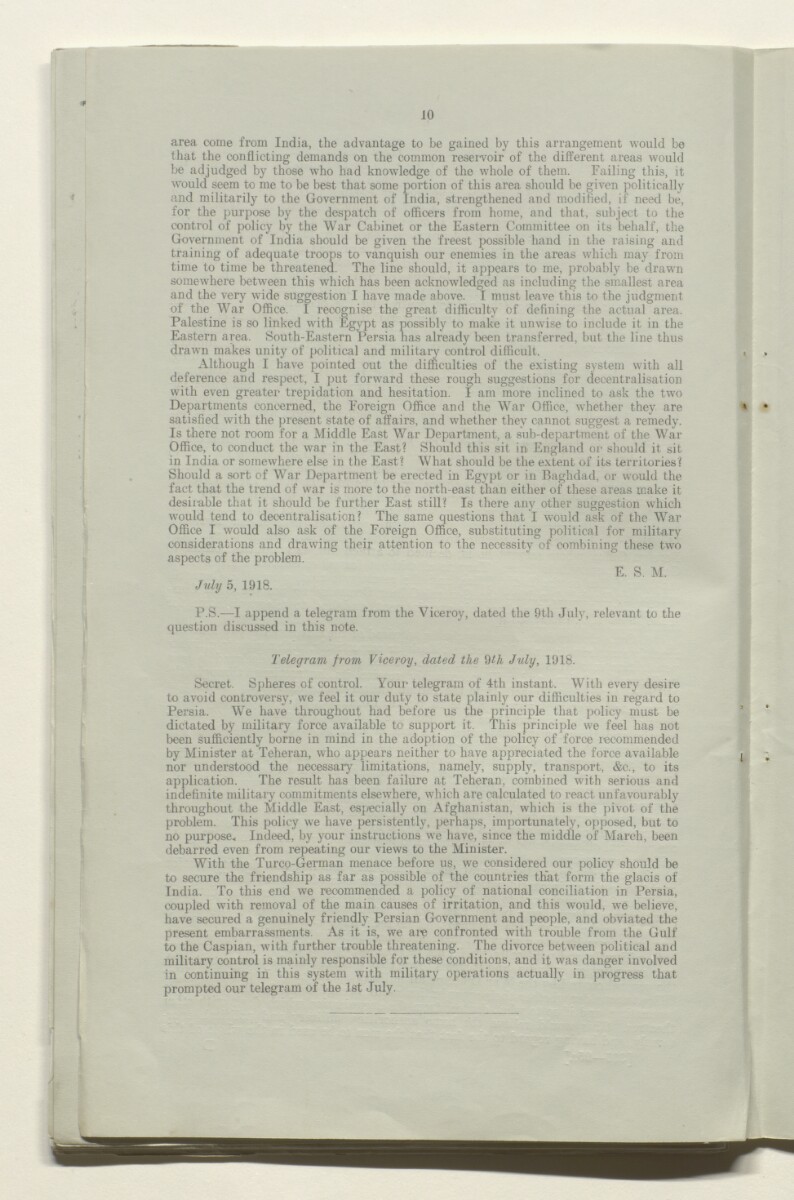
10
area come from India, the advantage to be gained by this arrangement would be
that the conflicting demands on the common reservoir of the different areas would
be adjudged by those who had knowledge of the whole of them. Failing this, it
would seem to me to be best that some portion of this area should be given politically
and militarily to the Government of India, strengthened and modified, if need be,
for the purpose by the despatch of officers from home, and that, subject to the
control of policy by the War Cabinet or the Eastern Committee on its behalf, the
Government of India should be given the freest possible hand in the raising and
training of adequate troops to vanquish our enemies in the areas which may from
time to time be threatened. The line should, it appears to me, probably be drawn
somewhere between this which has been acknowledged as including the smallest area
and the very wide suggestion I have made above. I must leave this to the judgment
of the War Office. I recognise the great difficulty of defining the actual area.
Palestine is so linked with Egypt as possibly to make it unwise to include it in the
Eastern area. South-Eastern Persia has already been transferred, but the line thus
drawn makes unity of political and military control difficult.
Although I have pointed out the difficulties of the existing system with all
deference and respect, I put forward these rough suggestions for decentralisation
with even greater trepidation and hesitation. I am more inclined to ask the two
Departments concerned, the Foreign Office and the War Office, whether they are
satisfied with the present state of affairs, and whether they cannot suggest a remedy.
Is there not room for a Middle East War Department, a sub-department of the War
Office, to conduct the war in the East? Should this sit in England or should it sit
in India or somewhere else in the East? What should be the extent of its territories?
Should a sort of War Department be erected in Egypt or in Baghdad, or would the
fact that the trend of war is more to the north-east than either of these areas make it
desirable that it should be further East still? Is there any other suggestion which
would tend to decentralisation? The same questions that I would ask of the War
Office I would also ask of the Foreign Office, substituting political for military
considerations and drawing their attention to the necessity of combining these two
aspects of the problem.
E. S. M.
July 5, 1918.
P.S.—I append a telegram from the Viceroy, dated the 9th July, relevant to the
question discussed in this note.
Telegram from Viceroy, dated the Sth July, 1918.
Secret. Spheres of control. Your telegram of 4th instant. With every desire
to avoid controversy, we feel it our duty to state plainly our difficulties in regard to
Persia. We have throughout had before us the principle that policy must be
dictated by military force available to support it. This principle we feel has not
been sufficiently borne in mind in the adoption of the policy of force recommended
by Minister at Teheran, who appears neither to have appreciated the force available
nor understood the necessary limitations, namely, supply, transport, &c., to its
application. The result has been failure at Teheran, combined with serious and
indefinite military commitments elsewhere, which are calculated to react unfavourably
throughout the Middle East, especially on Afghanistan, which is the pivot of the
problem. This policy we have persistently, perhaps, importunately, opposed, but to
no purpose^ Indeed, by your instructions we have, since the middle of March, been
debarred even from repeating our views to the Minister.
With the Turco-German menace before us, we considered our policy should be
to secure the friendship as far as possible of the countries that form the glacis of
India. To this end we recommended a policy of national conciliation in Persia,
coupled with removal of the main causes of irritation, and this would, we believe,
have secured a genuinely friendly Persian Government and people, and obviated the
present embarrassments. As it is, we are confronted with trouble from the Gulf
to the Caspian, with further trouble threatening. The divorce between political and
military control is mainly responsible for these conditions, and it was danger involved
in continuing in this system with military operations actually in progress that
prompted our telegram of the 1st July.
About this item
- Content
This file is composed of papers produced by the War Cabinet's Eastern Committee, which was chaired by George Curzon for most of its existence. The file contains a complete set of printed minutes, beginning with the committee's first meeting on 28 March 1918, and concluding with its final meeting on 7 January 1919 (ff 6-214 and ff 227-272).
The file begins with two copies of a memorandum by Curzon, dated 13 March 1918, proposing the formation of the Eastern Committee. This is followed by a memorandum by Arthur James Balfour, Secretary of State for Foreign Affairs, approving Curzon's proposal, and a copy of a procedure for the newly created committee, outlining arrangements for committee meetings and the dissemination of information to committee members.
Also included is a set of resolutions, passed by the committee in December 1918, in order to guide British representatives at the Paris Peace conference (ff 216-225). The resolutions cover the following: the Caucasus and Armenia; Syria; Palestine; Hejaz and Arabia; Mesopotamia, Mosul, Baghdad and Basra. They are preceded by a handwritten note written by Curzon 'some years later', which remarks on how they are a 'rather remarkable forecast of the bulk of the results since obtained.'
- Extent and format
- 1 file (272 folios)
- Arrangement
The papers are arranged in approximate chronological order from the front to the rear of the file.
- Physical characteristics
Foliation: the foliation sequence (used for referencing) commences at the first folio with 1, and terminates at the last folio with 272; these numbers are written in pencil, are circled, and are located in the top right corner of the recto The front of a sheet of paper or leaf, often abbreviated to 'r'. side of each folio.
- Written in
- English in Latin script View the complete information for this record
Use and share this item
- Share this item
Papers of the War Cabinet's Eastern Committee [90v] (180/544), British Library: India Office Records and Private Papers, Mss Eur F112/274, in Qatar Digital Library <https://www.qdl.qa/archive/81055/vdc_100069672677.0x0000b5> [accessed 20 August 2026]
https://www.qdl.qa/en/archive/81055/vdc_100069672677.0x0000b5
Copy and paste the code below into your web page where you would like to embed the image.
<meta charset="utf-8"><a href="https://www.qdl.qa/en/archive/81055/vdc_100069672677.0x0000b5">Papers of the War Cabinet's Eastern Committee [‎90v] (180/544)</a> <a href="https://www.qdl.qa/en/archive/81055/vdc_100069672677.0x0000b5"> <img src="https://iiif.qdl.qa/iiif/images/81055/vdc_100000001491.0x0002a8/Mss Eur F112_274_0180.jp2/full/!280,240/0/default.jpg" alt="" /> </a>
This record has a IIIF manifest available as follows. If you have a compatible viewer you can drag the icon to load it.https://www.qdl.qa/en/iiif/81055/vdc_100000001491.0x0002a8/manifestOpen in Universal viewerOpen in Mirador viewerMore options for embedding images
Copyright: How to use this content
- Reference
- Mss Eur F112/274
- Title
- Papers of the War Cabinet's Eastern Committee
- Pages
- 1r:214v, 216r:272v
- Author
- East India Company, the Board of Control, the India Office, or other British Government Department
- Usage terms
- Open Government Licence