
![Papers of the War Cabinet's Eastern Committee [‎46r] (91/544)](https://iiif.qdl.qa/iiif/images/81055/vdc_100000001491.0x0002a8/Mss Eur F112_274_0091.jp2/full/!1200,1200/0/default.jpg "Papers of the War Cabinet's Eastern Committee [‎46r] (91/544)")
Papers of the War Cabinet's Eastern Committee [46r] (91/544)
The record is made up of 1 file (272 folios). It was created in 13 Mar 1918-7 Jan 1919. It was written in English. The original is part of the British Library: India Office The department of the British Government to which the Government of India reported between 1858 and 1947. The successor to the Court of Directors. Records and Private Papers Documents collected in a private capacity. .
Transcription
This transcription is created automatically. It may contain errors.
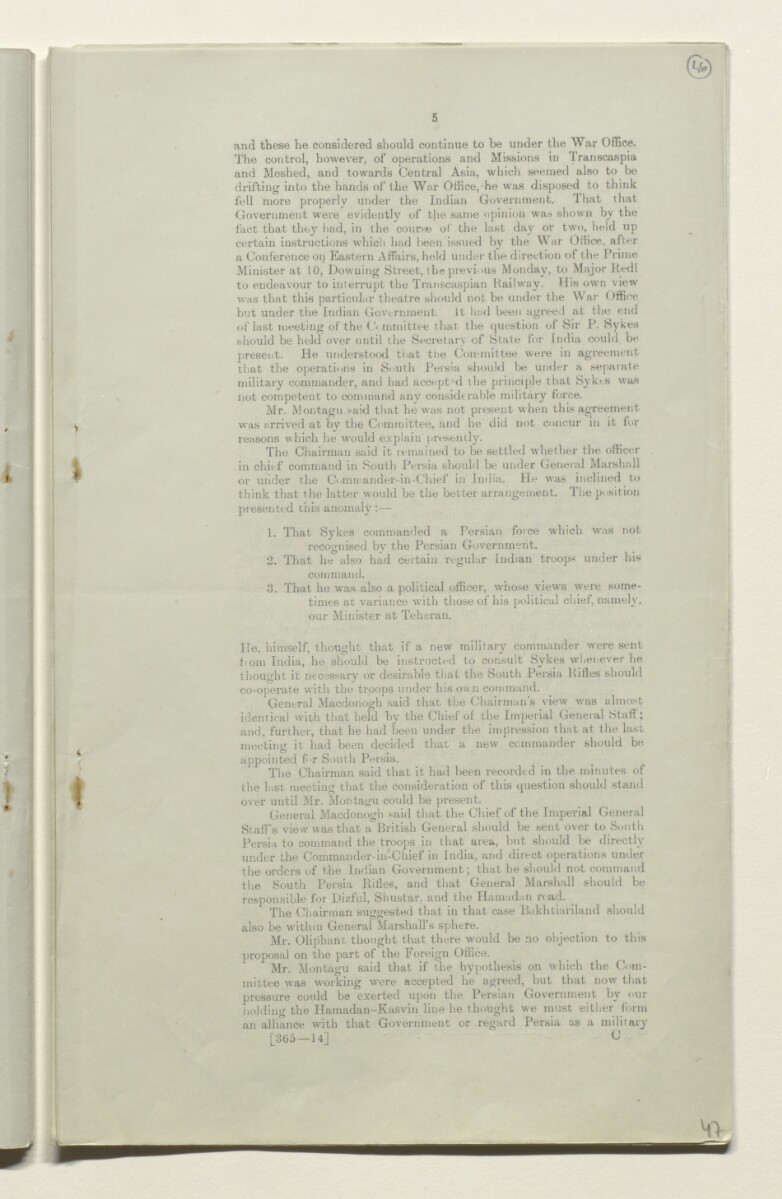
and these he considered should continue to be under the War Office.
The control, however, of operations and Missions in Iranscaspia
and Meshed, and towards Central Asia, which seemed also to be
drifting into the hands of the War Office, he was disposed to think
fell more properly under the Indian Government. lhat that
Government were evidently of the same opinion was shown by the
fact that they had, in the course ot the last day or two, held up
certain instructions which had been issued by the War Office, after
a Conference on Eastern Affairs, held under the direction of the Prime
Minister at 10, Downing Street, the previous Monday, to Major Redl
to endeavour to interrupt the Transcaspian Railway. His own view
was that this particular theatre should not be under the War Office
but under the Indian Government. It had been agreed at tbe end
of last meeting of the C< mrnittee that the question of Sir P. Sykes
should be held over until the Secretary of State for India could be
present. He understood that the Committee were in agreement
that the operations in South Persia should be under a separate
military commander, and had accept d the principle that Syk*;S was
not competent to command any considerable military force.
Mr. Montagu said that he was not present when this agreement
was arrived at by the Committee, and he did not concur in it for
reasons which he would explain'presently.
The Chairman said it remained to be settled whether the officer
in chief command in South Persia should be under General Marshall
or under the Commander-in-Chief in India. H e was inclined to
think that the latter would be the better arrangement. The position
presented this anomaly :—
1. That Sykes commanded a Persian force which was not
recognised by the Persian Government.
2. That ho also had certain regular Indian troops under his
command.
3. That he was also a political officer, whose views were some
times at variance with those of his political chief, name]} 7 ,
our Minister at Teheran.
He, himself, thought that if a new military commander were sent
ftom India, he should be instructed to consult Sykes whenever he
thought it necessary or desirable that the South Persia Rifles should
co-operate with the troops under his own command.
General Macdonogh said that the Chairman’s view was almost
identical with that held by the Chief of the Imperial General Staff;
and, further, that he had been under the impression that at the last
meeting it had been decided that a new commander should be
appointed f"r South Persia.
The Chairman said that it had been recorded in the minutes of
the last meeting that the consideration of this question should stand
over until Mr. Montagu could be present.
General Macdonogh said that the Chief of the Imperial General
Staff's view was that a British General should be sent over to South
Persia to command the troops in that area, but should be directly
under the Commander-in-Chief in India, and direct operations under
the orders of the Indian Government; that he should not command
the South Persia Rifles, and that General Marshall should be
responsible for Dizful, Shustar. and the Hamad;m road.
The Chairman suggested that in that case Bukhtiariland should
also be within General Marshall’s sphere.
Mr. Oliphant thought that there would be no objection to this
proposal on the part of the Foreign Office.
Mr. Montagu said that if the hypothesis on which the Com
mittee was working were accepted he agreed, but that now that
pressure could be exerted upon the Persian Government by our
holding the Hamadan-Kasvin line he thought we must either form
an alliance with that Government or regard Persia as a military
[365—14] H
About this item
- Content
This file is composed of papers produced by the War Cabinet's Eastern Committee, which was chaired by George Curzon for most of its existence. The file contains a complete set of printed minutes, beginning with the committee's first meeting on 28 March 1918, and concluding with its final meeting on 7 January 1919 (ff 6-214 and ff 227-272).
The file begins with two copies of a memorandum by Curzon, dated 13 March 1918, proposing the formation of the Eastern Committee. This is followed by a memorandum by Arthur James Balfour, Secretary of State for Foreign Affairs, approving Curzon's proposal, and a copy of a procedure for the newly created committee, outlining arrangements for committee meetings and the dissemination of information to committee members.
Also included is a set of resolutions, passed by the committee in December 1918, in order to guide British representatives at the Paris Peace conference (ff 216-225). The resolutions cover the following: the Caucasus and Armenia; Syria; Palestine; Hejaz and Arabia; Mesopotamia, Mosul, Baghdad and Basra. They are preceded by a handwritten note written by Curzon 'some years later', which remarks on how they are a 'rather remarkable forecast of the bulk of the results since obtained.'
- Extent and format
- 1 file (272 folios)
- Arrangement
The papers are arranged in approximate chronological order from the front to the rear of the file.
- Physical characteristics
Foliation: the foliation sequence (used for referencing) commences at the first folio with 1, and terminates at the last folio with 272; these numbers are written in pencil, are circled, and are located in the top right corner of the recto The front of a sheet of paper or leaf, often abbreviated to 'r'. side of each folio.
- Written in
- English in Latin script View the complete information for this record
Use and share this item
- Share this item
Papers of the War Cabinet's Eastern Committee [46r] (91/544), British Library: India Office Records and Private Papers, Mss Eur F112/274, in Qatar Digital Library <https://www.qdl.qa/archive/81055/vdc_100069672677.0x00005c> [accessed 26 July 2026]
https://www.qdl.qa/en/archive/81055/vdc_100069672677.0x00005c
Copy and paste the code below into your web page where you would like to embed the image.
<meta charset="utf-8"><a href="https://www.qdl.qa/en/archive/81055/vdc_100069672677.0x00005c">Papers of the War Cabinet's Eastern Committee [‎46r] (91/544)</a> <a href="https://www.qdl.qa/en/archive/81055/vdc_100069672677.0x00005c"> <img src="https://iiif.qdl.qa/iiif/images/81055/vdc_100000001491.0x0002a8/Mss Eur F112_274_0091.jp2/full/!280,240/0/default.jpg" alt="" /> </a>
This record has a IIIF manifest available as follows. If you have a compatible viewer you can drag the icon to load it.https://www.qdl.qa/en/iiif/81055/vdc_100000001491.0x0002a8/manifestOpen in Universal viewerOpen in Mirador viewerMore options for embedding images
Copyright: How to use this content
- Reference
- Mss Eur F112/274
- Title
- Papers of the War Cabinet's Eastern Committee
- Pages
- 1r:214v, 216r:272v
- Author
- East India Company, the Board of Control, the India Office, or other British Government Department
- Usage terms
- Open Government Licence