
![Coll 6/21(2) 'Saudi Arabia: Relations with H.M.G.: Saudi Legation in London and British Minister in Jeddah. Prolongation of Treaty of Jedda.' [‎12v] (24/761)](https://iiif.qdl.qa/iiif/images/81055/vdc_100000000555.0x000272/IOR_L_PS_12_2088_0027.jp2/full/!1200,1200/0/default.jpg "Coll 6/21(2) 'Saudi Arabia: Relations with H.M.G.: Saudi Legation in London and British Minister in Jeddah. Prolongation of Treaty of Jedda.' [‎12v] (24/761)")
Coll 6/21(2) 'Saudi Arabia: Relations with H.M.G.: Saudi Legation in London and British Minister in Jeddah. Prolongation of Treaty of Jedda.' [12v] (24/761)
The record is made up of 1 file (379 folios). It was created in 14 Jan 1935-12 Apr 1947. It was written in English and Arabic. The original is part of the British Library: India Office The department of the British Government to which the Government of India reported between 1858 and 1947. The successor to the Court of Directors. Records and Private Papers Documents collected in a private capacity. .
Transcription
This transcription is created automatically. It may contain errors.
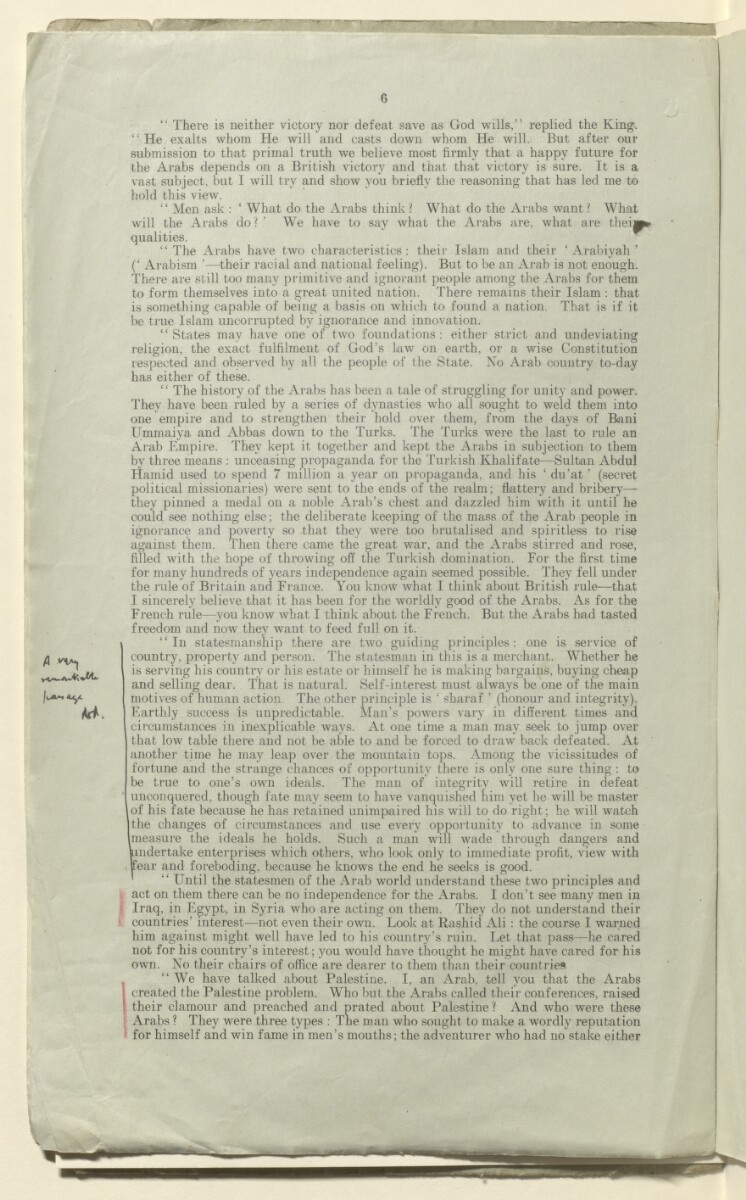
6
“ There is neither victory nor defeat save as God wills,” replied the King.
“He exalts whom He will and casts down whom He will. But after our
submission to that primal truth we believe most firmly that a happy future for
the Arabs depends on a British victory and that that victory is sure. It is a
vast subject, but I will try and show you briefly the reasoning that has led me to
hold this view.
‘ ‘ Men ask : ‘ What do the Arabs think ? What do the Arabs want ? What
will the Arabs do? ’ We have to say what the Arabs are, what are theip*
qualities.
“ The Arabs have two characteristics : their Islam and their ‘ Arabiyah ’
(‘ Arabism ’—their racial and national feeling). But to be an Arab is not enough.
There are still too many primitive and ignorant people among the Arabs for them
to form themselves into a great united nation. There remains their Islam : that
is something capable of being a basis on which to found a nation. That is if it
be true Islam uncorrupted by ignorance and innovation.
“ States may have one of two foundations : either strict and undeviating
religion, the exact fulfilment of God’s law on earth, or a wise Constitution
respected and observed by all the people of the State. No Arab country to-day
has either of these.
‘ ‘ The history of the Arabs has been a tale of struggling for unity and power.
They have been ruled by a series of dynasties who all sought to weld them into
one empire and to strengthen their hold over them, from the days of Bani
Ummaiya and Abbas down to the Turks. The Turks were the last to rule an
Arab Empire. They kept it together and kept the Arabs in subjection to them
by three means : unceasing propaganda for the Turkish Khalifate—Sultan Abdul
Hamid used to spend 7 million a year on propaganda, and his ‘ du’at ’ (secret
political missionaries) were sent to the ends of the realm; flattery and bribery—
they pinned a medal on a noble Arab’s chest and dazzled him with it until he
could see nothing else; the deliberate keeping of the mass of the Arab people in
ignorance and poverty so that they were too brutalised and spiritless to rise
against them. Then there came the great war, and the Arabs stirred and rose,
filled with the hope of throwing off the Turkish domination. For the first time
for many hundreds of years independence again seemed possible. They fell under
the rule of Britain and France. You know what I think about British rule—that
I sincerely believe that it has been for the worldly good of the Arabs. As for the
French rule—you know what I think about the French. But the Arabs had tasted
freedom and now they want to feed full on it.
“In statesmanship there are two guiding principles: one is service of
country, property and person. The statesman in this is a merchant. Whether he
is serving his country or his estate or himself he is making bargains, buying cheap
and selling dear. That is natural. Self-interest must always be one of the main
motives of human action. The other principle is ‘ sharaf ' (honour and integrity).
Earthly success is unpredictable. Man’s powers vary in different times and
circumstances in inexplicable ways. At one time a man may seek to jump over
that low table there and not be able to and be forced to draw back defeated. At
another time he may leap over the mountain tops. Among the vicissitudes of
fortune and the strange chances of opportunity there is only one sure thing : to
be true to one’s own ideals. The man of integrity will retire in defeat
unconquered, though fate may seem to have vanquished him yet he will be master
of his fate because he has retained unimpaired his will to do right; he will watch
I the changes of circumstances and use every opportunity to advance in some
measure the ideals he holds. Such a man will wade through dangers and
^undertake enterprises which others, who look only to immediate profit, view with
Gear and foreboding, because he knows the end he seeks is good.
“ Until the statesmen of the Arab world understand these two principles and
act on them there can be no independence for the Arabs. I don’t see many men in
Iraq, in Egypt, in Syria who are acting on them. They do not understand their
countries' interest—not even their own. Book at Rashid Ali : the course I warned
him against might well have led to his country’s ruin. Fet that pass—he cared
not for his country’s interest; you would have thought he might have cared for his
own. No their chairs of office are dearer to them than their countries
“ We have talked about Palestine. I, an Arab, tell you that the Arabs
? created the Palestine problem. Who but the Arabs called their conferences, raised
their clamour and preached and prated about Palestine ? And who were these
Arabs ? They were three types : The man who sought to make a wordly reputation
for himself and win fame in men’s mouths; the adventurer who had no stake either
ft
About this item
- Content
This file, like the previous volume (IOR/L/PS/12/2087), concerns relations between the British Government and the Government of Saudi Arabia.
The file largely consists of copies of Foreign Office correspondence, mainly between His Majesty's Minister at Jedda (Sir Andrew Ryan, Sir Reader William Bullard, Hugh Stonehewer Bird, and Stanley R Jordan successively) and officials of the Foreign Office. Other prominent correspondents include the following: the Secretary of State for Foreign Affairs; His Majesty's Chargé d’Affaires to Jedda (Albert Spencer Calvert, succeeded by Alan Charles Trott); His Majesty's Ambassador in Baghdad (Sir Kinahan Cornwallis); Ibn Saud [‘Abd al-‘Azīz bin ‘Abd al-Raḥmān bin Fayṣal Āl Sa‘ūd]; Amir Faisal [Fayṣal bin ‘Abd al-‘Azīz Āl Sa‘ūd], Minister of Foreign Affairs for Saudi Arabia; officials of the Colonial Office and the War Office.
The correspondence documents the progression of negotiations for a general settlement between the two governments, which would result in the initial prolongation of the validity of the Treaty of Jedda (the treaty signed between Britain and Ibn Saud in 1927, which initially expired in September 1934) for a period of seven years from 1936 (and for another seven years from 1943).
In addition to discussing matters relating to the proposed general settlement (e.g. the eastern and south-eastern boundaries of Saudi Arabia, slavery regulations, arms traffic, and Saudi debts), the correspondence also documents various visits and meetings, including the following:
- The visit of Amir Saud [Āl Sa‘ūd, Sa‘ūd bin ‘Abd al-‘Azīz, heir apparent of Ibn Saud] to Britain (17 June-1 July 1935), accompanied by Fuad Bey Hamza, Deputy Minister for Foreign Affairs for Saudi Arabia.
- Further meetings at the Foreign Office between Fuad Bey Hamza, Hafiz Wahba (Saudi Minister in London), Sir Andrew Ryan, George William Rendel (Head of the Foreign Office's Eastern Department), and other Foreign Office officials, in July 1935, following on from meetings in September 1934.
- Sir Andrew Ryan's meetings with Ibn Saud in Riyadh in December 1935 and in Jedda in February 1936.
- Four interviews held between Ibn Saud, Sir Reader William Bullard and George William Rendel, in Jedda, during March 1937.
Also discussed are matters relating to the Second World War, including:
- An exchange of letters between Ibn Saud and the British Prime Minister, Neville Chamberlain, in early 1939, which principally relate to Ibn Saud's concerns regarding his country's security in the event of the beginning of general hostilities.
- German radio broadcasts in Jedda during the first few weeks of the Second World War and their possible effect on the Jedda population.
- The possibility of Iraq and Saudi Arabia formally joining the Allies in the Second World War.
In addition to correspondence the file includes the following: a copy of a programme for Amir Saud's visit to Britain (ff 339-348); exchanges of notes (in English and Arabic) between the Saudi Ministry of Foreign Affairs and the British Legation at Jedda, confirming the prolongation of the Treaty of Jedda, dated 1936 and 1943 respectively (ff 189-192 and ff 4-5); a sketch map showing air routes over Saudi Arabia and Iraq (f 31v).
Although the material in this file falls inside the date range of 1935-1943, the final document in the file does include an additional date stamp which is marked '12 April 1947'.
The file includes two dividers which give a list of correspondence references contained in the file by year. These are placed at the back of the correspondence.
- Extent and format
- 1 file (379 folios)
- Arrangement
The papers are arranged in approximate chronological order from the rear to the front of the file.
- Physical characteristics
Foliation: the foliation sequence commences at the inside front cover with 1, and terminates at the last folio with 380; these numbers are written in pencil, are circled, and are located in the top right corner of the recto The front of a sheet of paper or leaf, often abbreviated to 'r'. side of each folio. A previous foliation sequence, which is also circled, has been superseded and therefore crossed out.
- Written in
- English and Arabic in Latin and Arabic script View the complete information for this record
Use and share this item
- Share this item
Coll 6/21(2) 'Saudi Arabia: Relations with H.M.G.: Saudi Legation in London and British Minister in Jeddah. Prolongation of Treaty of Jedda.' [12v] (24/761), British Library: India Office Records and Private Papers, IOR/L/PS/12/2088, in Qatar Digital Library <https://www.qdl.qa/archive/81055/vdc_100048209023.0x00001b> [accessed 4 July 2026]
https://www.qdl.qa/en/archive/81055/vdc_100048209023.0x00001b
Copy and paste the code below into your web page where you would like to embed the image.
<meta charset="utf-8"><a href="https://www.qdl.qa/en/archive/81055/vdc_100048209023.0x00001b">Coll 6/21(2) 'Saudi Arabia: Relations with H.M.G.: Saudi Legation in London and British Minister in Jeddah. Prolongation of Treaty of Jedda.' [‎12v] (24/761)</a> <a href="https://www.qdl.qa/en/archive/81055/vdc_100048209023.0x00001b"> <img src="https://iiif.qdl.qa/iiif/images/81055/vdc_100000000555.0x000272/IOR_L_PS_12_2088_0027.jp2/full/!280,240/0/default.jpg" alt="" /> </a>
This record has a IIIF manifest available as follows. If you have a compatible viewer you can drag the icon to load it.https://www.qdl.qa/en/iiif/81055/vdc_100000000555.0x000272/manifestOpen in Universal viewerOpen in Mirador viewerMore options for embedding images
Copyright: How to use this content
- Reference
- IOR/L/PS/12/2088
- Title
- Coll 6/21(2) 'Saudi Arabia: Relations with H.M.G.: Saudi Legation in London and British Minister in Jeddah. Prolongation of Treaty of Jedda.'
- Pages
- front, front-i, 2r:4r, 5r, 6r:31r, 32r:75v, 77r:77v, 79r:152v, 158r:173v, 175r:180v, 186r:187v, 188v:189r, 190v:191r, 192r:199v, 201r:204v, 206r:266v, 269r:275v, 276v:278v, 280r:286v, 288r:293r, 295r:314r, 316r:380v, back
- Author
- East India Company, the Board of Control, the India Office, or other British Government Department
- Usage terms
- Open Government Licence